Stock Analysis · Orbia Advance Corporation S.A.B. de C.V (MXCHF)
Overview
Orbia Advance Corporation is a diversified industrial company based in Mexico with operations tied to construction, infrastructure, agriculture, telecom, and energy. Rather than relying on one single product, Orbia operates through several business groups that supply materials, components, and services used in everyday systems such as water pipes, irrigation networks, data cables, fluorinated products, and building materials. This makes the company easier to understand as a collection of industrial platforms rather than as a traditional conglomerate with unrelated assets.
Its revenue comes mainly from five operating groups. Based on the company’s recent annual reporting, the business mix is approximately the following:
- Building & Infrastructure (Wavin): about 45% to 50% of revenue. This unit makes plastic pipe systems and solutions for water management, sanitation, indoor climate, and urban infrastructure.
- Polymer Solutions (Vestolit and related operations): about 20% to 25% of revenue. This business includes PVC resins, compounds, and other inputs used in construction and industrial applications.
- Precision Agriculture (Netafim): about 15% to 20% of revenue. It provides drip irrigation, digital farming tools, and related agricultural solutions focused on improving crop yields and water efficiency.
- Connectivity Solutions (Dura-Line): about 10% to 15% of revenue. This segment produces conduit and related infrastructure used for telecom, fiber-optic, and power networks.
- Fluor & Energy Materials (Koura): about 8% to 12% of revenue. This unit includes fluorine-based products used in refrigeration, industrial applications, batteries, and energy-transition materials.
This portfolio gives Orbia exposure to several long-term themes: water scarcity, infrastructure renewal, broadband rollout, more efficient farming, and selected battery-material applications. At the same time, it also means results are influenced by construction cycles, chemical pricing, industrial demand, and regional economic conditions.
The longer-term operating picture shows that revenue rose strongly in 2022, then weakened in 2023 and 2024 before recovering in 2025. However, profitability compressed much more sharply than sales, with operating income and net income falling faster as interest expense stayed elevated and gross profit narrowed. That pattern is important for long-term analysis: Orbia still generates large revenue, but earnings quality has become more fragile.
Key Figures
| Metric | Value | Sector ⓘ |
|---|---|---|
| Date | Oct 03, 2026 | |
| Context | ||
| Sector | Industrials | |
| Industry | Conglomerates | |
| Market Cap ⓘ | $2.41B | |
| Beta ⓘ | 0.70 | |
Value (Cheapness) | ||
| P/E Ratio ⓘ | N/A | 22.45 |
| P/B Ratio ⓘ | 1.27 | 1.98 |
| FCF Yield ⓘ | 8.31% | 6.31% |
| Dividend Yield ⓘ | N/A | 1.96% |
| EBIT / EV ⓘ | 8.42% | 4.81% |
| PEG ⓘ | N/A | |
Growth (Business expansion) | ||
| Revenue Growth ⓘ | 19.60% | 9.10% |
| RPS Growth (5Y CAGR) ⓘ | -2.14% | 7.75% |
| EPS Growth (5Y CAGR) ⓘ | N/A | -13.59% |
| BVPS Growth (5Y CAGR) ⓘ | -12.46% | 6.22% |
| Margin Growth (5Y Trend) ⓘ | -10.55% | 0.72% |
| FCF Growth (5Y CAGR) ⓘ | -36.26% | 10.98% |
| DPS Growth (5Y CAGR) ⓘ | -7.41% | 9.48% |
Quality (Business durability) | ||
| ROIC (Latest) ⓘ | N/A | 10.92% |
| ROA (Latest) ⓘ | -2.66% | 5.41% |
| ROIC (5Y Median) ⓘ | 10.24% | 9.21% |
| ROA (5Y Median) ⓘ | 1.28% | 4.94% |
| Net Debt / EBIT (Latest) ⓘ | 7.69 | 2.07 |
| Net Debt / EBIT (5Y Median) ⓘ | 4.92 | 2.28 |
| Net Debt / EBITDA (Latest) ⓘ | 3.66 | 1.43 |
| Net Debt / Assets ⓘ | 40.10% | 19.27% |
| EBITDA / Interest ⓘ | 2.51 | 9.53 |
| Operating Margin (Latest) ⓘ | 7.33% | 10.50% |
| Operating Margin (5Y Median) ⓘ | 10.65% | 10.27% |
| Debt to Equity (Latest) ⓘ | 251.81% | 65.48% |
| Profit Margin (Latest) ⓘ | -3.68% | 6.62% |
| Free Cash Flow (Latest) ⓘ | $200.12M | |
Momentum (Price trend) | ||
| 3Y Return ⓘ | -46.24% | +58.56% |
| 12M Return (excl. last month) ⓘ | +48.81% | +15.63% |
| 6M Return ⓘ | -0.89% | +4.19% |
| Price vs. 200-Day MA ⓘ | -7.60% | +0.93% |
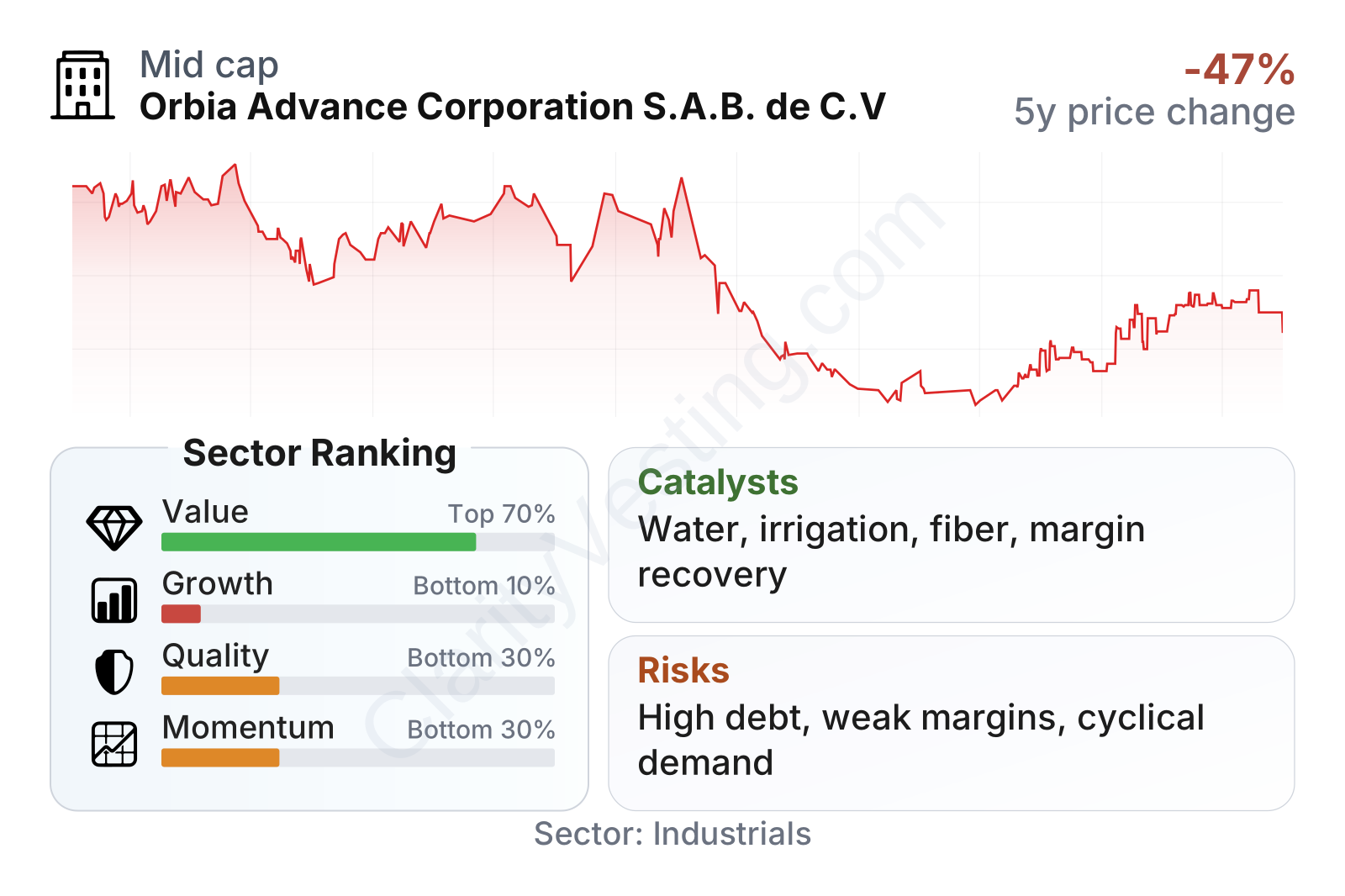
Orbia is a mid-sized industrial company with a relatively low share-price volatility profile, as indicated by a beta below 1. On valuation factors, it screens better than many sector peers: price-to-book is below the sector median, free cash flow yield is higher than the median, and EBIT relative to enterprise value also looks comparatively favorable. The weaker side is business quality and long-term growth consistency. Recent revenue growth has improved, but five-year trends in revenue per share, book value per share, operating margin, and free cash flow remain well below sector norms. In short, the market appears to be giving credit for cash generation and a depressed price, while still discounting leverage and uneven profitability.
Growth
Orbia operates in areas that are broadly attractive over a long horizon. Water infrastructure, more efficient irrigation, electrification materials, and fiber-network deployment are all supported by structural demand rather than short-lived trends. That matters because the company is not dependent on a single end market. If construction is weak in one region, agriculture, telecom infrastructure, or refrigerant-related demand can partially offset the pressure.
The industrial logic of the portfolio is strongest in businesses tied to essential infrastructure. Wavin benefits from investment in water management and urban resilience. Netafim is positioned around the need to grow more food with less water. Dura-Line is linked to expanding broadband and data infrastructure. Koura adds optionality through refrigerants and battery materials, especially where fluorinated inputs remain necessary in advanced industrial applications.
Recent sales momentum is better than the longer-term record suggests. After a long stretch of declines through much of 2023 and 2024, year-over-year revenue growth turned positive again and accelerated in the latest periods, reaching a high-teens pace most recently. That rebound is encouraging because it suggests demand conditions may be stabilizing across parts of the portfolio, even if the recovery is still uneven.
Cash generation remains a more constructive feature than accounting profit. Free cash flow has dropped sharply from the unusually strong levels seen earlier in the cycle, but it has stayed positive and recently improved from a low base. For a capital-intensive industrial company under margin pressure, remaining cash-flow positive is meaningful. It gives management more room to support operations, invest selectively, and manage debt, even though that room is not especially large.
Recent company updates have also emphasized portfolio discipline, operational efficiencies, and selective investments in higher-value applications. That strategy makes sense given the current environment: Orbia does not need aggressive expansion everywhere. It needs steadier margins, better capital allocation, and growth concentrated in businesses with stronger structural demand and less commodity-like pricing pressure.
Risks
This article is for informational purposes only and does not constitute financial advice. Some content is AI-generated. See Disclaimer