Stock Analysis · Mueller Water Products (MWA)
Overview
Mueller Water Products is an American industrial company focused on water infrastructure. Its products are used mainly by municipalities, utilities, and contractors that build, repair, and monitor drinking water networks. In simple terms, the company helps move water from treatment plants through underground pipes and supports the equipment needed to control pressure, detect leaks, measure usage, and maintain system safety.
The business is centered on products that are difficult to avoid in water distribution systems: fire hydrants, iron gate valves, repair products, service brass, metering technologies, and related software and communications tools. That gives Mueller Water Products exposure to a part of infrastructure spending that tends to be driven more by replacement needs and regulation than by consumer demand.
Based on recent company reporting, revenue is mainly generated from two operating segments.
- Water Flow Solutions — about 76% to 78% of revenue: This is the largest business. It includes legacy infrastructure products such as fire hydrants, gate valves, butterfly valves, pipe repair products, fittings, couplings, and service brass used in water transmission and distribution systems.
- Water Management Solutions — about 22% to 24% of revenue: This segment includes water meters, leak detection, pressure management, pipe condition assessment, software, communications technologies, and other products aimed at improving network efficiency and visibility.
The business mix matters because it combines a large installed-base replacement business with a smaller but more technology-oriented offering. That can create steadier demand than a pure construction supplier while also leaving room for digital upgrades across aging water systems.
Over the last few years, the company’s revenue has risen moderately, but profit expansion has been much stronger. Gross profit and operating income have improved faster than sales, which suggests better pricing, product mix, and factory execution rather than growth driven only by volume.
Key Figures
| Metric | Value | Sector ⓘ |
|---|---|---|
| Date | Oct 03, 2026 | |
| Context | ||
| Sector | Industrials | |
| Industry | Specialty Industrial Machinery | |
| Market Cap ⓘ | $3.35B | |
| Beta ⓘ | 1.01 | |
Value (Cheapness) | ||
| P/E Ratio ⓘ | 15.23 | 22.45 |
| P/B Ratio ⓘ | 2.98 | 1.98 |
| FCF Yield ⓘ | 5.36% | 6.31% |
| Dividend Yield ⓘ | 1.28% | 1.96% |
| EBIT / EV ⓘ | 8.82% | 4.81% |
| PEG ⓘ | 0.92 | |
Growth (Business expansion) | ||
| Revenue Growth ⓘ | 4.10% | 9.10% |
| RPS Growth (5Y CAGR) ⓘ | 6.79% | 7.75% |
| EPS Growth (5Y CAGR) ⓘ | 20.20% | -13.59% |
| BVPS Growth (5Y CAGR) ⓘ | 9.31% | 6.22% |
| Margin Growth (5Y Trend) ⓘ | 7.66% | 0.72% |
| FCF Growth (5Y CAGR) ⓘ | 16.31% | 10.98% |
| DPS Growth (5Y CAGR) ⓘ | 5.03% | 9.48% |
Quality (Business durability) | ||
| ROIC (Latest) ⓘ | 15.44% | 10.92% |
| ROA (Latest) ⓘ | 11.72% | 5.41% |
| ROIC (5Y Median) ⓘ | 8.72% | 9.21% |
| ROA (5Y Median) ⓘ | 5.69% | 4.94% |
| Net Debt / EBIT (Latest) ⓘ | -0.14 | 2.07 |
| Net Debt / EBIT (5Y Median) ⓘ | 2.11 | 2.28 |
| Net Debt / EBITDA (Latest) ⓘ | -0.12 | 1.43 |
| Net Debt / Assets ⓘ | -2.17% | 19.27% |
| EBITDA / Interest ⓘ | 28.77 | 9.53 |
| Operating Margin (Latest) ⓘ | 19.97% | 10.50% |
| Operating Margin (5Y Median) ⓘ | 10.59% | 10.27% |
| Debt to Equity (Latest) ⓘ | 40.42% | 65.48% |
| Profit Margin (Latest) ⓘ | 15.02% | 6.62% |
| Free Cash Flow (Latest) ⓘ | $179.60M | |
Momentum (Price trend) | ||
| 3Y Return ⓘ | +73.89% | +58.56% |
| 12M Return (excl. last month) ⓘ | -7.45% | +15.63% |
| 6M Return ⓘ | -22.33% | +4.19% |
| Price vs. 200-Day MA ⓘ | -18.52% | +0.93% |
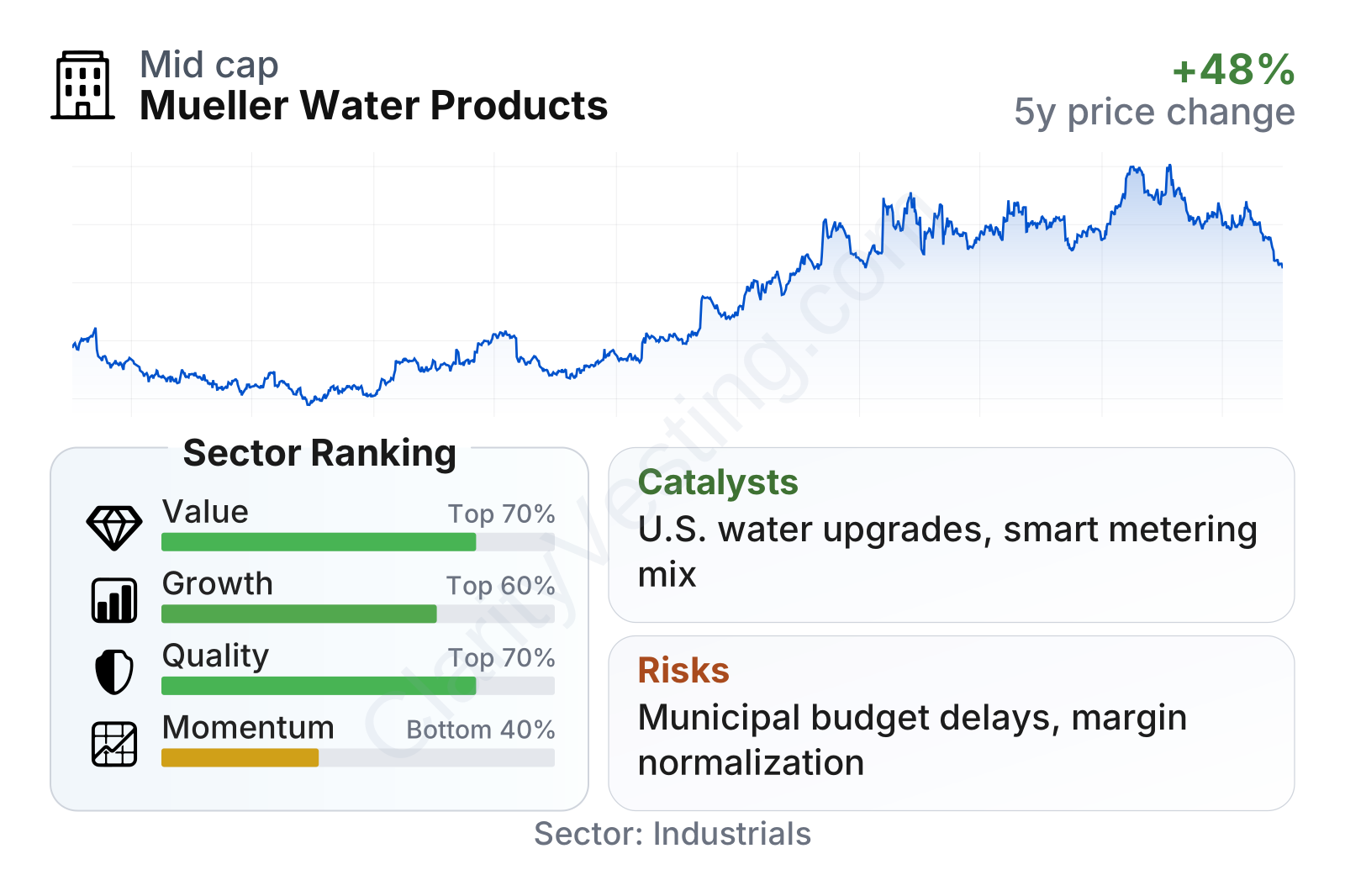
Mueller Water Products sits in the mid-cap range, with share-price volatility close to the broader market. The most notable feature in the current metrics is the combination of solid quality and moderate valuation: profitability and returns on capital are above sector medians, while the earnings multiple is below the sector median. Growth indicators are more mixed, with recent sales growth trailing many industrial peers even though earnings and cash flow growth over five years have been strong. Market performance has also cooled in the shorter term, which helps explain why the valuation has become less demanding.
Growth
Mueller Water Products operates in a sector with long-term support. Water infrastructure in the United States is old, maintenance needs are persistent, water loss remains a major issue for utilities, and public systems face pressure to improve resilience. Those trends support demand not only for replacement hardware but also for monitoring and efficiency tools. This is a favorable backdrop because many water systems cannot simply postpone repairs forever without risking leaks, outages, or compliance issues.
The company’s strategy also makes sense for this environment. Its larger business is tied to essential replacement products, while its smaller water management operation gives it exposure to smarter networks, metering upgrades, and leak detection. That creates a practical bridge between traditional infrastructure and modern utility technology. If utilities keep investing in reducing non-revenue water and improving system visibility, Mueller can benefit from both physical product demand and higher-value monitoring solutions.
Recent revenue growth appears steady rather than explosive. After a more volatile period, year-over-year sales increases have returned to the low- to mid-single-digit range. That is not exceptional for an industrial company, but in water infrastructure it can still be meaningful when paired with margin gains and recurring replacement demand.
Cash generation has improved materially compared with earlier years, although it has not moved in a straight line. Free cash flow turned sharply positive after a weaker phase and remains at a healthy level. That matters because infrastructure equipment businesses can look attractive on earnings while consuming cash through working capital or capital spending; Mueller’s recent profile suggests that operating improvement has translated into real cash.
A key catalyst is public and utility spending on water systems. Federal support for infrastructure modernization, combined with local replacement cycles, can create a multi-year demand tailwind. Another growth driver is the need to reduce water loss. Leak detection, pressure management, and advanced metering are not as large as the company’s core valve and hydrant businesses today, but they are strategically important because they can deepen customer relationships and lift the mix toward more technology-enabled products.
Recent company updates have also pointed to continued demand in core municipal markets and ongoing attention to operational efficiency. That does not change the business into a high-growth company, but it strengthens the case for durable, compounding improvement if execution remains disciplined.
Risks
This article is for informational purposes only and does not constitute financial advice. Some content is AI-generated. See Disclaimer