Stock Analysis · Mitsui Fudosan Co Ltd (MTSFY)
Overview
Mitsui Fudosan Co Ltd is one of Japan’s largest real estate groups. The company develops, owns, leases, and manages a broad portfolio that includes office buildings, shopping centers, logistics facilities, hotels, housing projects, and mixed-use urban developments. It is especially well known for large-scale redevelopment in Tokyo and other major Japanese cities, where it combines land ownership, construction planning, tenant relationships, and long-term property management.
The business is diversified across recurring rental income and more cyclical property sales. Based on the company’s recent segment reporting in its latest annual materials, the main revenue sources can be summarized approximately as follows:
- Leasing: about 34% of revenue. This includes office buildings, retail properties, logistics assets, and other rental operations that generate recurring income.
- Property sales: about 31% of revenue. This mainly includes condominium and housing sales, as well as sales of other developed properties.
- Management: about 18% of revenue. This covers property management, brokerage, asset management, and related services.
- Facility operations: about 11% of revenue. This includes hotels, resorts, and other operated facilities.
- Other businesses: about 6% of revenue. This typically includes smaller adjacent activities and overseas operations not fully captured above.
This mix matters because it gives Mitsui Fudosan both stability and growth optionality. Leasing and management provide more recurring cash generation, while property sales and redevelopment can lift profits when market conditions are favorable. Over the last five fiscal years, revenue has moved steadily higher, and operating income has expanded faster than sales, suggesting that the business has been scaling reasonably well even as financing costs increased.
The long-term trend is broadly constructive: revenue has risen meaningfully since fiscal 2022, net income has also advanced, and operating profit in the latest fiscal year improved more strongly than sales. One notable pressure point is interest expense, which has climbed over time, reflecting the capital-heavy nature of the business.
Key Figures
| Metric | Value | Sector ⓘ |
|---|---|---|
| Date | Nov 21, 2026 | |
| Context | ||
| Sector | Real Estate | |
| Industry | Real Estate - Diversified | |
| Market Cap ⓘ | $26.46B | |
| Beta ⓘ | 0.42 | |
Value (Cheapness) | ||
| P/E Ratio ⓘ | 15.85 | 17.59 |
| P/B Ratio ⓘ | N/A | 1.58 |
| FCF Yield ⓘ | 1.14% | 5.76% |
| Dividend Yield ⓘ | 1.12% | 4.81% |
| EBIT / EV ⓘ | 4.81% | 4.97% |
| PEG ⓘ | 2.12 | |
Growth (Business expansion) | ||
| Revenue Growth ⓘ | 8.60% | 5.70% |
| RPS Growth (5Y CAGR) ⓘ | 8.94% | 5.96% |
| EPS Growth (5Y CAGR) ⓘ | -12.31% | -3.46% |
| BVPS Growth (5Y CAGR) ⓘ | 4.06% | 0.32% |
| Margin Growth (5Y Trend) ⓘ | 5.83% | -0.65% |
| FCF Growth (5Y CAGR) ⓘ | N/A | 5.08% |
| DPS Growth (5Y CAGR) ⓘ | 23.94% | 5.00% |
Quality (Business durability) | ||
| ROIC (Latest) ⓘ | 3.76% | 5.13% |
| ROE (Latest) ⓘ | 8.49% | 7.64% |
| ROA (Latest) ⓘ | 2.60% | 3.05% |
| ROIC (5Y Median) ⓘ | 3.34% | 4.20% |
| ROE (5Y Median) ⓘ | 7.80% | 6.03% |
| ROA (5Y Median) ⓘ | 2.45% | 2.41% |
| Net Debt / EBIT (Latest) ⓘ | 11.15 | 7.59 |
| Net Debt / EBIT (5Y Median) ⓘ | 11.41 | 8.34 |
| Net Debt / EBITDA (Latest) ⓘ | 8.26 | 5.43 |
| Net Debt / Assets ⓘ | 46.03% | 38.21% |
| EBITDA / Interest ⓘ | 9.87 | 4.20 |
| Operating Margin (Latest) ⓘ | 16.91% | 34.59% |
| Operating Margin (5Y Median) ⓘ | 14.25% | 37.64% |
| Debt to Equity (Latest) ⓘ | 151.49% | 90.32% |
| Profit Margin (Latest) ⓘ | 10.33% | 20.10% |
| Free Cash Flow (Latest) ⓘ | $301.98M | |
Momentum (Price trend) | ||
| 3Y Return ⓘ | +33.52% | +27.88% |
| 12M Return (excl. last month) ⓘ | -8.97% | +1.16% |
| 6M Return ⓘ | +3.34% | -3.06% |
| Price vs. 200-Day MA ⓘ | -4.04% | -0.73% |
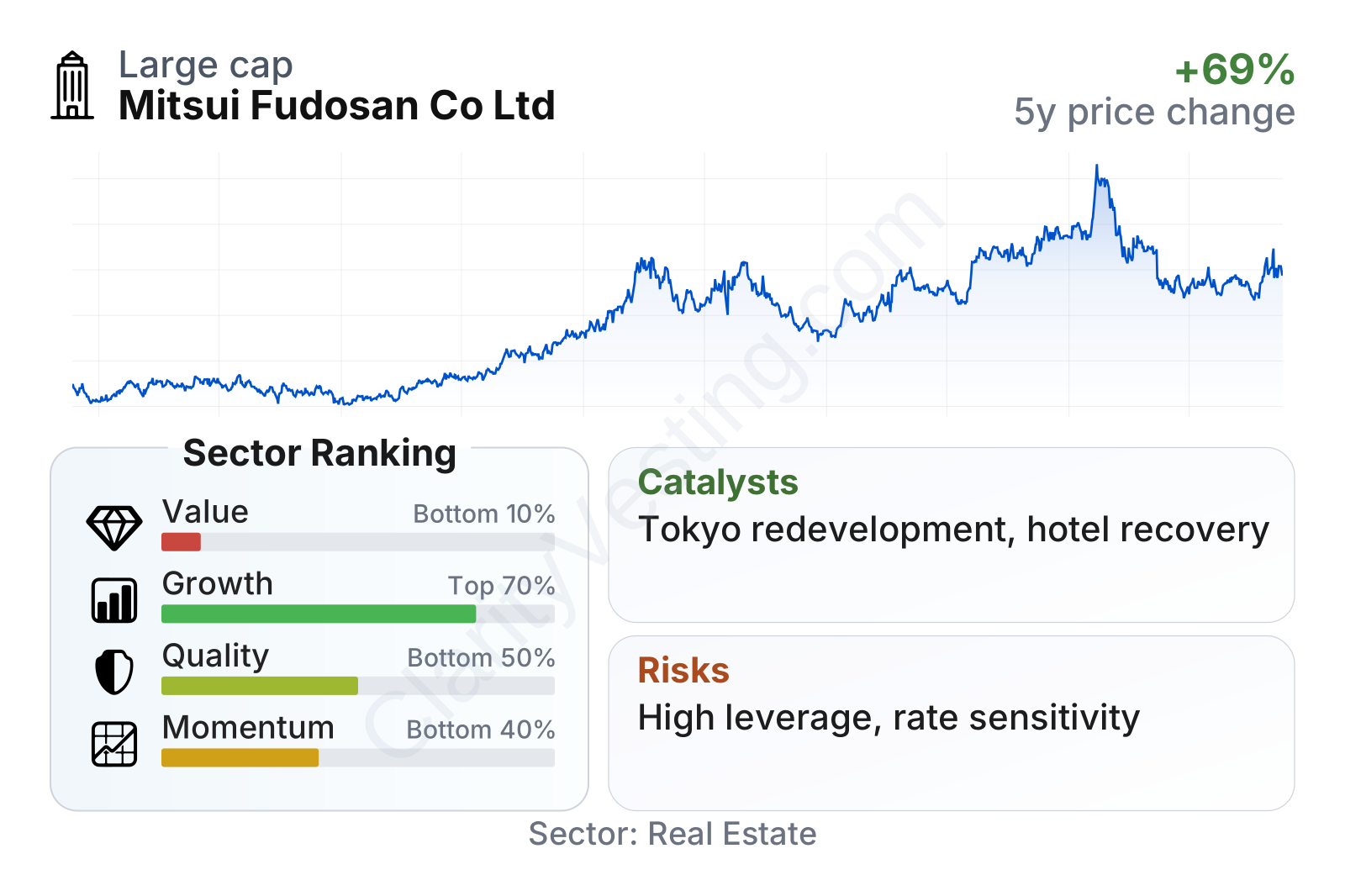
Mitsui Fudosan is a large-cap real estate company with relatively low share-price volatility, as reflected by a beta well below 1. On valuation, the stock does not look stretched on earnings compared with the sector median, but it also does not screen as especially cheap overall because cash flow yield and dividend yield sit below many peers, while the PEG ratio points to a price that already reflects some expected growth. Growth metrics are better than the sector median in several areas, especially revenue growth, book value growth, margin improvement over five years, and dividend growth. Quality is more mixed: returns on equity are decent, but returns on assets and capital remain modest, which is common in real estate yet still important to monitor. Momentum has weakened recently after a strong multiyear run, with the shares below their recent longer-term trend line.
Growth
Mitsui Fudosan operates in a sector that can still grow over the long run, but not in a simple straight line. Real estate in Japan is supported by urban concentration, redevelopment demand, tourism recovery, logistics modernization, and the need for higher-quality mixed-use assets in major cities. The company is positioned where these themes are strongest: central Tokyo offices, major retail destinations, large urban redevelopment projects, and expanding logistics and hospitality exposure.
Its strategy also makes industrial sense. Rather than relying on a single property type, Mitsui Fudosan combines development, leasing, operations, and services. That approach can recycle capital across the cycle: land is developed, leased, stabilized, sometimes sold, and then replaced by new projects. For a long-term business, this is usually stronger than depending only on one-time property sales.
Revenue per share has shown a clear multiyear uptrend, which supports the view that growth has not come only from accounting changes or balance-sheet expansion. It suggests the underlying business base has been getting larger on a per-share basis as the company added assets and expanded operations.
Dividend per share has also climbed sharply over the last five years. That does not by itself guarantee future income growth, but it does indicate management has been sharing a larger portion of business progress with shareholders while earnings and asset values improved.
Several visible catalysts support the growth case. The first is large-scale redevelopment in Tokyo, where Mitsui Fudosan has a long track record and a valuable land and tenant network. The second is inbound tourism and hotel demand, which can support facility operations and retail traffic. The third is logistics and mixed-use development, both of which remain structurally relevant as e-commerce, supply-chain modernization, and urban regeneration continue. In recent company disclosures, management has also emphasized continued progress on major projects and portfolio recycling, which can unlock value from mature assets and fund new developments.
Risks
This article is for informational purposes only and does not constitute financial advice. Some content is AI-generated. See Disclaimer


