Stock Analysis · Materion Corporation (MTRN)
Overview
Materion Corporation is a specialty materials company that makes high-performance metals, alloys, coatings, powders, and engineered parts used in demanding applications. Its products are designed for markets where material performance matters more than commodity pricing, including semiconductors, industrial equipment, aerospace and defense, energy, automotive, and medical uses. In simple terms, Materion sits upstream in the manufacturing chain: it provides advanced materials and components that help other companies build chips, sensors, electronics, precision tools, and mission-critical systems.
The business is not a traditional mining company despite its market classification. It is better understood as a value-added materials engineering company. A meaningful part of its appeal comes from processing know-how, specialized manufacturing, tight customer qualification requirements, and exposure to technology-heavy end markets rather than from raw metal extraction alone.
Based on recent company reporting, Materion’s revenue is spread across several business lines, with the largest sources generally coming from electronic materials and advanced engineered materials. Approximate revenue mix can be summarized as follows:
- Electronic Materials: about 35% to 40% of revenue. This includes materials used in semiconductor fabrication and advanced electronics, such as sputtering targets, evaporation materials, and related products.
- Performance Materials: about 30% to 35% of revenue. This segment includes copper and nickel alloys, strip products, rod and bar products, and engineered material solutions used in industrial, energy, automotive, and consumer applications.
- Precision Optics: about 15% to 20% of revenue. This business provides optical filters, thin-film coatings, and precision optics for aerospace, defense, semiconductor, and scientific uses.
- Other engineered products and services: about 10% to 15% of revenue. This includes specialized materials processing and products serving niche industrial and technical applications.
One useful feature of Materion’s model is that reported sales can move not only with volumes, but also with metal prices, product mix, and demand from semiconductor and industrial customers. That makes top-line figures a little noisier than they might look at first glance, so margin and cash generation matter as much as revenue.
The multiyear operating picture shows a business that has kept revenue around the high-$1 billion range, but with pressure from production costs, periodic swings in demand, and acquisition-related financing. Gross profit remained meaningful over the last several years, yet net income has been much more volatile, showing how sensitive final earnings can be to costs, interest expense, and non-operating items.
Over the last five years, revenue has been relatively stable with a modest upward trend, but profitability has not advanced in a straight line. Operating income held up better than net income, which suggests the core business remained productive even when below-the-line items weighed on results. That distinction matters for understanding why the shares have moved strongly while some valuation ratios still look stretched.
Key Figures
| Metric | Value | Sector ⓘ |
|---|---|---|
| Date | Oct 24, 2026 | |
| Context | ||
| Sector | Basic Materials | |
| Industry | Other Industrial Metals & Mining | |
| Market Cap ⓘ | $4.99B | |
| Beta ⓘ | 1.05 | |
Value (Cheapness) | ||
| P/E Ratio ⓘ | 55.88 | 16.92 |
| P/B Ratio ⓘ | 5.30 | 1.66 |
| FCF Yield ⓘ | 0.68% | 5.83% |
| Dividend Yield ⓘ | 0.23% | 2.07% |
| EBIT / EV ⓘ | 2.17% | 6.38% |
| PEG ⓘ | 1.28 | |
Growth (Business expansion) | ||
| Revenue Growth ⓘ | 42.20% | 11.25% |
| RPS Growth (5Y CAGR) ⓘ | 4.01% | 4.49% |
| EPS Growth (5Y CAGR) ⓘ | -12.73% | -15.24% |
| BVPS Growth (5Y CAGR) ⓘ | 6.68% | 5.49% |
| Margin Growth (5Y Trend) ⓘ | 0.60% | -1.54% |
| FCF Growth (5Y CAGR) ⓘ | N/A | 0.37% |
| DPS Growth (5Y CAGR) ⓘ | 4.10% | 5.91% |
Quality (Business durability) | ||
| ROIC (Latest) ⓘ | 8.72% | 9.59% |
| ROA (Latest) ⓘ | 4.92% | 4.92% |
| ROIC (5Y Median) ⓘ | 8.38% | 7.91% |
| ROA (5Y Median) ⓘ | 5.21% | 3.92% |
| Net Debt / EBIT (Latest) ⓘ | 3.92 | 1.36 |
| Net Debt / EBIT (5Y Median) ⓘ | 3.91 | 1.69 |
| Net Debt / EBITDA (Latest) ⓘ | 2.48 | 0.93 |
| Net Debt / Assets ⓘ | 26.28% | 13.69% |
| EBITDA / Interest ⓘ | 6.91 | 12.38 |
| Operating Margin (Latest) ⓘ | 5.98% | 13.24% |
| Operating Margin (5Y Median) ⓘ | 7.16% | 11.82% |
| Debt to Equity (Latest) ⓘ | 51.42% | 40.30% |
| Profit Margin (Latest) ⓘ | 4.30% | 6.38% |
| Free Cash Flow (Latest) ⓘ | $34.10M | |
Momentum (Price trend) | ||
| 3Y Return ⓘ | +168.25% | +73.47% |
| 12M Return (excl. last month) ⓘ | +112.03% | +27.59% |
| 6M Return ⓘ | +40.46% | -4.02% |
| Price vs. 200-Day MA ⓘ | +19.98% | -0.65% |
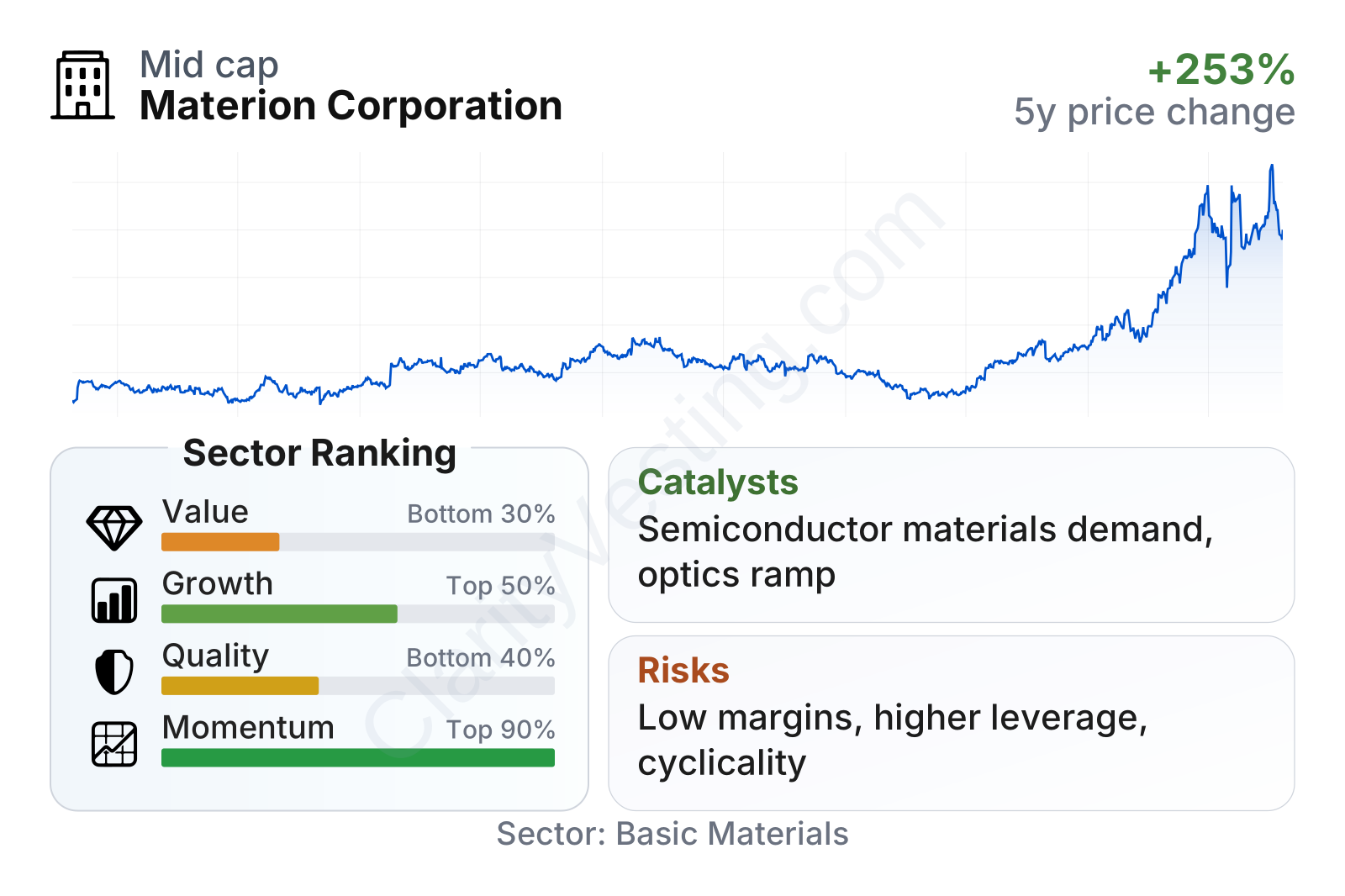
Materion is a mid-sized materials company with a market value around the mid-single-digit billions and share-price volatility close to the broader market. The table points to a mixed profile: growth and market momentum are strong relative to much of the sector, while value and quality rank lower. In plain language, the market is currently rewarding the company for improving business conditions and future expectations, but current profitability and cash flow still look less robust than many peers in basic materials.
The most striking contrast is between market performance and fundamentals. The stock has delivered a very strong run over the last one, three, and recent six-month periods, yet valuation ratios remain well above sector norms and free cash flow yield is notably low. At the same time, long-term balance-sheet metrics and returns on capital are not weak enough to suggest a broken business; they point more toward a company in transition, with the market already pricing in a better earnings phase.
Growth
Materion operates in several areas with credible long-term demand drivers. Semiconductor manufacturing is one of the most important. The company supplies materials used in chip fabrication equipment and processes, which ties it to growth in artificial intelligence infrastructure, high-performance computing, advanced memory, and more localized chip production. Aerospace and defense also provide support, especially where precision optics and specialized alloys are required for harsh environments. Electrification, grid upgrades, and industrial automation add more end-market depth.
The strategy is sensible for future growth because it focuses on specialized materials where qualification cycles are long and customers are reluctant to switch suppliers quickly. That can create sticky relationships once Materion’s products are designed into a manufacturing process. The company has also spent years repositioning toward higher-value niches rather than lower-margin commodity exposure, which fits the direction of modern manufacturing.
Recent growth has accelerated sharply after a softer period in 2023 and early 2024. Year-over-year revenue turned negative for several quarters, then recovered, and the latest readings moved into a much stronger range, clearly ahead of the sector median. That rebound suggests improving demand and mix, not just a flat industrial backdrop. It also helps explain why the market has become much more optimistic over the past year.
Cash generation, however, has been less consistent than revenue. Free cash flow has moved between negative and positive territory over the last several years and remains modest relative to the company’s size. For a long-term assessment, this is important: a business tied to attractive markets is more compelling when growth converts into durable cash rather than staying trapped in working capital, inventory swings, or capital spending.
A meaningful recent catalyst is Materion’s exposure to U.S. semiconductor investment and the broader buildout of advanced manufacturing capacity. Public company updates have highlighted semiconductor-related demand as a major area of focus. In addition, the company has continued to invest in capacity and product capabilities for electronic materials and precision applications, positioning it to capture more content in technically demanding production lines. If semiconductor customers continue increasing utilization and new fabs ramp, Materion could benefit disproportionately because its materials are used in critical steps rather than optional add-ons.
Risks
This article is for informational purposes only and does not constitute financial advice. Some content is AI-generated. See Disclaimer


