Stock Analysis · MGIC Investment Corp (MTG)
Overview
MGIC Investment Corp is a U.S. mortgage insurance company. Its main job is to insure lenders against losses when homebuyers make a small down payment and then default on their mortgage. In simple terms, MGIC helps banks and mortgage lenders make loans with less than 20% down while reducing part of the lender’s risk. The company operates mainly through Mortgage Guaranty Insurance Corporation, one of the older and better-known private mortgage insurers in the U.S.
Its business is closely tied to the housing market, mortgage originations, employment, home prices, and interest rates. When more people buy homes and lenders issue more low-down-payment mortgages, MGIC has more chances to write new insurance. When defaults rise, its claims costs can increase.
MGIC’s revenue mix is fairly concentrated because it is primarily a mortgage insurance business. Based on its public filings, the largest sources of revenue are:
- Net premiums earned: approximately 70% to 75%. This is the core business and includes insurance premiums collected on mortgage policies already in force.
- Net investment income: approximately 15% to 20%. MGIC invests its insurance float, mainly in fixed-income securities, and earns interest income.
- Other revenue, including fee income and realized investment gains or losses: approximately 5% to 10%. This is a smaller and more variable contributor.
That concentration is important for long-term analysis: MGIC is not a diversified financial conglomerate. It is largely a focused play on U.S. private mortgage insurance, with profitability shaped by underwriting discipline, credit performance, and capital management.
Over the last several years, the business has remained highly profitable, with total revenue broadly stable around the low-$1 billion range annually and net income consistently strong. Expense control has also been favorable, helping preserve wide margins even when revenue growth slowed.
The long-term pattern shows a business with unusually high profitability for the broader financial sector. Revenue has been steady rather than fast-growing, but the company has converted a large portion of that revenue into operating income and net income, which matters in a mature insurance niche.
Key Figures
| Metric | Value | Sector ⓘ |
|---|---|---|
| Date | Oct 03, 2026 | |
| Context | ||
| Sector | Financial Services | |
| Industry | Insurance - Specialty | |
| Market Cap ⓘ | $5.30B | |
| Beta ⓘ | 0.65 | |
Value (Cheapness) | ||
| P/E Ratio ⓘ | 8.82 | 12.60 |
| P/B Ratio ⓘ | 1.11 | 1.23 |
| FCF Yield ⓘ | 13.33% | 10.16% |
| Dividend Yield ⓘ | 2.12% | 2.96% |
| EBIT / EV ⓘ | 14.27% | 7.77% |
| PEG ⓘ | 0.40 | |
Growth (Business expansion) | ||
| Revenue Growth ⓘ | -2.90% | 9.50% |
| RPS Growth (5Y CAGR) ⓘ | 12.35% | 12.10% |
| EPS Growth (5Y CAGR) ⓘ | -14.33% | -9.45% |
| BVPS Growth (5Y CAGR) ⓘ | 6.71% | 5.01% |
| Margin Growth (5Y Trend) ⓘ | 5.80% | -4.07% |
| FCF Growth (5Y CAGR) ⓘ | 5.32% | 4.96% |
| DPS Growth (5Y CAGR) ⓘ | 21.63% | 8.79% |
Quality (Business durability) | ||
| ROIC (Latest) ⓘ | 12.83% | 9.60% |
| ROE (Latest) ⓘ | 13.90% | 13.84% |
| ROA (Latest) ⓘ | 10.76% | 1.53% |
| ROIC (5Y Median) ⓘ | 19.51% | 7.86% |
| ROE (5Y Median) ⓘ | 14.68% | 12.20% |
| ROA (5Y Median) ⓘ | 11.20% | 1.29% |
| Net Debt / EBIT (Latest) ⓘ | 0.48 | 0.91 |
| Net Debt / EBIT (5Y Median) ⓘ | 0.31 | 0.74 |
| Net Debt / EBITDA (Latest) ⓘ | 0.48 | 0.97 |
| Operating Margin (Latest) ⓘ | 76.96% | 22.12% |
| Operating Margin (5Y Median) ⓘ | 79.44% | 24.39% |
| Debt to Equity (Latest) ⓘ | 12.90% | 60.37% |
| Profit Margin (Latest) ⓘ | 59.20% | 26.62% |
| Free Cash Flow (Latest) ⓘ | $706.48M | |
Momentum (Price trend) | ||
| 3Y Return ⓘ | +69.23% | +89.23% |
| 12M Return (excl. last month) ⓘ | +12.76% | +17.35% |
| 6M Return ⓘ | +1.55% | +10.00% |
| Price vs. 200-Day MA ⓘ | -4.61% | +3.73% |
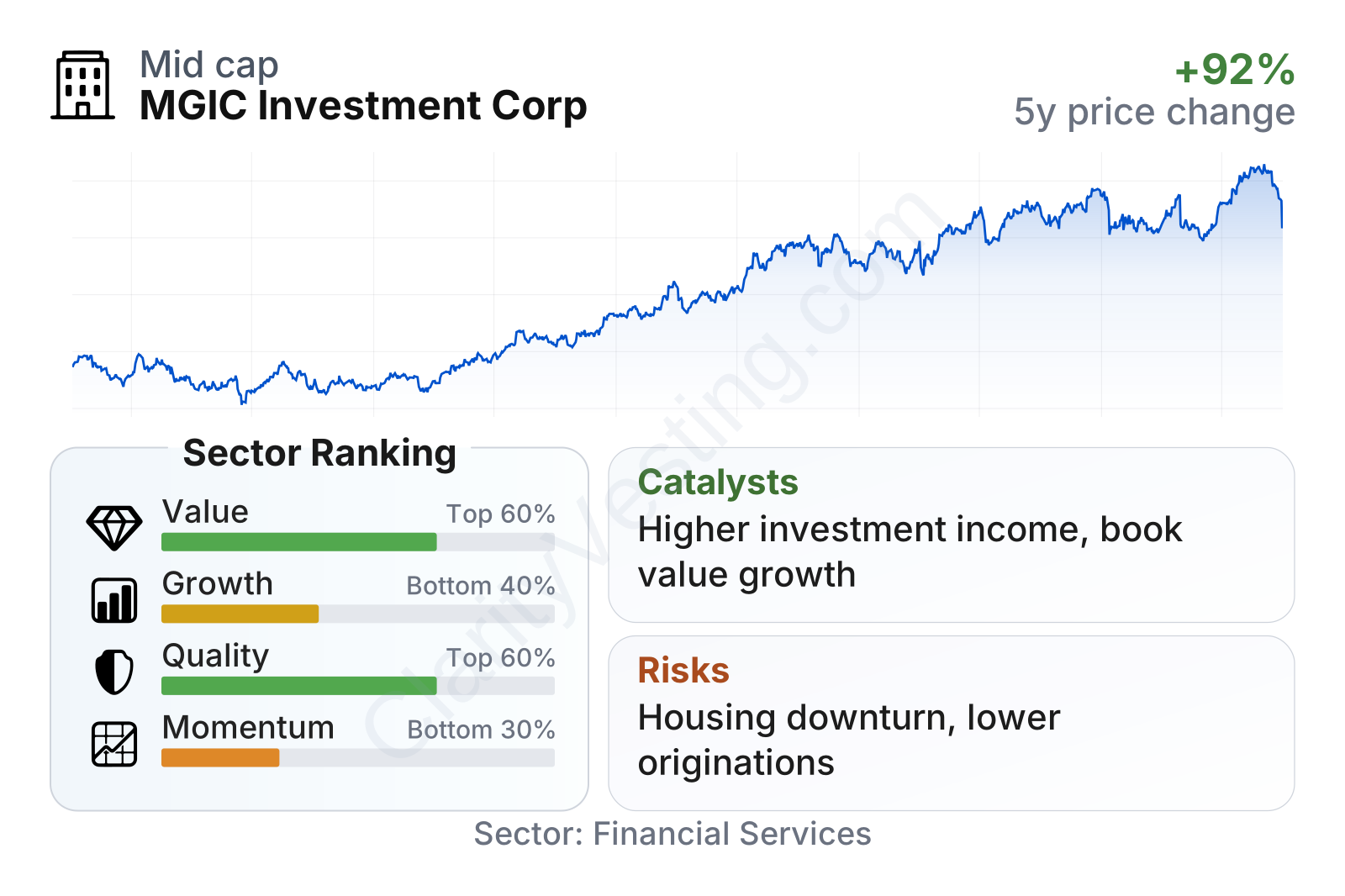
MGIC is a mid-sized financial company with a relatively low beta, which suggests the stock has historically moved less violently than the broader market. On valuation, the company screens on the cheaper side of the sector, with earnings and cash-flow-based measures looking more favorable than the median. On quality, profitability and balance-sheet discipline stand out, especially margins, returns on assets, and modest leverage. Growth is more mixed: long-term book value and free cash flow trends are solid, but recent revenue growth has been slightly negative and longer-term earnings growth has been uneven. Price momentum has also lagged much of the sector despite a strong multi-year share price climb.
Growth
MGIC operates in a sector that is mature rather than explosive, but it still has room to grow through housing finance activity, market share retention, and disciplined underwriting. Private mortgage insurance remains relevant because many borrowers still cannot make large down payments, and lenders need credit enhancement on conventional loans with higher loan-to-value ratios. That gives the industry a durable role in the U.S. housing system.
The main growth driver is not rapid expansion into new products. Instead, it is a combination of steady new insurance written, favorable credit performance, investment income from a large portfolio, and efficient use of capital. That strategy makes sense for this type of insurer. Mortgage insurance tends to reward caution, pricing discipline, and risk selection more than aggressive expansion.
There is also a useful structural support behind the business: the U.S. housing market still faces affordability challenges, and that often increases the need for low-down-payment mortgage solutions. Even when home sales volumes are pressured by higher rates, private mortgage insurance remains essential for many first-time and moderate-income borrowers.
Earnings per share have been resilient over time, even if the path has not been perfectly smooth. After a strong jump in 2022, earnings dipped in 2023 and then recovered, with 2024 and 2025 showing solid profitability. That pattern suggests MGIC has been able to manage through shifting mortgage volumes and credit conditions without a collapse in earnings power.
Book value per share has improved meaningfully since the temporary drop in 2022. The rebound through 2023 to 2025 points to retained earnings, capital strength, and shareholder returns that did not prevent balance-sheet growth. For an insurer, rising book value over time is an important sign that underlying economics remain healthy.
A recent opportunity for MGIC comes from higher investment yields compared with the ultra-low-rate period of earlier years. As insurance companies reinvest cash flows into higher-yielding fixed-income assets, investment income can become a stronger contributor. Another positive factor is that U.S. homeowners generally entered this period with better credit quality and more home equity than before past housing downturns, which can help reduce severe loss trends for mortgage insurers.
Risks
This article is for informational purposes only and does not constitute financial advice. Some content is AI-generated. See Disclaimer