Stock Analysis · Matador Resources Company (MTDR)
Overview
Matador Resources Company is a U.S. oil and gas producer. It explores for, develops, and produces crude oil, natural gas, and natural gas liquids, with its core operations centered in the Delaware Basin, a highly active part of the Permian Basin in West Texas and New Mexico. The company also owns a midstream business through San Mateo Midstream, which handles gathering, processing, and transportation infrastructure that supports its upstream production.
In simple terms, Matador makes money primarily by pulling hydrocarbons out of the ground and selling them into the market. A smaller but still meaningful part of the business comes from the services and infrastructure needed to move and process that production.
Based on recent company reporting, Matador’s revenue mix is heavily weighted toward product sales, with oil remaining the most important driver because it usually carries higher pricing than gas. A practical breakdown is:
- Oil sales: approximately 60% to 70% of total revenue. This is the company’s largest earnings engine and the main reason its results are sensitive to crude prices.
- Natural gas and natural gas liquids sales: approximately 20% to 30%. This includes gas sold at market prices and liquids such as propane and butane.
- Midstream and other revenue: approximately 10% or less. This includes gathering, processing, and related infrastructure services, largely connected to production in its operating areas.
Matador’s business model is more integrated than that of a pure exploration-and-production company because its midstream assets can help reduce bottlenecks, improve field-level efficiency, and support development plans. Over the last several years, the company has also expanded through acquisitions and organic drilling, which helped lift total revenue from roughly $1.7 billion in 2021 to about $3.7 billion in 2025, although annual profit has moved up and down with commodity prices and financing costs.
The business has grown materially since 2021, but the path has not been smooth. Revenue has expanded strongly over the full period, while net income has stayed profitable but below the 2022 peak. That pattern is typical in this industry: production growth can be real and durable, yet reported earnings still swing as oil and gas prices change.
Key Figures
| Metric | Value | Sector ⓘ |
|---|---|---|
| Date | Oct 03, 2026 | |
| Context | ||
| Sector | Energy | |
| Industry | Oil & Gas E&P | |
| Market Cap ⓘ | $6.27B | |
| Beta ⓘ | 0.79 | |
Value (Cheapness) | ||
| P/E Ratio ⓘ | 8.83 | 14.47 |
| P/B Ratio ⓘ | 1.14 | 1.70 |
| FCF Yield ⓘ | 9.98% | 8.66% |
| Dividend Yield ⓘ | 2.79% | 3.77% |
| EBIT / EV ⓘ | 10.83% | 7.46% |
| PEG ⓘ | 0.61 | |
Growth (Business expansion) | ||
| Revenue Growth ⓘ | 26.80% | 27.35% |
| RPS Growth (5Y CAGR) ⓘ | 20.42% | 6.75% |
| EPS Growth (5Y CAGR) ⓘ | -22.09% | -15.45% |
| BVPS Growth (5Y CAGR) ⓘ | 27.80% | 5.85% |
| Margin Growth (5Y Trend) ⓘ | -13.72% | 0.75% |
| FCF Growth (5Y CAGR) ⓘ | -6.77% | 3.62% |
| DPS Growth (5Y CAGR) ⓘ | 80.86% | 16.85% |
Quality (Business durability) | ||
| ROIC (Latest) ⓘ | 10.82% | 11.33% |
| ROA (Latest) ⓘ | 5.76% | 6.03% |
| ROIC (5Y Median) ⓘ | 19.47% | 10.16% |
| ROA (5Y Median) ⓘ | 12.74% | 5.34% |
| Net Debt / EBIT (Latest) ⓘ | 2.81 | 1.62 |
| Net Debt / EBIT (5Y Median) ⓘ | 1.82 | 1.91 |
| Net Debt / EBITDA (Latest) ⓘ | 1.37 | 1.06 |
| Net Debt / Assets ⓘ | 24.24% | 17.29% |
| EBITDA / Interest ⓘ | 10.93 | 9.64 |
| Operating Margin (Latest) ⓘ | 29.90% | 16.32% |
| Operating Margin (5Y Median) ⓘ | 43.22% | 19.53% |
| Debt to Equity (Latest) ⓘ | 55.62% | 54.41% |
| Profit Margin (Latest) ⓘ | 18.85% | 8.79% |
| Free Cash Flow (Latest) ⓘ | $625.84M | |
Momentum (Price trend) | ||
| 3Y Return ⓘ | -7.04% | +62.93% |
| 12M Return (excl. last month) ⓘ | +18.89% | +44.83% |
| 6M Return ⓘ | -17.17% | -1.62% |
| Price vs. 200-Day MA ⓘ | -1.42% | +5.18% |
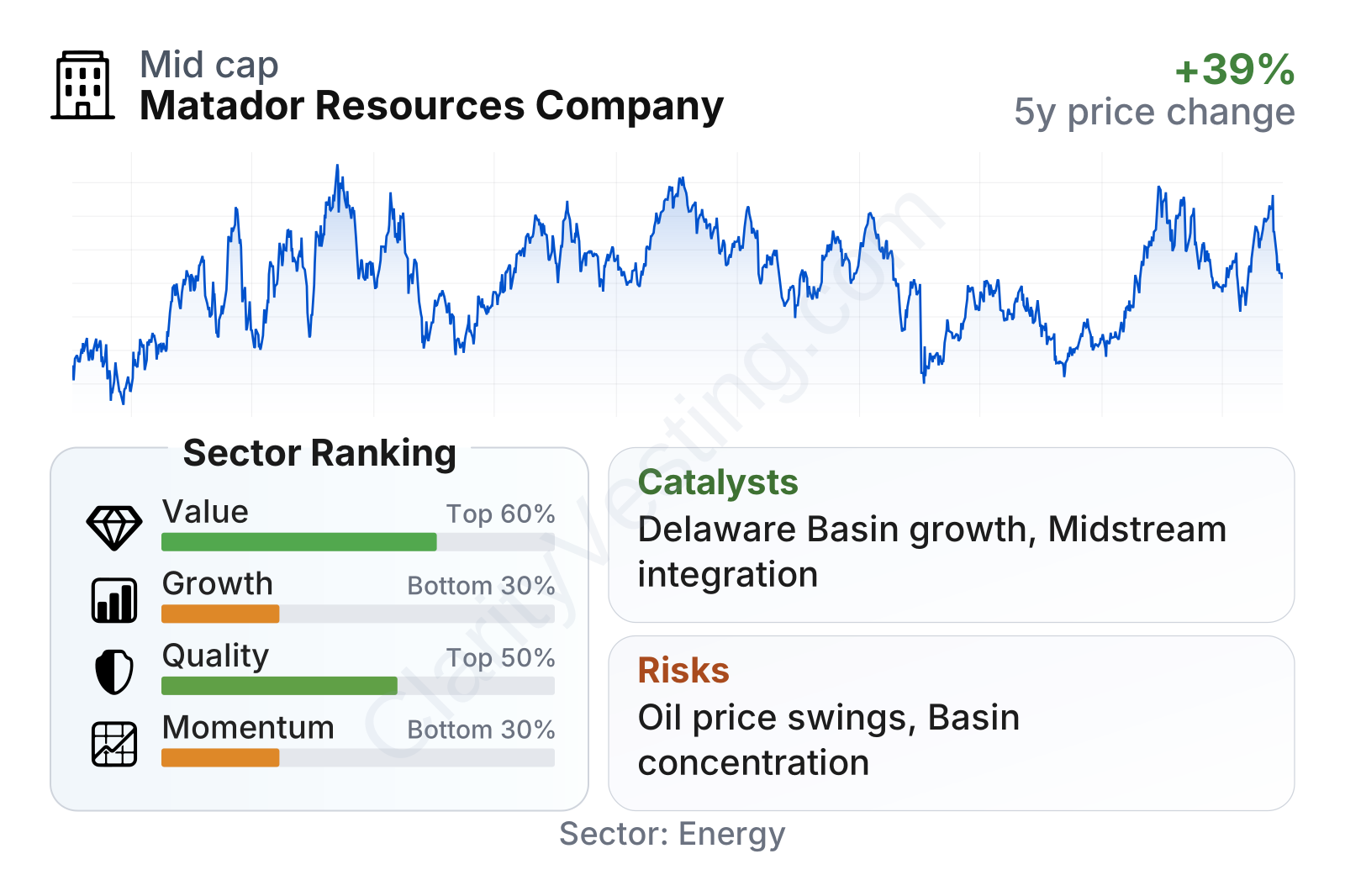
Matador looks like a mid-sized energy company with a market value in the multi-billion-dollar range and a stock that has historically moved less sharply than many peers. On valuation, several measures sit below sector medians, while cash generation and operating profitability remain solid. The weaker areas are recent share-price momentum and some growth-quality indicators, which reflect a more volatile earnings profile and the cyclical nature of the business rather than a simple deterioration across the board.
Growth
Matador operates in a sector that remains strategically important even as the broader energy system evolves. Oil and gas demand still matters for transportation, industry, petrochemicals, and power markets, and the Permian Basin continues to be one of the lowest-cost and most productive oil regions in North America. That matters because long-term resilience in this industry often comes less from headline demand growth and more from having acreage that can remain economical across different price environments.
Matador’s strategy is built around concentrating capital in the Delaware Basin, extending drilling inventory, and pairing upstream growth with owned midstream infrastructure. That approach makes industrial sense. It can improve operating control, reduce reliance on third parties, and support more efficient development of acquired acreage. The company has used acquisitions in recent years to deepen its position in core areas, which can create value if integration is disciplined and new wells perform as expected.
Revenue growth has been uneven quarter to quarter, which is normal for an exploration and production company, but the broader picture still shows a business that has expanded meaningfully over time. Recent year-over-year growth returned to positive territory after a weaker stretch, suggesting that production additions and asset expansion are still contributing despite commodity-price swings.
Free cash flow has been positive but volatile. That is a key point for long-term analysis: Matador is capable of generating meaningful excess cash, yet the amount can change sharply depending on oil prices, capital spending, and working-capital movements. The latest trailing figure remains substantial in absolute terms, which supports dividends, debt service, and continued field development, but the pattern shows why this is not a smooth compounding business in the way a software or consumer staples company might be.
A notable catalyst for future growth is continued execution in the Delaware Basin, where well productivity, infrastructure access, and scale can support further output gains. Another important factor is the company’s midstream position, which can become more valuable as production volumes rise. In recent company updates, management has continued to emphasize operational efficiency, acreage development, and capital returns, all of which fit the profile of a company trying to grow while preserving financial flexibility.
Risks
This article is for informational purposes only and does not constitute financial advice. Some content is AI-generated. See Disclaimer


