Stock Analysis · Mettler-Toledo International Inc (MTD)
Overview
Mettler-Toledo International Inc. makes precision instruments used to measure, analyze, and inspect materials in laboratories, factories, and retail settings. Its products are essential tools in life sciences, pharmaceuticals, food production, chemicals, logistics, and industrial manufacturing. In simple terms, the company helps customers weigh tiny samples accurately, test chemical properties, inspect packaged goods, and automate quality control.
The business is organized around three main product areas, with revenue usually split in a fairly balanced way across them. Based on the company’s recent annual reporting, the main sources of revenue are approximately:
- Laboratory instruments: about 53% of revenue. This includes laboratory balances, pipettes, automated chemistry systems, titration instruments, thermal analysis tools, and other analytical instruments used in research, drug development, and quality testing.
- Industrial instruments: about 35% of revenue. This segment includes industrial weighing systems, product inspection equipment, transportation and logistics dimensioning solutions, and process analytics tools used in manufacturing environments.
- Retail and other: about 12% of revenue. This mainly covers retail weighing solutions and related services, especially for food retail and commercial weighing applications.
A meaningful part of revenue also comes from recurring activities such as services, consumables, software, spare parts, and validation support. That matters because it makes the business less dependent on one-time equipment sales and helps stabilize performance across economic cycles.
The operating profile is notable for consistency. Over the last several years, revenue has moved within a relatively narrow band around $3.7 billion to just above $4.0 billion, while gross profit and net income remained strong. The bigger picture is that Mettler-Toledo is not a hypergrowth company; it is a specialized instrumentation company with high margins, disciplined cost control, and resilient demand from quality-critical industries.
The flow of revenue to profit shows a business with durable gross margins and unusually steady operating earnings. Selling and administrative expenses take a large share of costs, which is typical for a company that relies on global sales, service, and support networks, while research spending has remained meaningful but controlled.
Key Figures
| Metric | Value | Sector ⓘ |
|---|---|---|
| Date | Oct 24, 2026 | |
| Context | ||
| Sector | Healthcare | |
| Industry | Diagnostics & Research | |
| Market Cap ⓘ | $33.62B | |
| Beta ⓘ | 1.19 | |
Value (Cheapness) | ||
| P/E Ratio ⓘ | 37.82 | 25.42 |
| P/B Ratio ⓘ | 2,649.38 | 3.08 |
| FCF Yield ⓘ | 2.57% | 3.12% |
| Dividend Yield ⓘ | N/A | 1.85% |
| EBIT / EV ⓘ | 3.68% | 0.56% |
| PEG ⓘ | 2.77 | |
Growth (Business expansion) | ||
| Revenue Growth ⓘ | 4.50% | 7.50% |
| RPS Growth (5Y CAGR) ⓘ | 5.29% | 8.60% |
| EPS Growth (5Y CAGR) ⓘ | -16.22% | -17.73% |
| BVPS Growth (5Y CAGR) ⓘ | N/A | 3.72% |
| Margin Growth (5Y Trend) ⓘ | 1.00% | -0.57% |
| FCF Growth (5Y CAGR) ⓘ | 1.45% | 0.96% |
| DPS Growth (5Y CAGR) ⓘ | N/A | 6.69% |
Quality (Business durability) | ||
| ROIC (Latest) ⓘ | 46.12% | 3.17% |
| ROA (Latest) ⓘ | 25.18% | 2.98% |
| ROIC (5Y Median) ⓘ | 47.30% | 4.56% |
| ROA (5Y Median) ⓘ | 25.04% | 1.87% |
| Net Debt / EBIT (Latest) ⓘ | 1.75 | 1.34 |
| Net Debt / EBIT (5Y Median) ⓘ | 1.84 | 1.86 |
| Net Debt / EBITDA (Latest) ⓘ | 1.58 | 1.00 |
| Net Debt / Assets ⓘ | 56.13% | 5.06% |
| EBITDA / Interest ⓘ | 18.83 | 9.55 |
| Operating Margin (Latest) ⓘ | 28.41% | 9.25% |
| Operating Margin (5Y Median) ⓘ | 28.73% | 7.33% |
| Debt to Equity (Latest) ⓘ | 16470.12% | 26.68% |
| Profit Margin (Latest) ⓘ | 21.91% | 3.34% |
| Free Cash Flow (Latest) ⓘ | $863.97M | |
Momentum (Price trend) | ||
| 3Y Return ⓘ | +67.00% | +51.61% |
| 12M Return (excl. last month) ⓘ | +18.50% | +19.90% |
| 6M Return ⓘ | +28.59% | +10.10% |
| Price vs. 200-Day MA ⓘ | +26.54% | +6.44% |
Mettler-Toledo stands out most on business quality. Profitability metrics are far above the sector median, with operating margin around 28% and profit margin around 22%, versus much lower typical levels in healthcare tools and diagnostics. Return on invested capital is also exceptionally strong. Growth has been positive but not fast, while valuation measures remain above sector norms. In short, the table points to a premium-priced company backed by very strong economics rather than rapid expansion.
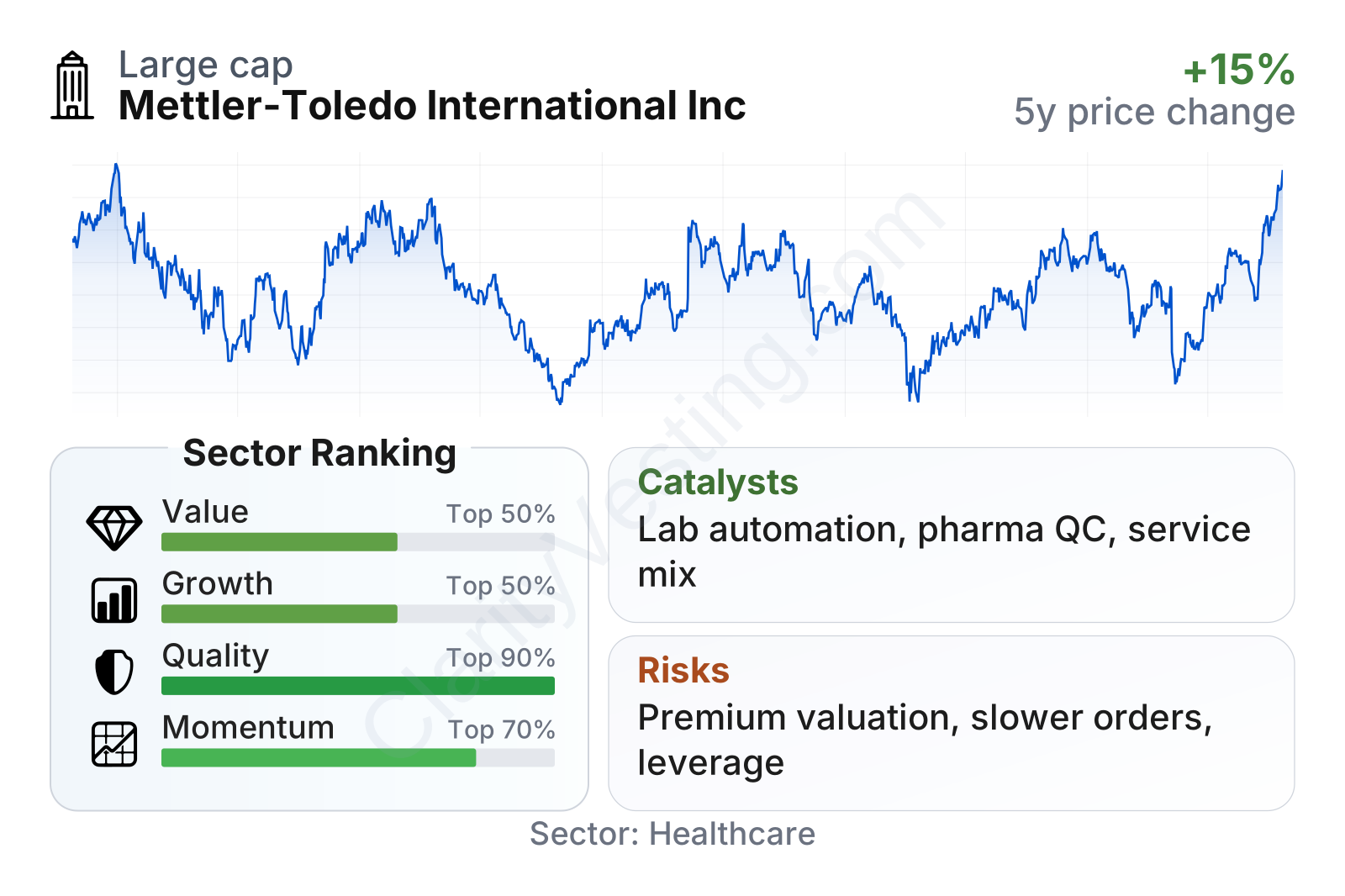
The share price history also reflects this pattern. The stock has been volatile over shorter periods, including a large pullback after the 2021 peak, but over a multiyear horizon it has generally tracked the market’s view of Mettler-Toledo as a high-quality compounder rather than a cyclical turnaround.
Growth
Mettler-Toledo operates in a part of the healthcare and industrial technology landscape that benefits from long-term structural demand. Laboratories need higher precision, stricter compliance, and more automation. Manufacturers face growing pressure to improve quality control, reduce waste, and digitize production lines. These are attractive trends because they are tied less to consumer fashion and more to regulation, safety, and efficiency.
The company’s strategy is coherent with that backdrop. It focuses on niche markets where measurement accuracy is mission-critical, and where customers often care more about reliability, service quality, and regulatory validation than about the lowest upfront price. That positioning supports pricing power and repeat business. The company has also invested in software-enabled workflows, automated laboratory solutions, and process analytics, which can deepen customer relationships and raise switching costs.
Revenue growth has not been linear. After very strong post-pandemic comparisons in 2021 and early 2022, growth slowed materially, turned negative for part of 2023 and 2024, and then recovered into mid-single-digit to high-single-digit territory. That rebound is important because it suggests the weaker period was more of a slowdown than a structural deterioration. Even so, current growth still looks moderate compared with the broader sector median.
Cash generation remains one of the strongest parts of the investment case. Free cash flow has stayed high in absolute terms, even with some recent moderation from the peak. For a company of this size, annual free cash flow around the high hundreds of millions of dollars provides room for research spending, acquisitions, debt service, and large share repurchases.
A practical catalyst is the company’s exposure to pharmaceutical and life-science quality control, where compliance requirements tend to become more demanding over time. Another is industrial automation: as factories digitize, precise measurement and in-line inspection become more valuable. The recent recovery in revenue growth also supports the idea that demand conditions are improving after a slower patch.
Recent company updates have also emphasized continued product innovation, service expansion, and disciplined capital returns. None of these alone changes the company overnight, but together they fit the pattern of a business designed to compound steadily through specialization, installed-base support, and high customer retention.
Risks
This article is for informational purposes only and does not constitute financial advice. Some content is AI-generated. See Disclaimer


