Stock Analysis · MTR Corp Ltd (MTCPY)
Overview
MTR Corporation is a Hong Kong-based rail operator and property company. It runs urban rail lines, airport rail links, cross-boundary services, station commercial activities, and a large property business built around and above transit infrastructure. This mix matters because MTR is not only a transportation operator: a meaningful part of its economics comes from real estate development, rental income, and commercial use of stations.
The company’s business is usually described through a few main pillars. Based on recent annual reporting and the structure of the group, revenue is broadly split as follows, from largest to smallest:
- Hong Kong transport operations: roughly 30% to 40% of recurring revenue. This includes domestic passenger rail, airport services, light rail, bus feeder services, and related fare income.
- Station commercial and property rental/management: roughly 20% to 30%. This includes retail leasing in stations and malls, advertising, telecommunications access, and property management fees.
- Mainland China and international railway operations: roughly 15% to 25%. This covers rail businesses outside Hong Kong, including operations in mainland China and selected overseas markets.
- Property development: highly variable year to year, often 10% to 30%+ depending on project completion and profit booking. This includes profits from residential and mixed-use developments linked to railway land.
That revenue mix can shift materially because property development is lumpy, while transport and rental activities are steadier. MTR’s long-standing “rail plus property” model is its defining feature: the company uses transport infrastructure to support nearby property value, and that property income can help offset the heavy capital needs of rail operations.
Over the last several years, total revenue has generally trended upward from the high HK$40 billions to around HK$60 billion before easing back in the latest period. Profitability has been more volatile than revenue because property timing and financing costs can have a large effect on reported earnings.
The business mix shows why MTR can report strong earnings even when pure transport trends are softer. Revenue has grown over time, but operating profit and net income have moved less smoothly, reflecting the importance of project timing, valuation effects, and interest costs rather than a simple fare-driven model.
Key Figures
| Metric | Value | Sector ⓘ |
|---|---|---|
| Date | Oct 17, 2026 | |
| Context | ||
| Sector | Industrials | |
| Industry | Railroads | |
| Market Cap ⓘ | $25.71B | |
| Beta ⓘ | 0.62 | |
Value (Cheapness) | ||
| P/E Ratio ⓘ | 8.80 | 22.10 |
| P/B Ratio ⓘ | 0.13 | 1.97 |
| FCF Yield ⓘ | -53.77% | 6.38% |
| Dividend Yield ⓘ | 4.03% | 1.94% |
| EBIT / EV ⓘ | N/A | 4.79% |
| PEG ⓘ | 0.86 | |
Growth (Business expansion) | ||
| Revenue Growth ⓘ | -4.10% | 9.30% |
| RPS Growth (5Y CAGR) ⓘ | 3.91% | 7.81% |
| EPS Growth (5Y CAGR) ⓘ | 31.94% | -13.06% |
| BVPS Growth (5Y CAGR) ⓘ | 1.45% | 6.14% |
| Margin Growth (5Y Trend) ⓘ | -13.05% | 0.88% |
| FCF Growth (5Y CAGR) ⓘ | N/A | 11.01% |
| DPS Growth (5Y CAGR) ⓘ | 3.13% | 9.48% |
Quality (Business durability) | ||
| ROIC (Latest) ⓘ | N/A | 10.84% |
| ROA (Latest) ⓘ | 9.37% | 5.41% |
| ROIC (5Y Median) ⓘ | 5.15% | 9.38% |
| ROA (5Y Median) ⓘ | 3.28% | 4.95% |
| Net Debt / EBIT (Latest) ⓘ | 3.10 | 2.08 |
| Net Debt / EBIT (5Y Median) ⓘ | 2.29 | 2.27 |
| Net Debt / EBITDA (Latest) ⓘ | 2.51 | 1.39 |
| Net Debt / Assets ⓘ | 18.24% | 19.28% |
| EBITDA / Interest ⓘ | 9.16 | 9.58 |
| Operating Margin (Latest) ⓘ | 25.73% | 10.50% |
| Operating Margin (5Y Median) ⓘ | 28.24% | 10.29% |
| Debt to Equity (Latest) ⓘ | 99.78% | 65.48% |
| Profit Margin (Latest) ⓘ | 44.30% | 6.67% |
| Free Cash Flow (Latest) ⓘ | -$13.83B | |
Momentum (Price trend) | ||
| 3Y Return ⓘ | +21.25% | +61.68% |
| 12M Return (excl. last month) ⓘ | +21.96% | +12.58% |
| 6M Return ⓘ | +5.27% | 0.00% |
| Price vs. 200-Day MA ⓘ | +23.51% | +0.02% |
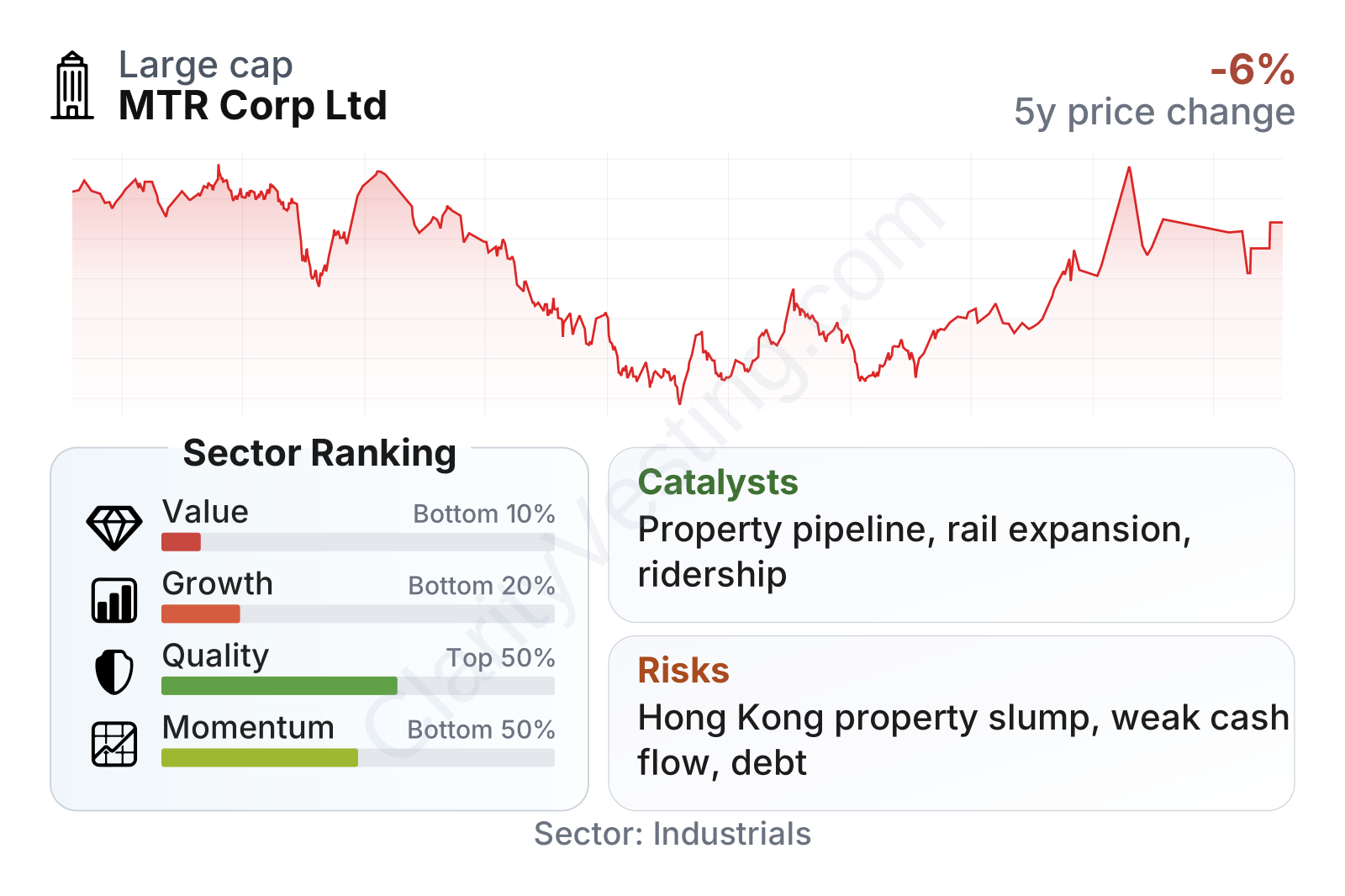
MTR is a large infrastructure company with a relatively low share-price volatility profile, as shown by its beta below 1. On valuation multiples, it screens far cheaper than the sector median, with a single-digit P/E and an exceptionally low price-to-book ratio. That said, the cheap appearance comes with important caveats: recent free cash flow is negative, growth metrics rank weakly versus the sector, and leverage is somewhat elevated. Profitability remains strong on reported margins, while momentum has improved more recently even though the longer three-year share-price record still trails much of the sector.
The stock-price history also highlights a business that has spent several years trading below earlier levels, followed by a partial recovery. That pattern fits a company whose assets are substantial and defensive, but whose market rating has been held back by uneven growth, real estate cyclicality, and a cautious view on Hong Kong exposure.
Growth
MTR operates in a sector with durable long-term demand. Urban rail remains essential in dense cities, and governments generally continue to support public transit, decarbonization, and transit-oriented development. Those themes are favorable for companies that already control high-quality transport assets in major metropolitan areas.
MTR’s strategy is coherent for that environment. Its advantage is not simply moving passengers; it is linking rail infrastructure with residential, retail, and commercial property. In dense cities where developable land near transit is scarce, that model can remain powerful for decades. New rail extensions, station upgrades, shopping-mall activity, and future property launches can all reinforce one another.
The near-term picture is less dynamic than the long-term one. Recent revenue growth has been negative year over year, and the company’s five-year revenue-per-share growth has lagged the sector median. However, earnings growth over five years has been much stronger than the sector in aggregate, showing that MTR has still been able to lift profit over a full cycle despite uneven top-line progress.
A key catalyst is the continued monetization of property tied to railway assets. When new projects reach booking milestones, reported profit can rise sharply. Another catalyst is ridership normalization and network expansion in Hong Kong and mainland China, which can improve the recurring transport base. If financing conditions stabilize, that could also ease one of the main pressures on earnings.
Recent company updates have also continued to emphasize investment in new railway projects and property development pipelines in Hong Kong. For a company like MTR, those project pipelines matter more than short-term fare movements because they shape earnings capacity several years ahead.
Risks
This article is for informational purposes only and does not constitute financial advice. Some content is AI-generated. See Disclaimer