Stock Analysis · M&T Bank Corporation (MTB)
Overview
M&T Bank Corporation is a regional banking group based in the United States. It operates M&T Bank and Wilmington Trust, serving consumers, small businesses, commercial clients, and institutional customers. In simple terms, the company gathers deposits, makes loans, earns interest on those loans and securities, and collects fees for services such as payments, wealth management, trust administration, and treasury services.
The bank’s footprint is concentrated in the Eastern U.S., with a particularly strong presence in the Northeast and Mid-Atlantic. That regional focus matters because banking is still a scale business at the local level: branch density, customer relationships, and knowledge of local commercial markets can support steadier deposit gathering and lending activity over time.
Based on the company’s recent annual reporting structure, M&T’s revenue comes mainly from spread income earned on loans and securities, followed by service-based fees. Approximate revenue mix is as follows:
- Net interest income: about 75% to 80% — the difference between interest earned on loans and investment securities and interest paid on deposits and borrowings.
- Service charges on deposit accounts: about 5% to 7% — fees tied to checking and other deposit account services.
- Mortgage banking revenues: about 3% to 5% — mortgage origination, sales, servicing, and related activities.
- Trust income: about 3% to 5% — wealth management, fiduciary, and institutional trust services, largely through Wilmington Trust.
- Commercial leasing and other revenues: about 2% to 4% — equipment financing and other specialized activities.
- Card and payment fees, brokerage, treasury, and other noninterest income: collectively about 8% to 12% — includes day-to-day banking services and capital-light fee businesses.
The broader earnings profile is typical of a traditional bank: revenue expanded strongly from 2021 through 2024 as rates rose and the People’s United acquisition added scale, but profitability also had to absorb higher funding costs. In 2025, revenue eased from the prior year while net income improved, suggesting expense control and a better balance between deposit costs and asset yields.
M&T’s business model remains centered on plain-vanilla banking rather than volatile trading or investment banking. That generally makes results easier to understand, though it also means performance is closely tied to credit quality, deposit costs, loan demand, and interest-rate conditions.
Key Figures
| Metric | Value | Sector ⓘ |
|---|---|---|
| Date | Oct 20, 2026 | |
| Context | ||
| Sector | Financial Services | |
| Industry | Banks - Regional | |
| Market Cap ⓘ | $30.87B | |
| Beta ⓘ | 0.61 | |
Value (Cheapness) | ||
| P/E Ratio ⓘ | 11.30 | 12.26 |
| P/B Ratio ⓘ | 1.10 | 1.23 |
| FCF Yield ⓘ | 11.93% | 10.33% |
| Dividend Yield ⓘ | 2.79% | 3.02% |
| EBIT / EV ⓘ | 11.91% | 8.14% |
| PEG ⓘ | 1.36 | |
Growth (Business expansion) | ||
| Revenue Growth ⓘ | 0.50% | 9.25% |
| RPS Growth (5Y CAGR) ⓘ | 13.63% | 12.19% |
| EPS Growth (5Y CAGR) ⓘ | 0.80% | -8.95% |
| BVPS Growth (5Y CAGR) ⓘ | 10.41% | 4.99% |
| Margin Growth (5Y Trend) ⓘ | -10.41% | -3.86% |
| FCF Growth (5Y CAGR) ⓘ | 2.75% | 4.81% |
| DPS Growth (5Y CAGR) ⓘ | 7.31% | 8.79% |
Quality (Business durability) | ||
| ROIC (Latest) ⓘ | 7.56% | 9.49% |
| ROE (Latest) ⓘ | 10.38% | 13.87% |
| ROA (Latest) ⓘ | 1.39% | 1.54% |
| ROIC (5Y Median) ⓘ | 7.89% | 7.86% |
| ROE (5Y Median) ⓘ | 9.59% | 12.17% |
| ROA (5Y Median) ⓘ | 1.25% | 1.30% |
| Net Debt / EBIT (Latest) ⓘ | 3.94 | 0.99 |
| Net Debt / EBIT (5Y Median) ⓘ | -4.50 | 0.73 |
| Net Debt / EBITDA (Latest) ⓘ | 4.15 | 0.91 |
| Operating Margin (Latest) ⓘ | 33.19% | 22.30% |
| Operating Margin (5Y Median) ⓘ | 29.99% | 24.63% |
| Debt to Equity (Latest) ⓘ | 71.10% | 58.32% |
| Profit Margin (Latest) ⓘ | 31.87% | 26.57% |
| Free Cash Flow (Latest) ⓘ | $3.68B | |
Momentum (Price trend) | ||
| 3Y Return ⓘ | +106.13% | +88.67% |
| 12M Return (excl. last month) ⓘ | +15.74% | +19.19% |
| 6M Return ⓘ | -0.99% | +4.70% |
| Price vs. 200-Day MA ⓘ | -3.86% | +3.66% |
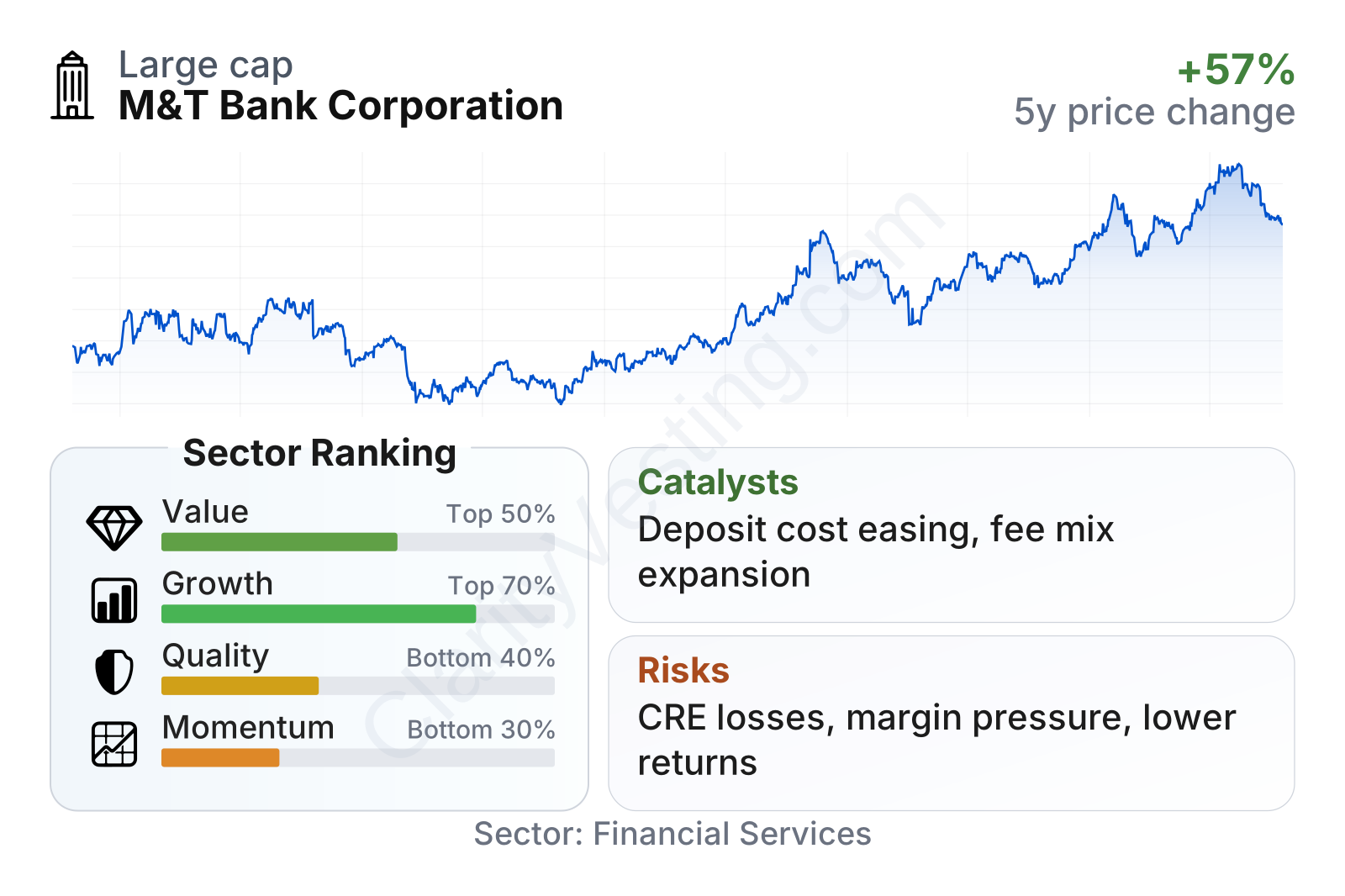
M&T is a large regional bank with a market value around $31 billion and a relatively low beta, which points to lower share-price swings than many stocks. On valuation, it screens slightly cheaper than the sector median on both earnings and book value, while its cash generation and operating profitability compare well. Growth metrics are more mixed: five-year per-share growth has been solid, but recent revenue growth has been modest. Quality measures are respectable in absolute terms, yet they trail many peers on return on equity and return on assets. Share-price momentum has also been softer than much of the sector in the shorter term, even after a strong rebound over the last three years.
Growth
Banking is not a high-growth industry in the same way as software or semiconductors, but it is a durable sector that tends to grow alongside population, business formation, household borrowing, and economic activity. For regional banks, growth usually comes from three levers: gathering low-cost deposits, expanding loans without weakening underwriting standards, and adding fee-based services that do not depend entirely on interest rates. M&T’s strategy fits that formula.
The company has been building scale in attractive East Coast markets and has continued integrating the benefits of the People’s United combination. That deal broadened its geographic reach, enlarged its deposit base, and created room for cost efficiencies. For a bank, that matters because a larger deposit franchise can support lending growth and reduce dependence on wholesale funding.
Earnings per share have not moved in a straight line, but the pattern shows resilience rather than deterioration. After pressure in 2022 and 2024, earnings recovered to a higher level in 2025. The 2026 year-to-date trajectory also suggests the bank is still generating solid profits. For long-term analysis, the key takeaway is not perfectly smooth growth, but the ability to recover earnings after rate and integration-related pressure.
Book value per share has risen steadily for several years, which is an important signal for banks because it reflects the growth of shareholder equity over time. M&T’s five-year growth in book value per share is well ahead of the sector median, indicating that the bank has been adding balance-sheet value even when earnings growth looked uneven. That strengthens the case that franchise value has been compounding underneath short-term market volatility.
Potential catalysts are fairly clear. If interest rates stabilize or decline gradually, deposit-cost pressure could ease while credit demand improves. M&T also has room to deepen relationships in commercial banking, wealth management, and treasury services across its expanded footprint. In addition, management has emphasized efficiency and disciplined capital deployment, which could support future earnings even if top-line growth remains moderate.
Recent company communications in 2026 also point to continued focus on expense discipline, loan quality, and capital strength rather than aggressive balance-sheet expansion. That is not the fastest route to growth, but it is often the more durable one for a regional bank.
Risks
This article is for informational purposes only and does not constitute financial advice. Some content is AI-generated. See Disclaimer


