Stock Analysis · ArcelorMittal SA (MT)
Overview
ArcelorMittal is one of the world’s largest steel and mining groups. The company makes flat steel, long steel, tubular products, and specialty steels used in cars, construction, machinery, appliances, energy infrastructure, and packaging. It also owns iron ore and coal mining assets that help supply part of its steelmaking needs. In simple terms, ArcelorMittal turns raw materials into steel products that are essential for industrial activity, buildings, transportation, and infrastructure.
Its revenue is mainly generated by selling steel products across several geographic regions, with a smaller contribution from mining. Based on the company’s recent segment reporting, the business mix is approximately the following:
- Europe: about 40% of revenue. This includes flat and long steel sold to automotive, construction, industrial, and distribution customers.
- NAFTA: about 25% of revenue. This is mainly steel sold in the United States, Canada, and Mexico, with exposure to manufacturing, energy, and construction markets.
- Brazil: about 10% of revenue. This business serves domestic industrial and construction demand and also includes some export activity.
- India joint venture and other Asian exposure: about 10% of economic contribution, although accounting presentation can differ because some assets are not fully consolidated in the same way as owned operations.
- Mining: about 5% to 10% of revenue, depending on commodity prices and shipment volumes. This segment includes iron ore and metallurgical coal production.
- Other operations, including long products, distribution, and regional businesses outside the largest reporting units: the remaining share.
What stands out is that ArcelorMittal is not only a steel producer but also a partially integrated raw-material supplier. That matters because mining can support margins when ore markets are favorable, while the broad geographic footprint reduces dependence on any single country.
Over the last few years, revenue has moved down from the exceptional 2021-2022 steel cycle, but costs have also adjusted. Profitability remains far below the peak years, showing how strongly earnings depend on steel spreads rather than on volume alone.
Key Figures
| Metric | Value | Sector ⓘ |
|---|---|---|
| Date | Sep 29, 2026 | |
| Context | ||
| Sector | Basic Materials | |
| Industry | Steel | |
| Market Cap ⓘ | $53.20B | |
| Beta ⓘ | 1.75 | |
Value (Cheapness) | ||
| P/E Ratio ⓘ | 29.71 | 17.70 |
| P/B Ratio ⓘ | 0.99 | 1.78 |
| FCF Yield ⓘ | -3.61% | 5.74% |
| Dividend Yield ⓘ | 0.84% | 2.10% |
| EBIT / EV ⓘ | 6.48% | 6.49% |
| PEG ⓘ | 0.66 | |
Growth (Business expansion) | ||
| Revenue Growth ⓘ | 5.20% | 11.30% |
| RPS Growth (5Y CAGR) ⓘ | 3.76% | 4.46% |
| EPS Growth (5Y CAGR) ⓘ | -42.42% | -13.58% |
| BVPS Growth (5Y CAGR) ⓘ | 12.54% | 6.36% |
| Margin Growth (5Y Trend) ⓘ | -16.89% | -2.15% |
| FCF Growth (5Y CAGR) ⓘ | -48.88% | 0.52% |
| DPS Growth (5Y CAGR) ⓘ | 18.20% | 6.08% |
Quality (Business durability) | ||
| ROIC (Latest) ⓘ | 4.81% | 8.86% |
| ROA (Latest) ⓘ | 1.83% | 4.94% |
| ROIC (5Y Median) ⓘ | 4.22% | 8.11% |
| ROA (5Y Median) ⓘ | 3.37% | 3.92% |
| Net Debt / EBIT (Latest) ⓘ | 2.29 | 1.37 |
| Net Debt / EBIT (5Y Median) ⓘ | 0.95 | 1.62 |
| Net Debt / EBITDA (Latest) ⓘ | 1.31 | 0.89 |
| Net Debt / Assets ⓘ | 9.60% | 13.69% |
| EBITDA / Interest ⓘ | 8.99 | 11.64 |
| Operating Margin (Latest) ⓘ | 6.62% | 12.39% |
| Operating Margin (5Y Median) ⓘ | 5.49% | 11.91% |
| Debt to Equity (Latest) ⓘ | 26.31% | 40.56% |
| Profit Margin (Latest) ⓘ | 2.88% | 6.78% |
| Free Cash Flow (Latest) ⓘ | -$1.92B | |
Momentum (Price trend) | ||
| 3Y Return ⓘ | +207.43% | +68.98% |
| 12M Return (excl. last month) ⓘ | +126.26% | +39.22% |
| 6M Return ⓘ | +39.22% | +6.79% |
| Price vs. 200-Day MA ⓘ | +15.19% | +2.46% |
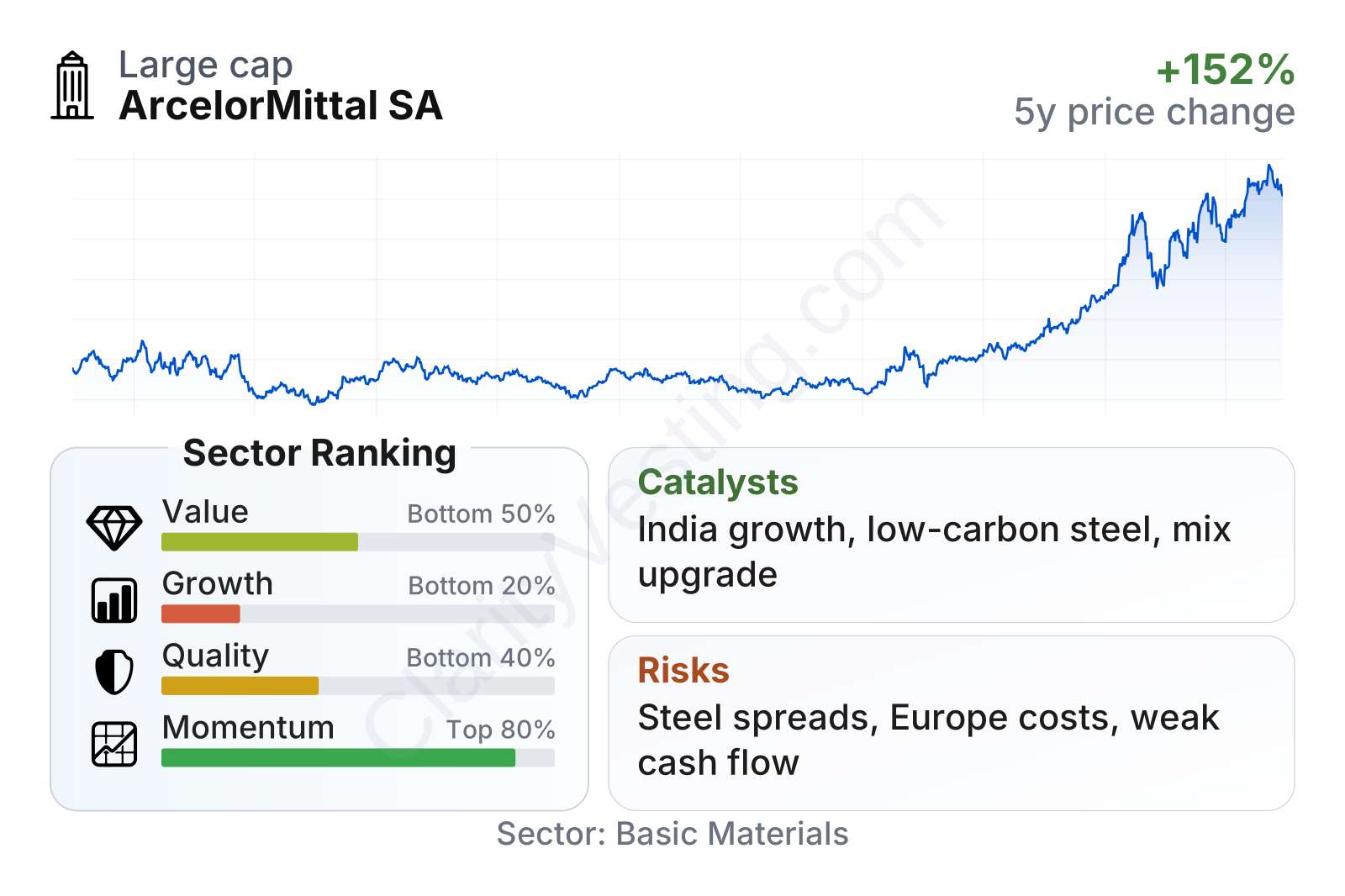
ArcelorMittal is a very large company in the global materials sector, and its stock has been much more volatile than the broader market, with a beta around 1.8. The recent share-price trend has been strong relative to many sector peers, but the underlying fundamentals are more mixed. Value measures do not point to a clearly cheap profile on earnings, even though the stock still trades around book value. Growth and quality rankings are below much of the sector, reflecting weak cash generation, modest returns on capital, and margins that remain under pressure compared with typical materials peers.
The table also suggests an important contrast: balance-sheet leverage is not excessive by sector standards, but current profitability is not strong enough to make the business look high quality at this point in the cycle. In other words, the company is financially solid enough to operate through downturns, yet its earnings power is still recovering rather than firing on all cylinders.
Growth
Steel is not a high-growth industry in the same way as software or semiconductors, but it remains a foundational sector. Demand is tied to urbanization, infrastructure spending, vehicle production, energy projects, and industrial reshoring. That gives ArcelorMittal exposure to long-cycle themes that can support demand over many years, especially in North America, India, and selected infrastructure markets.
A central part of the company’s strategy is to improve the mix of what it sells rather than simply chase raw tonnage. Management has emphasized higher-value steel products, more disciplined capital allocation, and selective investment in growth markets and lower-carbon production. This makes strategic sense because commodity steel alone usually delivers unstable profits, while more specialized products and localized supply relationships can protect margins better.
Another long-term catalyst is decarbonization. Steel customers, especially automakers and industrial groups, increasingly want lower-emission supply. ArcelorMittal has been investing in electric arc furnaces, direct reduced iron projects, scrap-based production, and carbon-reduction initiatives in Europe and North America. These projects are capital intensive, but they can improve the company’s position if carbon regulation tightens and customers place more value on cleaner steel.
India is also important. The company’s exposure through ArcelorMittal Nippon Steel India gives it a foothold in one of the few major steel markets with structurally stronger demand growth than mature Western economies. If Indian capacity expansion continues and domestic consumption rises, this could become one of the company’s most relevant growth engines over time.
Recent revenue growth has turned positive again after a long stretch of contraction. That is encouraging, but the rebound is still modest and remains weaker than the sector median. It looks more like an early cyclical recovery than a broad-based acceleration.
Cash generation tells a more cautious story. Free cash flow has fallen sharply from the unusually strong levels seen earlier in the cycle and has recently turned negative. That likely reflects a mix of weaker earnings, ongoing capital spending, and working-capital swings. For a capital-heavy company like ArcelorMittal, a durable improvement in free cash flow would be one of the clearest signs that the current recovery is becoming more robust.
Recent company updates have also highlighted continued portfolio optimization, cost discipline, and progress on strategic projects. Those are not headline-grabbing on their own, but they matter in steel because small margin improvements can have a large effect on earnings.
Risks
This article is for informational purposes only and does not constitute financial advice. Some content is AI-generated. See Disclaimer


