Stock Analysis · MSG Knickerbockers Corp (MSGK)
Overview
MSG Knickerbockers Corp is the sports and entertainment company that owns and operates the New York Knicks of the NBA and the New York Rangers of the NHL. It also controls other related sports assets, including development teams and esports interests tied to those franchises. In simple terms, the business makes money by owning high-profile teams, selling access to games and premium experiences, and monetizing the audience around those brands.
The company reports as a single sports business, but its revenue is commonly driven by a few major economic streams that can be grouped as follows:
- Suite licenses, premium seating, and sponsorships: approximately 35% to 45% of revenue in a typical year. This includes luxury suites, club seating, and brand partnerships tied to the Knicks and Rangers.
- Ticket sales and game-day revenue: approximately 25% to 35%. This covers regular-season and playoff ticket sales, along with related in-arena spending connected to attendance.
- Local and national media rights distributions: approximately 20% to 30%. These are payments linked to league media contracts and team broadcasting arrangements.
- League distributions, licensing, and other team-related revenue: approximately 5% to 15%. This includes merchandise royalties, shared league economics, and smaller ancillary activities.
The business is unusual because its assets are scarce. There are very few major-league franchises in global gateway cities, and even fewer with the brand recognition of the Knicks and Rangers. That gives the company pricing power when team performance is strong and demand for premium experiences rises. At the same time, revenue can swing meaningfully with playoff participation, which makes year-to-year results less smooth than those of more diversified media or entertainment groups.
Recent financial flow trends show revenue climbing from under $0.9 billion in fiscal 2023 to above $1.1 billion in fiscal 2026. However, profitability has been much more volatile: operating income dropped sharply in fiscal 2025 before recovering only modestly in fiscal 2026, showing that stronger sales have not yet translated into consistently strong margins.
Key Figures
| Metric | Value | Sector ⓘ |
|---|---|---|
| Date | Nov 04, 2026 | |
| Context | ||
| Sector | Communication Services | |
| Industry | Entertainment | |
| Market Cap ⓘ | $7.58B | |
| Beta ⓘ | 0.63 | |
Value (Cheapness) | ||
| P/E Ratio ⓘ | N/A | 17.90 |
| FCF Yield ⓘ | 0.76% | 13.58% |
| Dividend Yield ⓘ | N/A | 2.66% |
| EBIT / EV ⓘ | 0.46% | 4.75% |
| PEG ⓘ | N/A | |
Growth (Business expansion) | ||
| Revenue Growth ⓘ | 36.70% | 5.65% |
| RPS Growth (5Y CAGR) ⓘ | 9.05% | 4.57% |
| EPS Growth (5Y CAGR) ⓘ | N/A | -17.92% |
| Margin Growth (5Y Trend) ⓘ | -9.33% | 1.03% |
| FCF Growth (5Y CAGR) ⓘ | -27.44% | 5.63% |
| DPS Growth (5Y CAGR) ⓘ | -85.98% | 5.16% |
Quality (Business durability) | ||
| ROIC (Latest) ⓘ | N/A | 8.55% |
| ROIC (5Y Median) ⓘ | N/A | 8.33% |
| Net Debt / EBIT (Latest) ⓘ | 25.07 | 1.97 |
| Net Debt / EBIT (5Y Median) ⓘ | 17.32 | 2.94 |
| Net Debt / EBITDA (Latest) ⓘ | 23.18 | 1.16 |
| Net Debt / Assets ⓘ | 63.69% | 18.70% |
| EBITDA / Interest ⓘ | 2.00 | 8.43 |
| Operating Margin (Latest) ⓘ | 3.39% | 15.62% |
| Operating Margin (5Y Median) ⓘ | 8.05% | 13.36% |
| Debt to Equity (Latest) ⓘ | -434.42% | 59.53% |
| Profit Margin (Latest) ⓘ | 0.67% | 8.72% |
| Free Cash Flow (Latest) ⓘ | $57.79M | |
Momentum (Price trend) | ||
| 3Y Return ⓘ | +256.87% | +43.25% |
| 12M Return (excl. last month) ⓘ | +75.74% | 0.00% |
| 6M Return ⓘ | +82.96% | 0.00% |
| Price vs. 200-Day MA ⓘ | +69.12% | +0.67% |
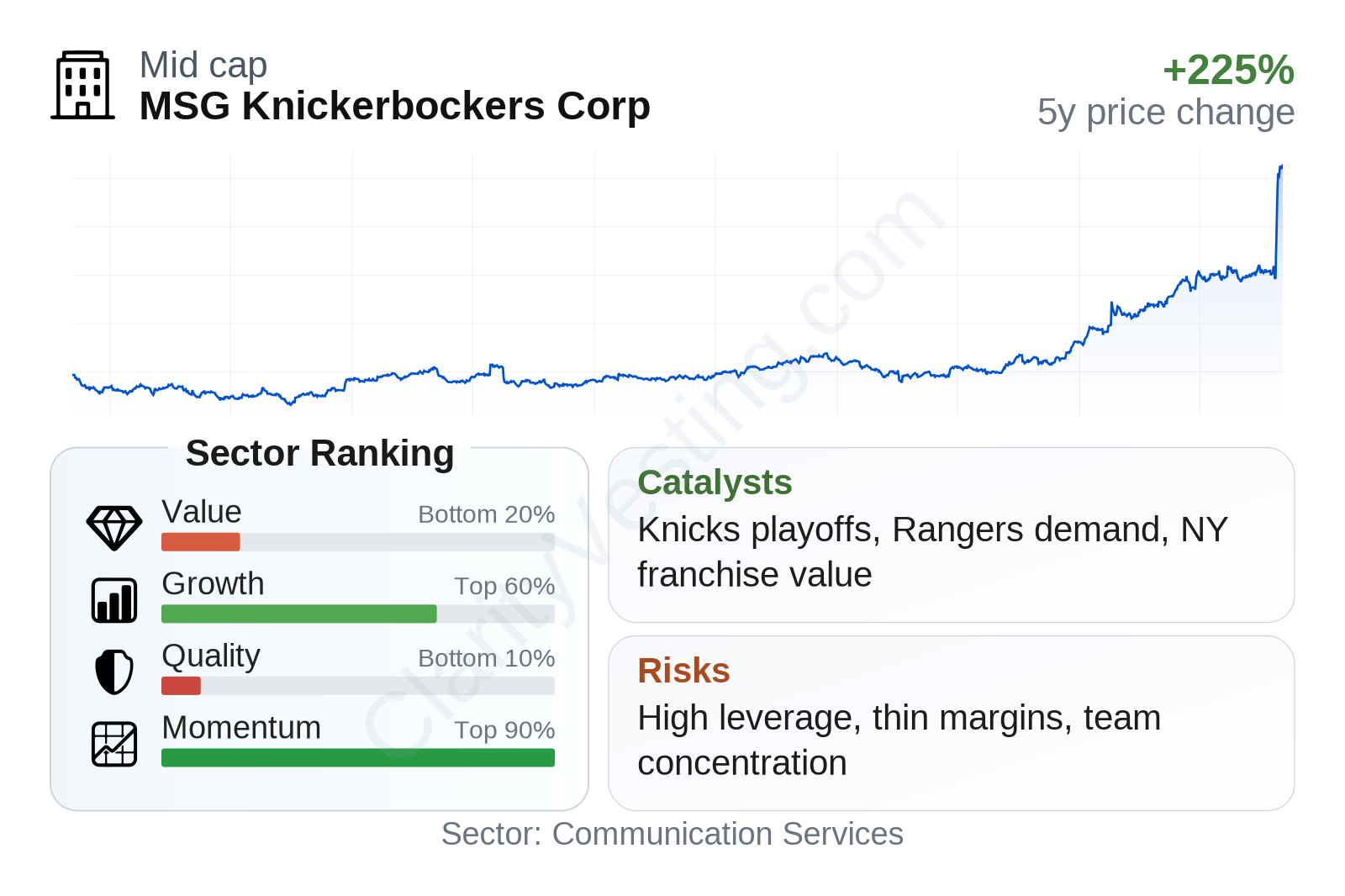
The stock has shown very strong price momentum over the last one to three years, clearly outperforming much of the broader Communication Services sector. Growth metrics also look better than the sector median, with revenue expanding at a fast pace recently and the five-year revenue-per-share trend remaining positive.
The weak area is business quality and valuation support. Profitability is thin, free cash flow yield is low, and leverage metrics are far heavier than sector norms. That combination suggests the market is placing a high value on the scarcity and brand appeal of the assets, even though current earnings and cash generation remain modest relative to the company’s size.
Growth
Professional sports remains an attractive long-term sector because top-tier franchises are limited in number, live sports continue to draw strong fan engagement, and media rights have historically held strategic value for distributors and streaming platforms. Premium live events are also more resistant than many other entertainment formats because fans tend to stay engaged through cycles, especially in major markets.
MSG Knickerbockers is positioned inside one of the strongest local sports markets in the world: New York. That matters because pricing for premium seating, sponsorship packages, and playoff inventory can rise sharply when teams are competitive. The company does not need nationwide market share gains in the way many traditional operating businesses do; instead, a large part of its growth potential comes from better monetization of existing assets.
A major catalyst is team performance. Deep playoff runs by the Knicks or Rangers can lift ticketing, sponsorship visibility, merchandise demand, and media attention in a compressed period. Another catalyst is the ongoing rise in franchise values across major U.S. sports leagues. Even when accounting profits are uneven, investors often view elite team ownership as a scarce asset class with long-term appreciation potential.
The strategy also makes sense in a narrower operational way. Revenue has continued to expand in recent years, which suggests the company is successfully pushing pricing and commercial partnerships. If management can convert more of that growth into steadier operating profit, the business could look materially stronger than it does today on margin-based measures.
Recent company disclosures have continued to highlight strong demand around the Knicks and Rangers and the benefits of premium offerings and sponsorship activity. The broader backdrop for sports rights and premium live entertainment still supports the idea that these franchises can keep extracting more value from their fan bases over time.
Risks
This article is for informational purposes only and does not constitute financial advice. Some content is AI-generated. See Disclaimer