Stock Analysis · Middlesex Water Company (MSEX)
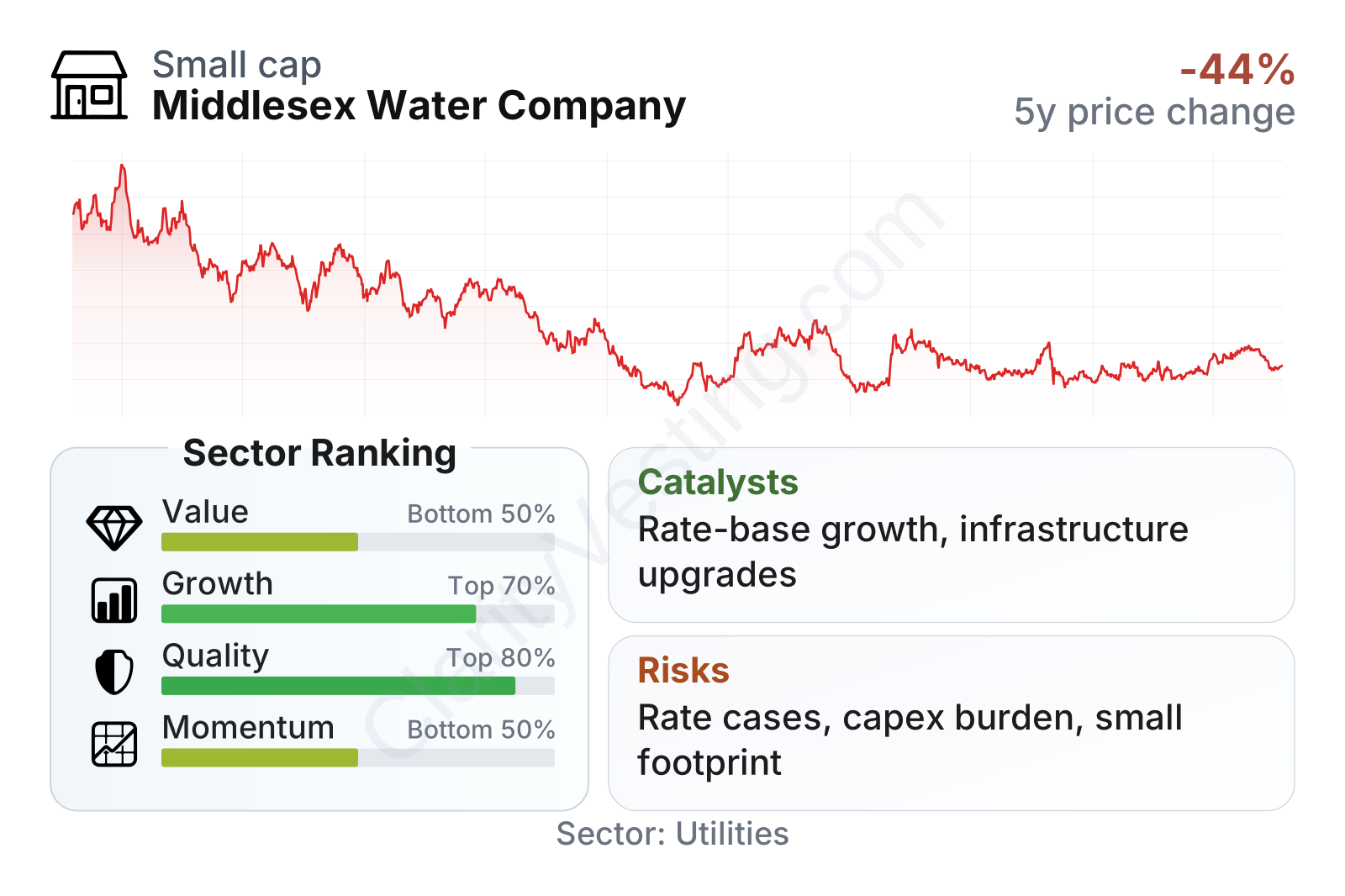
Overview
Middlesex Water Company is a regulated water utility serving parts of New Jersey and Delaware. Its core job is straightforward: it collects, treats, and delivers drinking water, and in some areas it also provides wastewater services. The company has been operating for more than a century, which is common in the water utility industry where assets such as pipes, treatment plants, and distribution networks are built for very long lives and operated under state regulation.
The business is mainly driven by utility revenue that comes from customer bills approved through regulatory frameworks. That tends to make results steadier than in many other industries, because demand for water is essential and less cyclical than demand for discretionary goods or services. Middlesex also has a smaller contract services activity through its Tidewater and utility-related operations.
Based on recent annual reporting, revenue is concentrated in a few core categories:
- Residential, commercial, and industrial water services: approximately 65% to 75% of revenue. This includes metered water sales to homes, businesses, and other users in the company’s regulated service territories.
- Wholesale and contract water supply: approximately 10% to 20% of revenue. This includes water sold to municipal or utility customers under longer-term arrangements.
- Wastewater and related utility services: approximately 10% to 15% of revenue. This covers regulated wastewater collection and treatment activities, primarily through Delaware operations and utility subsidiaries.
- Other utility-related and service revenue: generally less than 10%. This includes miscellaneous customer and service items tied to utility operations.
The overall business mix shows a company centered on essential infrastructure rather than rapid expansion into unrelated activities. Over the last several years, revenue has moved upward, while operating income has generally remained solid despite higher financing and infrastructure costs. Interest expense has risen as capital spending and borrowing needs increased, which is typical for utilities that continuously invest in networks and treatment capacity.
The broad pattern is encouraging on the revenue side: sales have risen meaningfully since 2021, and operating profitability has remained strong. The main offset is that financing costs have also climbed, reminding readers that even a stable water utility is still exposed to the cost of capital.
Key Figures
| Metric | Value | Sector ⓘ |
|---|---|---|
| Date | Oct 17, 2026 | |
| Context | ||
| Sector | Utilities | |
| Industry | Utilities - Regulated Water | |
| Market Cap ⓘ | $1.01B | |
| Beta ⓘ | 0.73 | |
Value (Cheapness) | ||
| P/E Ratio ⓘ | 20.77 | 17.28 |
| P/B Ratio ⓘ | 1.92 | 1.51 |
| FCF Yield ⓘ | 1.48% | 0.65% |
| Dividend Yield ⓘ | 2.64% | 3.77% |
| EBIT / EV ⓘ | 4.56% | 5.01% |
| PEG ⓘ | 18.45 | |
Growth (Business expansion) | ||
| Revenue Growth ⓘ | 14.30% | 6.10% |
| RPS Growth (5Y CAGR) ⓘ | 7.17% | 3.87% |
| EPS Growth (5Y CAGR) ⓘ | -10.94% | -11.30% |
| BVPS Growth (5Y CAGR) ⓘ | 6.91% | 4.23% |
| Margin Growth (5Y Trend) ⓘ | 6.30% | 3.57% |
| FCF Growth (5Y CAGR) ⓘ | -7.62% | -8.84% |
| DPS Growth (5Y CAGR) ⓘ | 5.53% | 4.84% |
Quality (Business durability) | ||
| ROIC (Latest) ⓘ | 6.45% | 6.53% |
| ROA (Latest) ⓘ | 3.47% | 3.20% |
| ROIC (5Y Median) ⓘ | 6.50% | 5.95% |
| ROA (5Y Median) ⓘ | 3.56% | 2.75% |
| Net Debt / EBIT (Latest) ⓘ | 6.61 | 7.13 |
| Net Debt / EBIT (5Y Median) ⓘ | 6.89 | 7.23 |
| Net Debt / EBITDA (Latest) ⓘ | 4.45 | 4.31 |
| Net Debt / Assets ⓘ | 30.70% | 38.42% |
| EBITDA / Interest ⓘ | 6.47 | 4.58 |
| Operating Margin (Latest) ⓘ | 32.07% | 20.83% |
| Operating Margin (5Y Median) ⓘ | 31.81% | 20.08% |
| Debt to Equity (Latest) ⓘ | 83.98% | 137.69% |
| Profit Margin (Latest) ⓘ | 23.26% | 11.37% |
| Free Cash Flow (Latest) ⓘ | $15.02M | |
Momentum (Price trend) | ||
| 3Y Return ⓘ | -11.40% | +52.37% |
| 12M Return (excl. last month) ⓘ | +7.60% | +8.84% |
| 6M Return ⓘ | +4.80% | -3.95% |
| Price vs. 200-Day MA ⓘ | +0.34% | -0.79% |
Middlesex is a small-cap regulated utility with relatively low share-price volatility, reflected in a beta below 1. On operating quality, it stands out well against much of the sector: margins are clearly above the industry median, leverage is lower than many peers, and interest coverage is healthier than average. Growth metrics are mixed but respectable for a utility, with revenue growth ahead of the sector median over both the last year and the last five years on a per-share basis. The weaker area is valuation, where the stock trades above the sector median on earnings and book value, even though recent share-price momentum has been uneven over a multiyear period.
Growth
The water utility sector is generally considered a slow-growth but durable part of the market. Demand is supported by basic public necessity, aging infrastructure, stricter water-quality requirements, and long-term population trends in served regions. That does not usually produce fast expansion, but it can support gradual rate-base growth as utilities invest in pipes, treatment systems, and resilience projects and then seek regulatory recovery on those investments.
Middlesex’s strategy fits that model. The company continues to invest in core water and wastewater infrastructure, which can expand the regulated asset base over time. In this industry, that matters because earnings growth often follows approved capital spending more than simple volume growth. If investment is prudent and regulators allow recovery, a larger asset base can translate into higher future revenue and earnings.
Revenue per share has trended upward steadily over the last five years, which is a positive sign because it shows growth after taking the share count into account. The pace is not dramatic, but for a regulated utility it compares favorably with sector norms and supports the view that the business is expanding in a measured and durable way.
Free cash flow has been volatile, including negative periods followed by recovery into positive territory. That pattern is not unusual for infrastructure-heavy utilities, since large capital programs can temporarily absorb cash. The important point is that recent free cash flow has turned positive, although not yet at a level that removes all concern about ongoing capital intensity.
A practical growth catalyst is the company’s ability to convert infrastructure spending into future regulated returns. Another is the continued need for water system upgrades across the U.S., including replacement of aging mains, treatment improvements, and resilience investments. Middlesex does not need a breakthrough technology to grow; it mainly needs steady execution, constructive rate cases, and continued demand for essential service.
Recent company reporting has also pointed to continued investment activity and normal utility rate mechanisms as drivers of results. In this sector, that can be more meaningful than headline expansion because it supports gradual, visible growth rather than uncertain one-time opportunities.
Risks
This article is for informational purposes only and does not constitute financial advice. Some content is AI-generated. See Disclaimer


