Stock Analysis · Marex Group plc (MRX)
Overview
Marex Group plc is a global financial services firm focused on market intermediation. In simple terms, it helps clients access markets, execute trades, hedge risk, finance positions, and move cash and securities across the financial system. Its client base includes commodity producers and consumers, hedge funds, asset managers, banks, professional traders, and corporate customers. The company has built its business around areas where clients need specialized access rather than broad retail banking or consumer finance.
Based on the company’s reporting structure, Marex’s revenue is mainly generated from four operating segments:
- Clearing — approximately 35% to 45% of revenue in recent periods. This business provides clearing, custody, settlement, and financing services for futures, options, and securities transactions.
- Agency and Execution — approximately 20% to 30%. This segment covers order execution across futures, options, equities, fixed income, and foreign exchange, where Marex acts mainly as an intermediary for clients.
- Market Making — approximately 20% to 30%. Here the company provides liquidity in selected markets, including commodities and financial products, earning spreads and trading-related income.
- Hedging and Investment Solutions — approximately 10% to 20%. This unit structures risk-management products and investment solutions, especially for corporate and institutional clients.
That mix matters because it makes Marex less dependent on a single product line. It is exposed to trading volumes, client activity, financing balances, and volatility across multiple markets. Over the last several years, the business has also expanded through acquisitions and by adding more products and geographic reach, which has helped lift total revenue and operating profit materially. The broad pattern has been strong top-line expansion with rising operating income, even though interest expense is a meaningful cost in this business model.
The long-term trend is clearly upward: revenue has climbed sharply since 2021, and operating income has grown even faster. Net income has also improved, although financing costs remain substantial, which is typical for a balance-sheet-intensive intermediary.
Key Figures
| Metric | Value | Sector ⓘ |
|---|---|---|
| Date | Oct 17, 2026 | |
| Context | ||
| Sector | Financial Services | |
| Industry | Capital Markets | |
| Market Cap ⓘ | $5.35B | |
| Beta ⓘ | -0.02 | |
Value (Cheapness) | ||
| P/E Ratio ⓘ | 14.55 | 12.26 |
| P/B Ratio ⓘ | 2.92 | 1.23 |
| FCF Yield ⓘ | 38.33% | 10.40% |
| Dividend Yield ⓘ | 1.04% | 3.02% |
| EBIT / EV ⓘ | 23.71% | 8.14% |
| PEG ⓘ | N/A | |
Growth (Business expansion) | ||
| Revenue Growth ⓘ | 32.10% | 9.35% |
| RPS Growth (5Y CAGR) ⓘ | 41.11% | 12.19% |
| EPS Growth (5Y CAGR) ⓘ | N/A | -9.53% |
| BVPS Growth (5Y CAGR) ⓘ | 25.26% | 4.99% |
| Margin Growth (5Y Trend) ⓘ | 20.98% | -3.86% |
| FCF Growth (5Y CAGR) ⓘ | 9.01% | 4.81% |
| DPS Growth (5Y CAGR) ⓘ | 26.76% | 8.79% |
Quality (Business durability) | ||
| ROIC (Latest) ⓘ | 12.81% | 9.49% |
| ROE (Latest) ⓘ | 44.93% | 13.90% |
| ROA (Latest) ⓘ | 1.82% | 1.55% |
| ROIC (5Y Median) ⓘ | N/A | 7.86% |
| ROE (5Y Median) ⓘ | 17.61% | 12.17% |
| ROA (5Y Median) ⓘ | 1.04% | 1.30% |
| Net Debt / EBIT (Latest) ⓘ | -0.53 | 0.96 |
| Net Debt / EBIT (5Y Median) ⓘ | 5.71 | 0.73 |
| Net Debt / EBITDA (Latest) ⓘ | -0.52 | 0.92 |
| Operating Margin (Latest) ⓘ | 31.86% | 22.30% |
| Operating Margin (5Y Median) ⓘ | 28.91% | 24.63% |
| Debt to Equity (Latest) ⓘ | 150.79% | 58.56% |
| Profit Margin (Latest) ⓘ | 12.21% | 26.57% |
| Free Cash Flow (Latest) ⓘ | $2.05B | |
Momentum (Price trend) | ||
| 3Y Return ⓘ | N/A | +88.33% |
| 12M Return (excl. last month) ⓘ | +112.39% | +19.38% |
| 6M Return ⓘ | +39.66% | +4.75% |
| Price vs. 200-Day MA ⓘ | +30.81% | +3.50% |
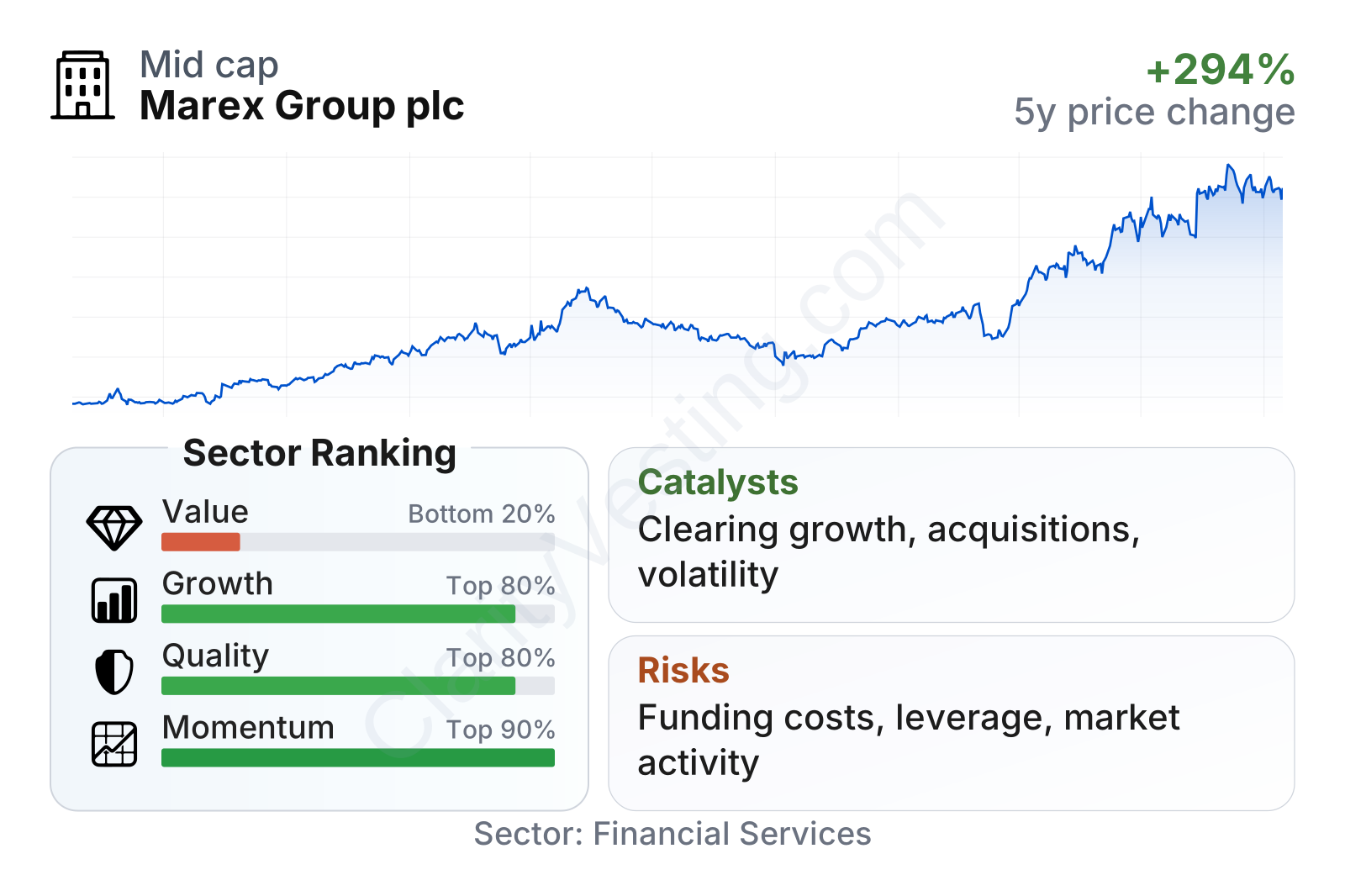
Marex is now a mid-sized capital markets company with a stock that has been very strong over the past year and well ahead of the broader sector. The metrics table shows a business that ranks well on growth, quality, and momentum, while looking less attractive on traditional value measures. That combination usually means the market is recognizing improved execution and stronger profitability, but is also assigning a richer multiple than it did closer to the IPO period.
The balance sheet profile needs careful interpretation. Reported debt to equity is high at roughly 151%, which is common to monitor closely in financial firms, yet net debt relative to earnings is currently negative, pointing to strong liquidity or cash support at the latest point in time. Free cash flow looks unusually strong, but cash flow metrics for brokerage and clearing firms can be volatile and are not always comparable to industrial companies.
Growth
Marex operates in a part of financial services that benefits from several durable industry trends: more demand for hedging, greater complexity in commodity and financial markets, rising regulatory needs around clearing and reporting, and a steady need for specialized execution across fragmented global venues. Those trends support firms that can combine technology, risk management, and client service in niche markets.
The company’s strategy appears coherent for future expansion. Rather than trying to dominate every area of investment banking, Marex has focused on businesses where scale, client relationships, regulatory infrastructure, and cross-product capabilities matter. That is visible in its growth record: recent year-over-year revenue growth has been around 32%, comfortably above the sector median, while five-year revenue-per-share growth has been far stronger than most peers. Operating margin trends have also improved over time, suggesting that growth has not come only from adding volume, but also from operating leverage and a better business mix.
Earnings per share moved up strongly from 2024 to 2025, showing that recent expansion translated into shareholder earnings rather than just larger activity levels. The 2026 interim pattern looks steadier, which may indicate a pause after a rapid jump rather than a breakdown in the underlying business.
Book value per share has also risen consistently over several years, from under $7 in 2021 to more than $16 by 2025. For a financial company, that is an important sign because book value often reflects whether the firm is compounding capital while expanding client activity. A rising book value base can support larger clearing balances, more financing capacity, and broader client relationships.
Potential catalysts are fairly specific. Continued growth in exchange-traded derivatives and clearing volumes would directly support one of Marex’s largest businesses. More corporate demand for commodity and currency hedging could lift structured solutions and execution activity. The company also has room to keep broadening geographically and integrating acquisitions into a wider client network. In addition, if market volatility remains elevated but orderly, intermediaries like Marex often see more client engagement across execution, market making, and risk management services.
Recent company communications have also highlighted ongoing business expansion, including acquisitions and new capabilities added over time. For a firm of this size, successful integration can create a meaningful revenue opportunity because new products can be sold into an existing institutional client base rather than built from scratch.
Risks
This article is for informational purposes only and does not constitute financial advice. Some content is AI-generated. See Disclaimer


