Stock Analysis · Meren Energy Inc (MRNFF)
Overview
Meren Energy Inc is an upstream oil and gas company. In simple terms, it explores for hydrocarbons, develops fields, and sells the oil and natural gas it produces. The business is therefore tied mainly to production volumes, realized commodity prices, and the company’s ability to control costs and convert reserves into cash flow.
The company’s revenue base appears highly concentrated in core oil and gas production rather than diversified downstream or service activities. Based on the latest annual profile available from public company materials, the main sources of revenue are:
- Crude oil sales: the largest contributor, generated from producing and selling crude oil from operated and non-operated fields.
- Natural gas sales: a secondary contributor, tied to produced gas volumes and local or export pricing.
- Natural gas liquids and related hydrocarbons: a smaller but still relevant stream where the company’s production mix includes condensate or other liquids.
For long-term analysis, the practical takeaway is that Meren is mostly a direct play on upstream energy economics: reserve quality, field execution, and commodity price realization matter more here than branding, retail distribution, or manufacturing scale.
The recent financial flow also shows a notable shift. After a very weak 2024, 2025 brought a return to reported revenue and positive operating income, although net income remained negative because financing and other below-the-line costs still weighed on results. That pattern suggests the operating base improved, but the full earnings picture is not yet consistently stable.
The overall flow points to a company that has rebuilt operating momentum faster than accounting earnings. Revenue and gross profit reappeared in 2025, operating profit turned positive, and free cash generation improved, but interest and other charges still limited the benefit at the bottom line.
Key Figures
| Metric | Value | Sector ⓘ |
|---|---|---|
| Date | Oct 17, 2026 | |
| Context | ||
| Sector | Energy | |
| Industry | Oil & Gas E&P | |
| Market Cap ⓘ | $1.01B | |
| Beta ⓘ | 0.45 | |
Value (Cheapness) | ||
| P/E Ratio ⓘ | N/A | 15.44 |
| P/B Ratio ⓘ | 1.45 | 1.73 |
| FCF Yield ⓘ | 21.85% | 8.20% |
| Dividend Yield ⓘ | 10.28% | 3.59% |
| EBIT / EV ⓘ | 3.03% | 7.46% |
| PEG ⓘ | N/A | |
Growth (Business expansion) | ||
| Revenue Growth ⓘ | 183.80% | 26.90% |
| RPS Growth (5Y CAGR) ⓘ | N/A | 6.90% |
| EPS Growth (5Y CAGR) ⓘ | -45.38% | -15.73% |
| BVPS Growth (5Y CAGR) ⓘ | -11.39% | 6.07% |
| Margin Growth (5Y Trend) ⓘ | N/A | 0.58% |
| FCF Growth (5Y CAGR) ⓘ | N/A | 1.86% |
| DPS Growth (5Y CAGR) ⓘ | N/A | 16.79% |
Quality (Business durability) | ||
| ROIC (Latest) ⓘ | -2.07% | 11.40% |
| ROA (Latest) ⓘ | -4.96% | 6.06% |
| ROIC (5Y Median) ⓘ | N/A | 10.30% |
| ROA (5Y Median) ⓘ | -4.41% | 5.42% |
| Net Debt / EBIT (Latest) ⓘ | 5.63 | 1.64 |
| Net Debt / EBIT (5Y Median) ⓘ | N/A | 1.83 |
| Net Debt / EBITDA (Latest) ⓘ | 0.81 | 1.08 |
| Net Debt / Assets ⓘ | 11.75% | 17.29% |
| EBITDA / Interest ⓘ | 6.53 | 9.64 |
| Operating Margin (Latest) ⓘ | 5.28% | 16.27% |
| Operating Margin (5Y Median) ⓘ | N/A | 20.39% |
| Debt to Equity (Latest) ⓘ | 41.56% | 54.76% |
| Profit Margin (Latest) ⓘ | -13.24% | 8.82% |
| Free Cash Flow (Latest) ⓘ | $221.56M | |
Momentum (Price trend) | ||
| 3Y Return ⓘ | -5.94% | +67.38% |
| 12M Return (excl. last month) ⓘ | +39.74% | +49.19% |
| 6M Return ⓘ | -11.06% | +7.07% |
| Price vs. 200-Day MA ⓘ | -2.18% | +9.56% |
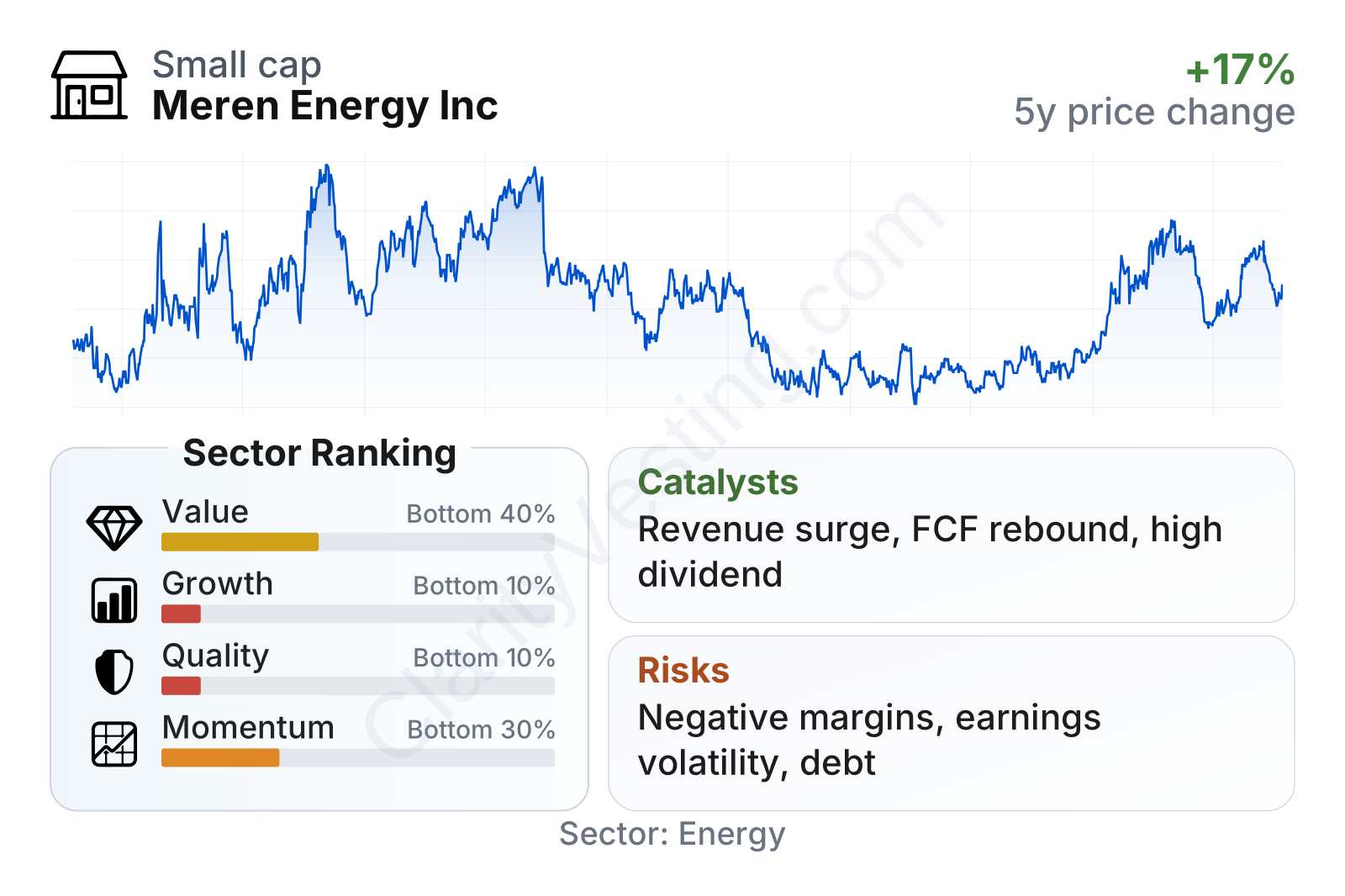
Meren is a small-cap energy producer with a market value around $1 billion and a low beta near 0.4, which is unusual for a commodity-linked business and suggests the stock has recently moved less aggressively than many peers. On valuation multiples, the picture is mixed: price-to-book is slightly below the sector median, free cash flow yield is well above the sector median, and the dividend yield is also materially higher than typical energy names. However, weaker profitability and returns on capital explain why traditional value screens do not automatically make the shares look cheap on every measure.
The table also shows a sharp contrast between near-term operating improvement and weaker long-run quality indicators. Revenue growth has been very strong recently, but five-year earnings and book value trends remain weak, and returns on capital and assets are below sector norms. In other words, the company currently shows signs of operational recovery, but it has not yet built the consistency usually associated with higher-quality energy operators.
Growth
The company operates in a sector that remains strategically important. Oil and gas demand is still supported by transportation, power, industrial use, and petrochemicals, even as energy systems gradually diversify. For an upstream producer like Meren, long-term growth does not depend on creating a new market; it depends on replacing reserves, improving field performance, and keeping projects economic across commodity cycles.
Meren’s recent operating trend is clearly stronger than its longer-term record. The latest year-over-year revenue growth readings are exceptionally high, including roughly 50% in one recent quarter and well above 100% in the next. That kind of expansion is far above the sector median and usually points to a major change in production base, asset contribution, or sales normalization rather than ordinary incremental growth.
That revenue rebound matters because it changes the company’s financial flexibility. The business moved from negative trailing free cash flow in mid-2025 to solidly positive free cash flow by early 2026, reaching more than $140 million on a trailing basis and about $220 million in the latest metrics snapshot. For a company of this size, that is meaningful.
The strategic case for future growth appears to rest on converting operational progress into steadier earnings and balance-sheet improvement. If production volumes remain firm and costs are contained, cash generation could support debt management, shareholder distributions, and reinvestment into higher-return assets. A double-digit trailing dividend yield also indicates management is returning material cash, although sustaining that level depends on continued operating performance.
As a recent catalyst, the strongest visible signal is not a headline event but the combination of surging revenue and sharply improved free cash flow. In an upstream company, that often carries more long-term importance than short-lived market sentiment because it can reshape the company’s capital allocation options.
Risks
This article is for informational purposes only and does not constitute financial advice. Some content is AI-generated. See Disclaimer


