Stock Analysis · Moderna Inc (MRNA)
Overview
Moderna is a biotechnology company focused on medicines and vaccines built on messenger RNA, or mRNA. In simple terms, mRNA gives cells instructions to produce a protein, and that protein can train the immune system or help the body make a therapeutic molecule. Moderna became widely known for its COVID-19 vaccine, but its longer-term business is broader: it is trying to turn mRNA into a repeatable drug-development platform across respiratory vaccines, oncology, rare diseases, and other specialty areas.
Today, Moderna’s commercial business is still heavily concentrated in vaccines, and especially in its COVID-19 franchise. Based on the company’s recent annual reporting and product disclosures, revenue is dominated by Spikevax, its COVID-19 vaccine, while smaller contributions come from newer launches and collaboration or grant-related items.
- Spikevax (COVID-19 vaccine): approximately 80% to 90% of recent product revenue. This includes sales to governments, pharmacies, healthcare providers, and international markets, but demand has fallen sharply from pandemic peaks and is now more seasonal.
- mRESVIA / respiratory syncytial virus vaccine and other product sales: approximately 5% to 15%. This is the newer respiratory vaccine business, still at an early stage and not yet large enough to offset the COVID decline on its own.
- Collaboration, grant, and other revenue: generally a small share. This can include development partnerships, government support tied to certain programs, and miscellaneous revenue items, but it is not the main earnings driver.
What stands out is how fast the income profile changed. Moderna moved from extraordinary pandemic-era sales and very high profitability to a much smaller revenue base while still spending billions of dollars on research and development. That makes the company less a mature vaccine cash machine and more a heavily funded platform biotech trying to build its next wave of products.
The multi-year financial flow makes that shift very clear: revenue and profit surged in 2021 and 2022, then dropped steeply in 2023 through 2025, while research spending remained very high. In other words, Moderna has been using its earlier windfall to finance a large product pipeline rather than protecting near-term earnings.
Key Figures
| Metric | Value | Sector ⓘ |
|---|---|---|
| Date | Oct 03, 2026 | |
| Context | ||
| Sector | Healthcare | |
| Industry | Biotechnology | |
| Market Cap ⓘ | $76.88B | |
| Beta ⓘ | 1.11 | |
Value (Cheapness) | ||
| P/E Ratio ⓘ | N/A | 24.06 |
| P/B Ratio ⓘ | 11.07 | 3.08 |
| FCF Yield ⓘ | -1.59% | 3.07% |
| Dividend Yield ⓘ | N/A | 2.05% |
| EBIT / EV ⓘ | -4.46% | 0.63% |
| PEG ⓘ | N/A | |
Growth (Business expansion) | ||
| Revenue Growth ⓘ | 2.10% | 7.50% |
| RPS Growth (5Y CAGR) ⓘ | -40.97% | 8.70% |
| EPS Growth (5Y CAGR) ⓘ | N/A | -18.20% |
| BVPS Growth (5Y CAGR) ⓘ | -9.27% | 3.95% |
| Margin Growth (5Y Trend) ⓘ | N/A | -0.58% |
| FCF Growth (5Y CAGR) ⓘ | N/A | 0.88% |
| DPS Growth (5Y CAGR) ⓘ | 137.49% | 6.80% |
Quality (Business durability) | ||
| ROIC (Latest) ⓘ | -28.24% | 3.29% |
| ROA (Latest) ⓘ | -27.29% | 3.02% |
| ROIC (5Y Median) ⓘ | -18.47% | 4.75% |
| ROA (5Y Median) ⓘ | -21.29% | 1.93% |
| Net Debt / EBIT (Latest) ⓘ | N/A | 1.33 |
| Net Debt / EBIT (5Y Median) ⓘ | N/A | 1.83 |
| Net Debt / EBITDA (Latest) ⓘ | N/A | 0.99 |
| Net Debt / Assets ⓘ | -3.98% | 5.33% |
| EBITDA / Interest ⓘ | N/A | 9.63 |
| Operating Margin (Latest) ⓘ | -137.79% | 9.25% |
| Operating Margin (5Y Median) ⓘ | -57.01% | 7.80% |
| Debt to Equity (Latest) ⓘ | 19.04% | 28.99% |
| Profit Margin (Latest) ⓘ | -141.43% | 3.60% |
| Free Cash Flow (Latest) ⓘ | -$1.22B | |
Momentum (Price trend) | ||
| 3Y Return ⓘ | +82.89% | +37.48% |
| 12M Return (excl. last month) ⓘ | +540.39% | +20.85% |
| 6M Return ⓘ | +277.65% | +9.73% |
| Price vs. 200-Day MA ⓘ | +179.56% | +4.69% |
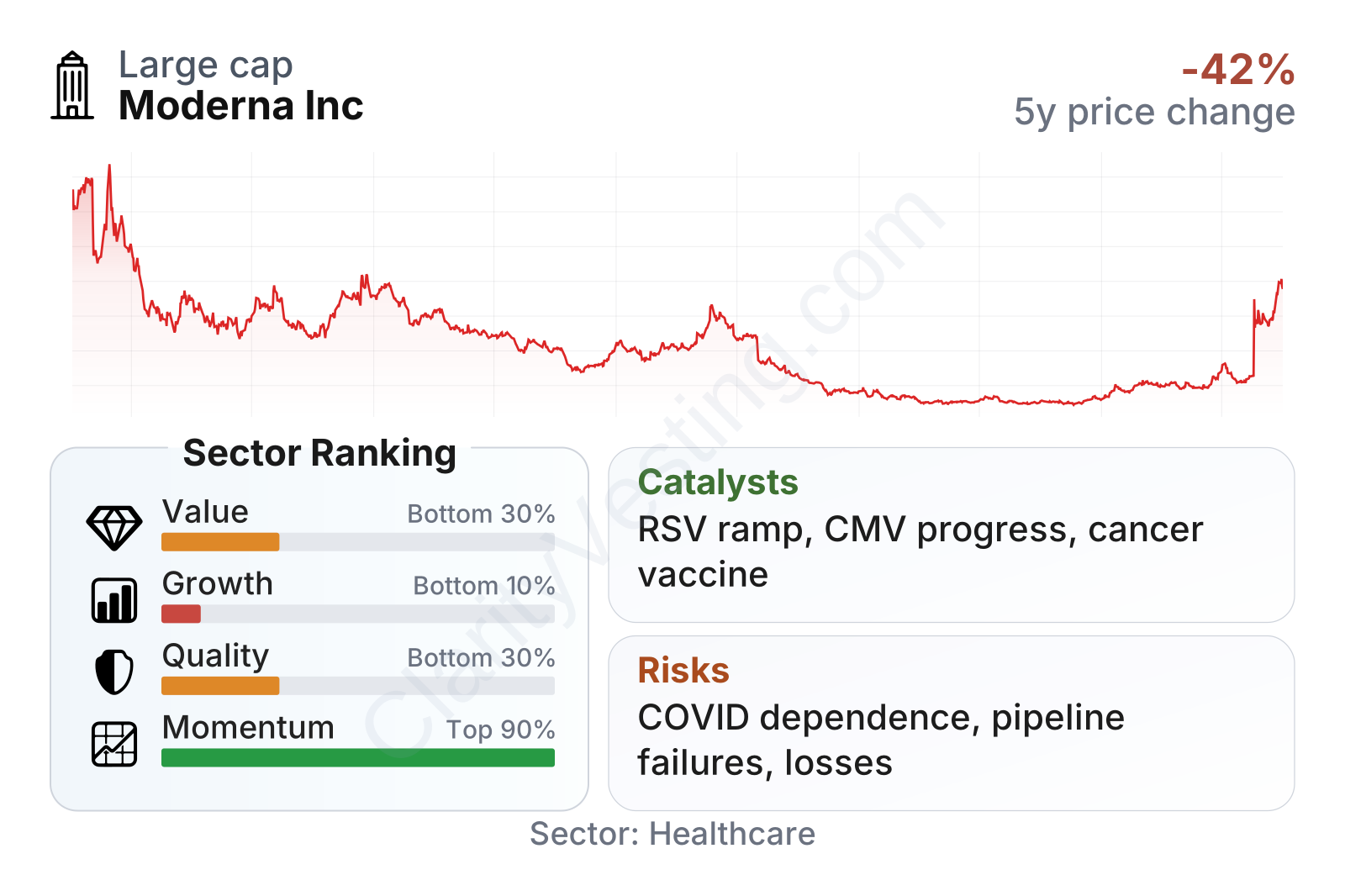
The market currently treats Moderna as a large biotech with unusually strong share-price momentum but weak underlying fundamentals. Relative to much of healthcare, its recent trading performance has been very strong, yet the company ranks poorly on value, growth, and quality measures because profits and free cash flow remain negative. The balance sheet is a more stable point: leverage is lower than the sector median, which gives Moderna more room to fund development than many loss-making biotech peers.
Growth
Moderna operates in a sector with real long-term expansion potential. Vaccines remain an important global market, but the bigger opportunity is the broader use of mRNA technology. If mRNA can be applied across several diseases with a common development and manufacturing backbone, the business can benefit from platform economics: one scientific engine supporting many products. That is the strategic logic behind Moderna’s pipeline.
The company’s current growth case depends less on today’s sales and more on whether it can convert pipeline assets into repeatable commercial products. Respiratory vaccines are the most immediate area. Moderna already has COVID and RSV products on the market, and combination approaches are strategically important because they could simplify vaccination and strengthen pharmacy and provider relationships. Beyond respiratory disease, individualized cancer vaccines and latent-virus programs such as cytomegalovirus are often viewed as major longer-term opportunities because they could open much larger categories than a single seasonal vaccine line.
Recent revenue patterns show how uneven the transition has been. Year-over-year growth was extremely strong during the pandemic, then turned deeply negative as COVID demand normalized. More recently, the comparison has started to stabilize, with one very strong rebound quarter followed by much more modest growth. That suggests Moderna may be moving out of the sharpest contraction phase, but it has not yet established a durable new growth base.
Cash generation tells a similar story. Free cash flow swung from very large positive levels during the COVID boom to clearly negative territory as sales fell and development spending stayed elevated. The improvement from the worst point is encouraging, but the business is still consuming cash rather than producing it. For long-term analysis, the key question is whether upcoming launches and late-stage programs can reverse that trend before the cash cushion erodes too far.
Recent company updates have kept attention on three potential growth catalysts. First, broader commercialization of RSV and next-generation respiratory products could help rebuild seasonal vaccine revenue. Second, the individualized cancer vaccine program with Merck remains one of the most watched assets in the pipeline because success there would validate Moderna beyond infectious disease. Third, progress in late-stage programs such as CMV would diversify the business away from COVID and reduce single-product dependence. Those are meaningful opportunities because each one could reshape how the market values the company’s platform.
Risks
This article is for informational purposes only and does not constitute financial advice. Some content is AI-generated. See Disclaimer


