Stock Analysis · Merck & Company Inc (MRK)
Overview
Merck & Co., Inc. is a large global pharmaceutical company focused on prescription medicines, vaccines, biologic therapies, and animal health products. Its business is centered on discovering, developing, manufacturing, and selling products used in oncology, vaccines, infectious disease, cardiometabolic care, immunology, and veterinary medicine. For long-term analysis, the most important point is that Merck is not a diversified conglomerate: it is mainly a research-driven drug company whose results depend heavily on the success, durability, and replacement of major products.
The company’s revenue base is still dominated by human pharmaceutical products, with a smaller but meaningful contribution from animal health. Based on recent annual reporting, the mix is approximately the following:
- Oncology, led by Keytruda: about 45% to 50% of total company revenue. Keytruda is Merck’s flagship cancer immunotherapy and the single biggest earnings driver.
- Other human pharmaceuticals: about 35% to 40%. This includes vaccines such as Gardasil, hospital acute care products, diabetes medicines, cardiovascular treatments, and newer specialty medicines.
- Animal Health: about 10% to 12%. This segment includes livestock medicines, companion animal products, and vaccine-related veterinary offerings.
That concentration matters. Merck has one of the strongest franchises in oncology, but it also means the company’s long-term profile depends on how well it expands Keytruda, grows newer products, and prepares for future patent expirations.
The company’s financial structure has also shown a notable rebound after the unusually weak 2023 period, when acquisition-related charges and heavy research spending sharply reduced reported profit. Revenue has continued to climb into the mid-single-digit range, while profitability recovered strongly in 2024 and 2025.
The long-term pattern is clear: revenue has trended upward from roughly $49 billion in 2021 to about $65 billion in 2025, while research spending has remained substantial. That confirms Merck is still funding its pipeline aggressively rather than simply harvesting existing products.
Key Figures
| Metric | Value | Sector ⓘ |
|---|---|---|
| Date | Oct 24, 2026 | |
| Context | ||
| Sector | Healthcare | |
| Industry | Drug Manufacturers - General | |
| Market Cap ⓘ | $369.78B | |
| Beta ⓘ | 0.22 | |
Value (Cheapness) | ||
| P/E Ratio ⓘ | 118.95 | 25.42 |
| P/B Ratio ⓘ | 8.69 | 3.08 |
| FCF Yield ⓘ | 4.34% | 3.12% |
| Dividend Yield ⓘ | 2.24% | 1.85% |
| EBIT / EV ⓘ | 2.12% | 0.56% |
| PEG ⓘ | 2.70 | |
Growth (Business expansion) | ||
| Revenue Growth ⓘ | 5.10% | 7.50% |
| RPS Growth (5Y CAGR) ⓘ | 7.78% | 8.60% |
| EPS Growth (5Y CAGR) ⓘ | N/A | -17.73% |
| BVPS Growth (5Y CAGR) ⓘ | 8.70% | 3.72% |
| Margin Growth (5Y Trend) ⓘ | 4.39% | -0.57% |
| FCF Growth (5Y CAGR) ⓘ | 6.35% | 0.96% |
| DPS Growth (5Y CAGR) ⓘ | 5.78% | 6.69% |
Quality (Business durability) | ||
| ROIC (Latest) ⓘ | 6.74% | 3.17% |
| ROA (Latest) ⓘ | 2.45% | 2.98% |
| ROIC (5Y Median) ⓘ | 20.78% | 4.56% |
| ROA (5Y Median) ⓘ | 13.52% | 1.87% |
| Net Debt / EBIT (Latest) ⓘ | 6.53 | 1.34 |
| Net Debt / EBIT (5Y Median) ⓘ | 1.60 | 1.86 |
| Net Debt / EBITDA (Latest) ⓘ | 3.38 | 1.00 |
| Net Debt / Assets ⓘ | 36.25% | 5.06% |
| EBITDA / Interest ⓘ | 7.99 | 9.55 |
| Operating Margin (Latest) ⓘ | 10.86% | 9.25% |
| Operating Margin (5Y Median) ⓘ | 30.15% | 7.33% |
| Debt to Equity (Latest) ⓘ | 128.55% | 26.68% |
| Profit Margin (Latest) ⓘ | 4.77% | 3.34% |
| Free Cash Flow (Latest) ⓘ | $16.06B | |
Momentum (Price trend) | ||
| 3Y Return ⓘ | +56.11% | +51.61% |
| 12M Return (excl. last month) ⓘ | +93.21% | +19.90% |
| 6M Return ⓘ | +32.14% | +10.10% |
| Price vs. 200-Day MA ⓘ | +18.34% | +6.44% |
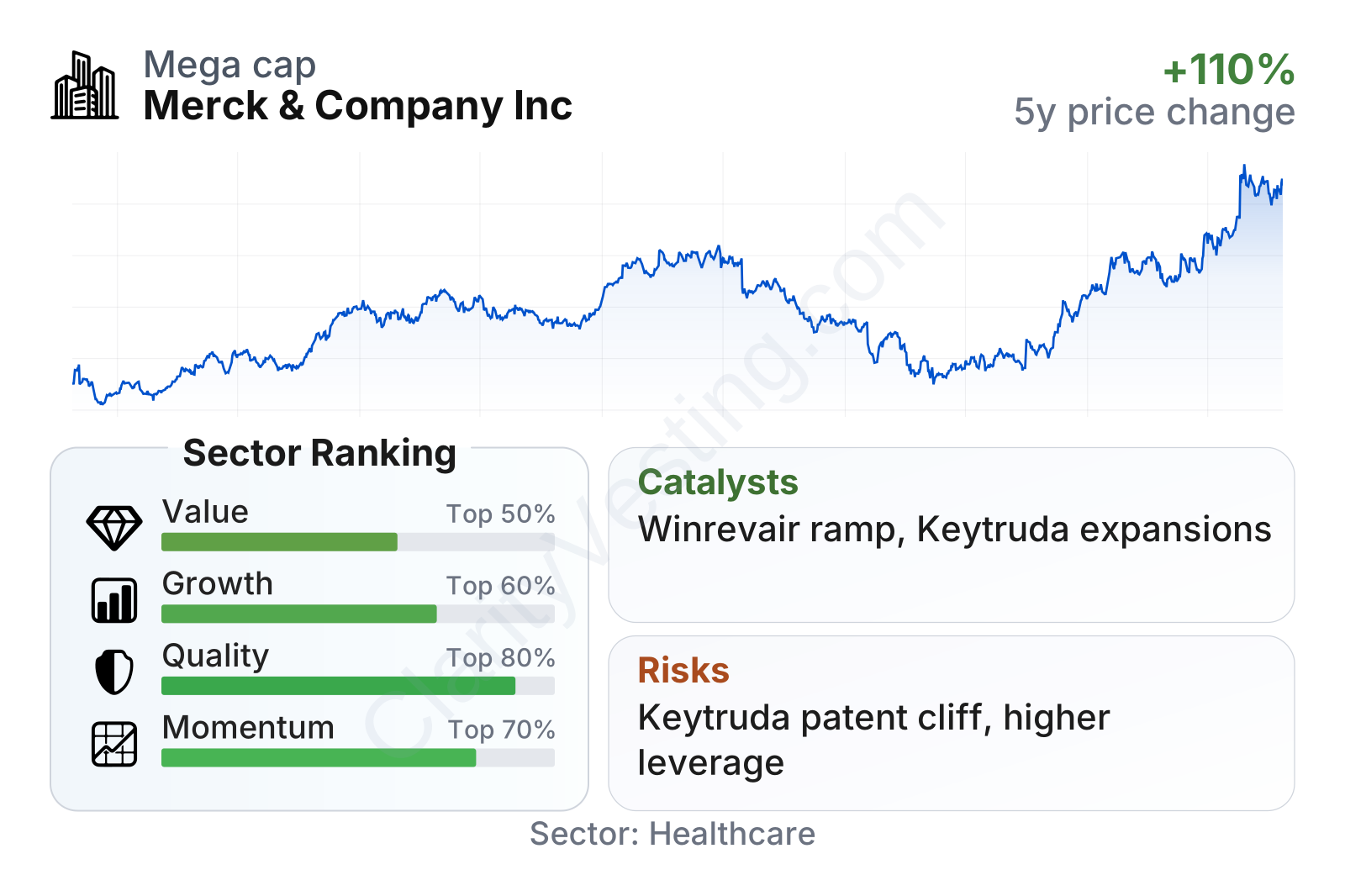
Merck is a very large healthcare company with unusually low share-price volatility for the sector, as reflected by its low beta. The overall factor profile is mixed but understandable: quality remains strong relative to peers, growth is respectable rather than exceptional, and recent price momentum has been much stronger than the sector. The biggest outlier is valuation on earnings and book value, which looks elevated mainly because recent reported earnings have been temporarily compressed relative to the company’s market value.
The stock-price history shows a strong multi-year advance, followed by a pronounced correction in 2025 and a sharp rebound into 2026. That kind of movement is common in large pharmaceutical names when the market reassesses patent risk, pipeline progress, and earnings normalization.
Growth
Merck operates in a sector with durable long-term demand. Global populations are aging, cancer care continues to absorb a growing share of healthcare spending, and vaccines remain strategically important. Those are supportive trends for a company with scale in oncology, immunology, and preventive medicine.
Merck’s strategy for future growth is sensible, but it is also under pressure to deliver. The company is using three main levers: extending the reach of Keytruda into additional cancer settings, expanding important non-Keytruda products such as Gardasil and Winrevair, and using acquisitions and licensing deals to add future products before major patent cliffs arrive. That approach is rational because it combines near-term execution with longer-term pipeline rebuilding.
Recent revenue growth has been steadier than spectacular. After a burst of stronger expansion in 2022, growth settled into a more moderate range, with some temporary softness in parts of 2025 before improving again in 2026. That pattern suggests Merck is still growing, but no longer in the easy phase where a few blockbuster products can drive outsized expansion without resistance.
Cash generation remains one of the company’s stronger characteristics. Free cash flow has stayed in the multi-billion-dollar range even while Merck continued to fund research, acquisitions, and shareholder distributions. Over a five-year period, free cash flow growth has been clearly stronger than the sector median, which supports the view that the business still has considerable economic strength beneath the headline swings in accounting earnings.
A major catalyst is Merck’s effort to reduce future dependence on Keytruda. The company has highlighted pipeline programs in oncology and cardiopulmonary disease, and the acquisition of Harpoon Therapeutics and the earlier purchase of Prometheus Biosciences fit the broader goal of adding new science in immunology and cancer treatment. Another important development has been the continued buildup of Winrevair in pulmonary arterial hypertension, which the company sees as a meaningful long-duration asset. If several newer products scale well at the same time, Merck’s post-Keytruda transition could become far more manageable than the market once feared.
Recent company updates have also pointed to continued progress in late-stage development and label expansion opportunities. In pharmaceuticals, new approved uses can be as important as entirely new drugs because they can expand the treated patient population without repeating the full commercial launch risk.
Risks
This article is for informational purposes only and does not constitute financial advice. Some content is AI-generated. See Disclaimer


