Stock Analysis · MPC Container Ships ASA (MPZZF)
Overview
MPC Container Ships ASA is a container vessel owner focused mainly on the smaller end of the market. Instead of operating a consumer-facing shipping brand, the company buys, owns, manages, and charters out container ships to liner companies and other shipping operators. In simple terms, it earns money by making its vessels available under charter contracts, while customers use those ships to move containers around regional and global trade routes.
This niche matters. Smaller container ships are important for “feeder” services, which connect large hub ports with smaller ports that cannot efficiently handle the biggest vessels. That gives MPC Container Ships exposure to trade flows that are less about headline megaships and more about the supporting network that keeps container logistics moving.
The company’s revenue is overwhelmingly tied to vessel chartering and related shipping activities. Based on its public reporting structure and business model, the main revenue sources can be described as follows:
- Time charter revenue: approximately 95% to 99% — recurring hire paid by customers for the use of MPC’s vessels over a defined contract period. This is the core of the business.
- Other operating revenue: approximately 1% to 5% — mainly ancillary items connected to vessel operations, commercial arrangements, and occasional reimbursements or service-related income.
- Asset sales: irregular, not part of ordinary revenue — vessel disposals can materially affect profit and cash generation in some periods, but they are not a stable revenue line in the same way as charter income.
The business has shown a clear pattern over the last several years: revenue climbed sharply during the strong shipping market of 2022 and 2023, then eased in 2024 and 2025 as charter rates normalized. Even so, operating profitability remained unusually strong for the broader industrial sector, showing that the company has kept a disciplined cost structure while benefiting from contracts signed during favorable market conditions.
The financial flow over recent years shows a company that converted a large share of revenue into operating income and net income during the shipping upcycle. Revenue has come down from its peak, but margins have remained robust, suggesting that charter coverage and operating discipline still provide meaningful earnings support.
Key Figures
| Metric | Value | Sector ⓘ |
|---|---|---|
| Date | Oct 17, 2026 | |
| Context | ||
| Sector | Industrials | |
| Industry | Marine Shipping | |
| Market Cap ⓘ | $1.52B | |
| Beta ⓘ | 0.17 | |
Value (Cheapness) | ||
| P/E Ratio ⓘ | 6.62 | 22.10 |
| P/B Ratio ⓘ | 1.33 | 1.97 |
| FCF Yield ⓘ | 8.18% | 6.38% |
| Dividend Yield ⓘ | 6.02% | 1.94% |
| EBIT / EV ⓘ | 12.90% | 4.79% |
| PEG ⓘ | N/A | |
Growth (Business expansion) | ||
| Revenue Growth ⓘ | -15.20% | 9.30% |
| RPS Growth (5Y CAGR) ⓘ | 4.53% | 7.81% |
| EPS Growth (5Y CAGR) ⓘ | -32.28% | -13.06% |
| BVPS Growth (5Y CAGR) ⓘ | 4.71% | 6.14% |
| Margin Growth (5Y Trend) ⓘ | 4.25% | 0.88% |
| FCF Growth (5Y CAGR) ⓘ | -0.24% | 11.01% |
| DPS Growth (5Y CAGR) ⓘ | -28.81% | 9.48% |
Quality (Business durability) | ||
| ROIC (Latest) ⓘ | 13.43% | 10.84% |
| ROA (Latest) ⓘ | 13.59% | 5.41% |
| ROIC (5Y Median) ⓘ | 28.28% | 9.38% |
| ROA (5Y Median) ⓘ | 24.40% | 4.95% |
| Net Debt / EBIT (Latest) ⓘ | 0.64 | 2.08 |
| Net Debt / EBIT (5Y Median) ⓘ | 0.37 | 2.27 |
| Net Debt / EBITDA (Latest) ⓘ | 0.43 | 1.39 |
| Net Debt / Assets ⓘ | 7.99% | 19.28% |
| EBITDA / Interest ⓘ | 7.78 | 9.58 |
| Operating Margin (Latest) ⓘ | 39.64% | 10.50% |
| Operating Margin (5Y Median) ⓘ | 53.10% | 10.29% |
| Debt to Equity (Latest) ⓘ | 43.67% | 65.48% |
| Profit Margin (Latest) ⓘ | 42.91% | 6.67% |
| Free Cash Flow (Latest) ⓘ | $124.18M | |
Momentum (Price trend) | ||
| 3Y Return ⓘ | +232.23% | +61.68% |
| 12M Return (excl. last month) ⓘ | +69.12% | +12.58% |
| 6M Return ⓘ | +28.69% | 0.00% |
| Price vs. 200-Day MA ⓘ | +27.35% | +0.02% |
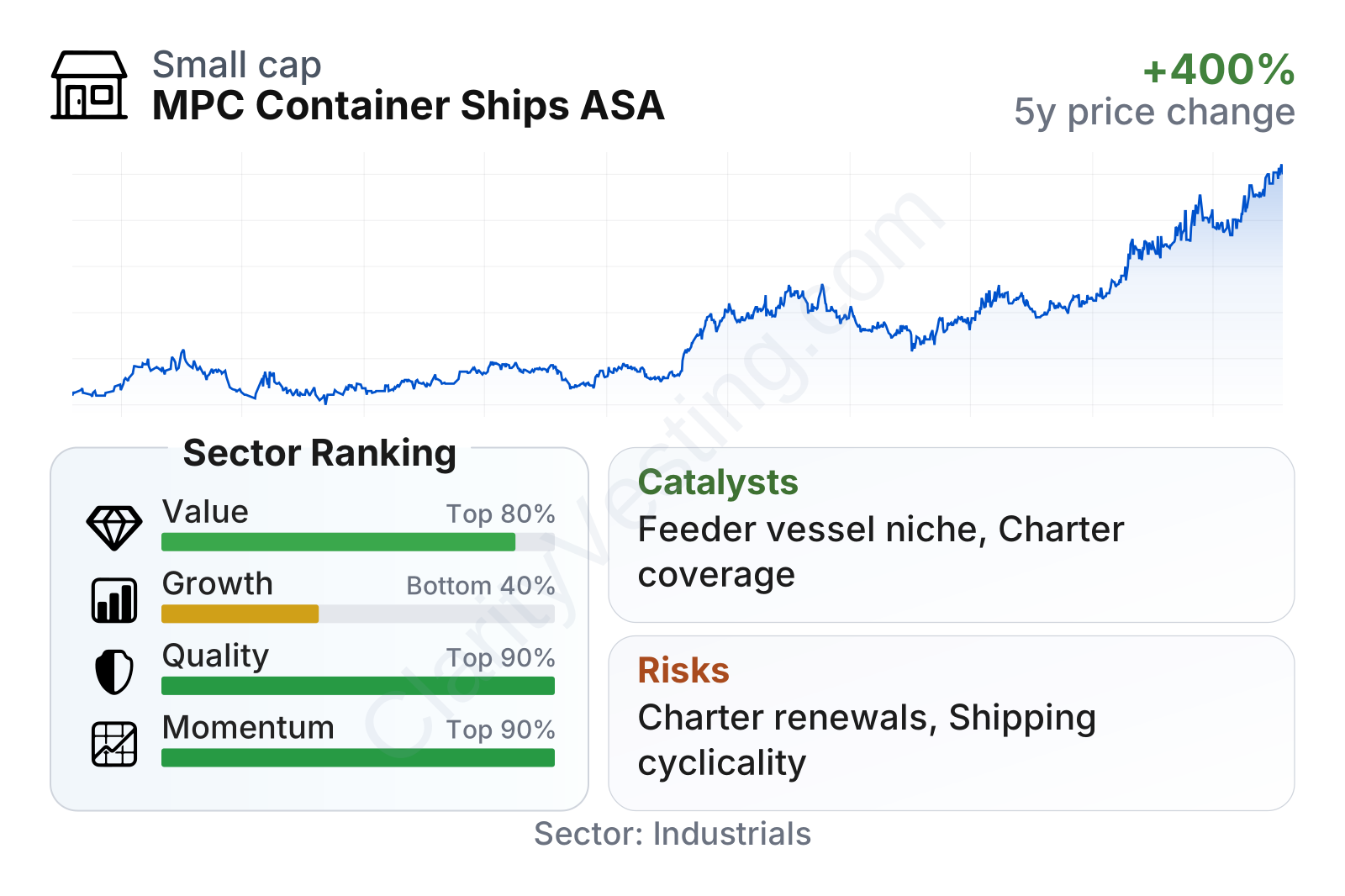
MPC Container Ships is a mid-sized shipping company with unusually strong quality measures for its sector. Profitability, returns on assets, and returns on invested capital are all well above sector medians, while leverage remains below the industry norm. The weaker area is growth: recent revenue and earnings trends have slowed after the exceptional market conditions of earlier years. On valuation metrics, the shares still screen cheaply relative to much of the industrial universe, although that has to be viewed in the context of a cyclical shipping business rather than a steady compounder.
The stock performance has been strong over the last three years, and recent momentum remains well above the sector median. At the same time, the company’s beta is low, which suggests that its trading pattern has been less volatile than many industrial names. That combination is unusual and reflects how strongly the market has responded to the company’s cash generation and balance-sheet profile.
Growth
Container shipping is a cyclical industry, not a smooth long-term growth sector. Demand tends to follow global trade volumes, port congestion, fleet supply, and charter market conditions. For MPC Container Ships, the more relevant question is not whether shipping grows every year, but whether its niche in smaller container vessels remains economically useful. On that point, the answer is broadly yes. Regional trade networks, port limitations, and feeder connectivity continue to support demand for smaller ships even when the market for larger vessels gets more attention.
The company’s strategy is relatively straightforward and makes sense for this part of the market: secure charter coverage, recycle capital through selective vessel sales and purchases, and avoid overstretching the balance sheet. This approach does not eliminate cyclicality, but it can reduce the damage from weaker freight environments. A key benefit is visibility. When a meaningful share of the fleet is fixed on charter, future revenue becomes easier to estimate than spot-exposed shipping businesses.
Recent revenue growth has clearly cooled. After very strong expansion in 2022 and parts of 2023, year-over-year comparisons turned negative through much of 2024 and remained mixed into 2026. That is consistent with a sector moving off unusually high charter rates rather than a broken operating model. The main challenge now is replacing older contracts at rates that still support healthy returns.
Cash generation has also been uneven, which is normal in shipping because vessel purchases, sales, debt movements, and working-capital swings can make free cash flow jump around. What stands out is that free cash flow recovered into positive territory after a weak 2025 reading. That recovery matters because it supports financial flexibility in a business where timing often drives opportunity.
A notable catalyst is the company’s exposure to a constrained part of the fleet market. Smaller container ships have faced years of limited newbuilding activity compared with some larger vessel classes, which can help vessel owners when demand holds up. Another positive factor is the company’s continued ability to post high operating margins well above sector averages, indicating that charter portfolio management has remained effective even after the industry peak.
Recent company communications have also emphasized fleet optimization and disciplined capital allocation. For long-term analysis, that is more important than short-lived freight spikes. In shipping, preserving balance-sheet strength and contract coverage often matters more than chasing volume growth.
Risks
This article is for informational purposes only and does not constitute financial advice. Some content is AI-generated. See Disclaimer


