Stock Analysis · Medical Properties Trust Inc (MPT)
Overview
Medical Properties Trust Inc. is a real estate investment trust, or REIT, focused on healthcare facilities. In simple terms, it buys hospital properties and other clinical facilities, then leases them to operators that run the medical businesses inside those buildings. The company does not usually provide healthcare itself; its role is mainly as a landlord and capital provider to hospital systems.
Its portfolio is centered on general acute care hospitals, with additional exposure to behavioral health facilities, inpatient rehabilitation hospitals, long-term acute care hospitals, and some other specialty healthcare real estate. MPT has historically emphasized large hospital properties because they are difficult to replace, highly regulated, and important to local communities.
The main source of revenue is rental and related income from leased healthcare properties. Based on the company’s business model and reporting structure, revenue is primarily made up of the following items:
- Rental revenue from hospital real estate: the largest source, representing the clear majority of revenue. This comes from long-term lease payments made by hospital operators that use MPT-owned properties.
- Interest and other income from financing arrangements: an additional source generated when MPT provides mortgage loans or other financing to tenants and healthcare operators.
- Straight-line rent, lease-related fees, and other real estate income: a smaller contribution tied to accounting adjustments, reimbursements, and property-related arrangements.
- Gains or proceeds tied to asset sales and restructuring activities: these can affect results in some years, but they are not the core recurring source of cash generation.
MPT’s recent financial profile shows a business still producing strong property-level margins, but with a much smaller revenue base than a few years ago. Annual revenue was around $1.5 billion in 2021 and 2022, then dropped to roughly $0.9 billion to $1.0 billion in 2023 through 2025. That change reflects tenant issues, asset sales, and portfolio repositioning rather than normal organic expansion.
The broad pattern over the last several years is that rent collection and operating profitability at the property level have remained structurally strong for a REIT, but interest expense has absorbed a much larger share of earnings and pushed net results into losses in several periods. That is central to understanding the company today: the real estate still generates substantial gross profit, yet balance-sheet pressure has become a defining issue.
The long-term picture here is not one of steady expansion. It is more a restructuring phase in which MPT is trying to stabilize its tenant base, recycle capital, and improve leverage after a period of major stress.
Key Figures
| Metric | Value | Sector ⓘ |
|---|---|---|
| Date | Oct 17, 2026 | |
| Context | ||
| Sector | Real Estate | |
| Industry | REIT - Healthcare Facilities | |
| Market Cap ⓘ | $1.83B | |
| Beta ⓘ | 1.49 | |
Value (Cheapness) | ||
| P/E Ratio ⓘ | N/A | 17.38 |
| P/B Ratio ⓘ | 0.41 | 0.85 |
| FCF Yield ⓘ | 12.41% | 7.38% |
| Dividend Yield ⓘ | 11.18% | 4.85% |
| EBIT / EV ⓘ | 6.11% | 3.78% |
| PEG ⓘ | 1.61 | |
Growth (Business expansion) | ||
| Revenue Growth ⓘ | 1.90% | 5.30% |
| RPS Growth (5Y CAGR) ⓘ | -11.34% | 6.02% |
| EPS Growth (5Y CAGR) ⓘ | -22.18% | -11.37% |
| BVPS Growth (5Y CAGR) ⓘ | -14.43% | 0.45% |
| Margin Growth (5Y Trend) ⓘ | -44.80% | -0.22% |
| FCF Growth (5Y CAGR) ⓘ | -25.43% | 5.40% |
| DPS Growth (5Y CAGR) ⓘ | -26.30% | 5.02% |
Quality (Business durability) | ||
| ROIC (Latest) ⓘ | 111.01% | 5.69% |
| ROE (Latest) ⓘ | -0.67% | 7.56% |
| ROA (Latest) ⓘ | -0.20% | 2.85% |
| ROIC (5Y Median) ⓘ | N/A | 4.22% |
| ROE (5Y Median) ⓘ | -5.89% | 6.03% |
| ROA (5Y Median) ⓘ | -1.89% | 2.44% |
| Net Debt / EBIT (Latest) ⓘ | 12.10 | 7.59 |
| Net Debt / EBIT (5Y Median) ⓘ | 9.69 | 8.40 |
| Net Debt / EBITDA (Latest) ⓘ | 8.85 | 5.27 |
| Net Debt / Assets ⓘ | 63.12% | 37.76% |
| EBITDA / Interest ⓘ | 1.63 | 4.10 |
| Operating Margin (Latest) ⓘ | 75.49% | 35.29% |
| Operating Margin (5Y Median) ⓘ | 28.09% | 37.31% |
| Debt to Equity (Latest) ⓘ | 215.72% | 88.87% |
| Profit Margin (Latest) ⓘ | -2.73% | 19.61% |
| Free Cash Flow (Latest) ⓘ | $226.82M | |
Momentum (Price trend) | ||
| 3Y Return ⓘ | -19.89% | +30.75% |
| 12M Return (excl. last month) ⓘ | -21.14% | +4.36% |
| 6M Return ⓘ | -35.10% | -2.52% |
| Price vs. 200-Day MA ⓘ | -31.24% | -2.34% |
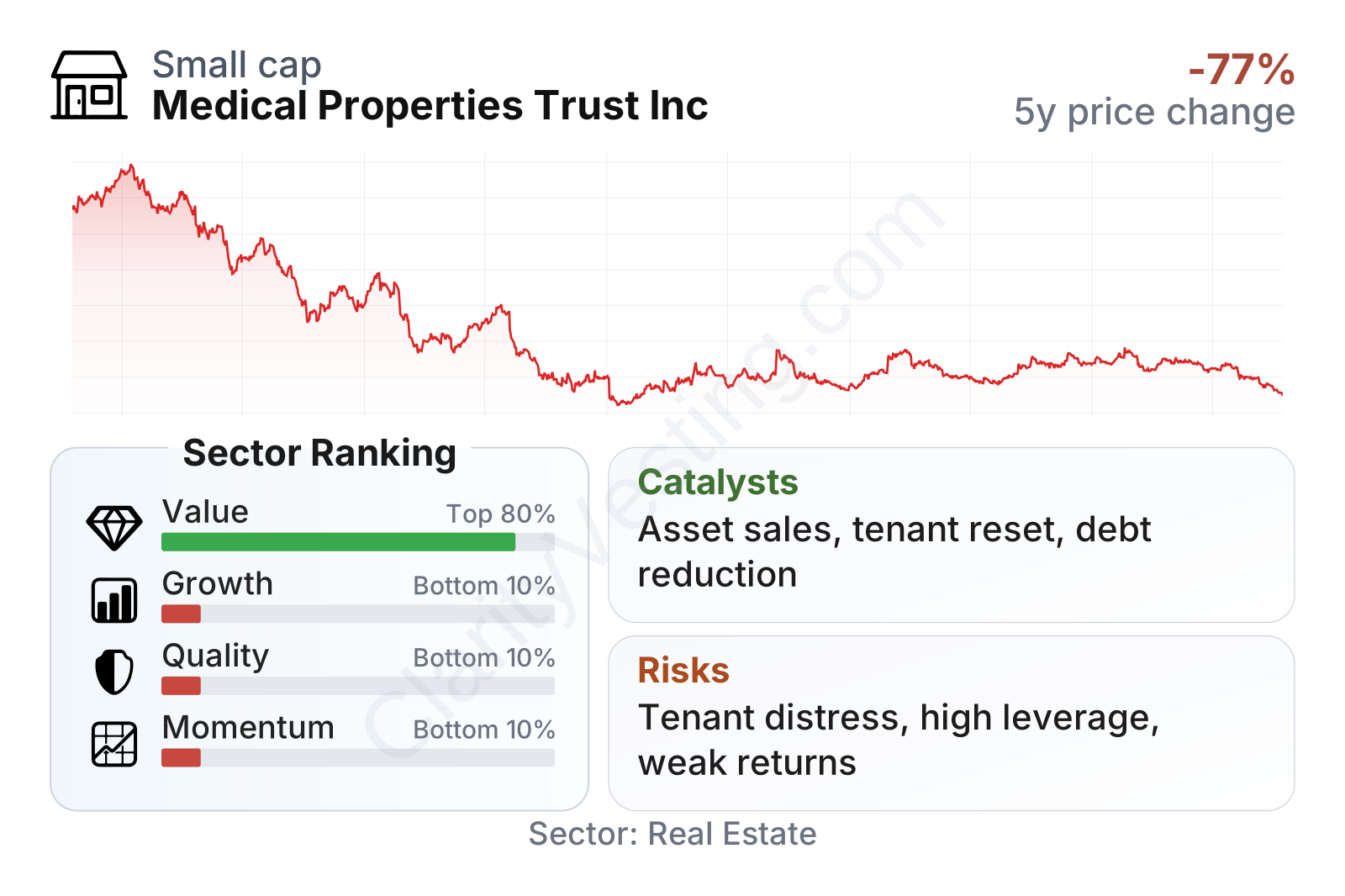
MPT is a mid-sized REIT with above-average share-price volatility. The overall snapshot is unusual: value metrics look optically cheap relative to much of the real estate sector, but growth, balance-sheet quality, and market momentum remain weak. Free cash flow yield and dividend yield stand out on paper, while leverage, returns on assets, and recent price performance continue to rank poorly against sector norms.
The stock-price history highlights how sharply market confidence has fallen since late 2021. Even after some rebound periods, the shares remain far below earlier levels, reflecting concerns about tenant health, asset write-downs, and refinancing risk rather than a normal cyclical decline.
Growth
Healthcare real estate is generally supported by durable long-term demand. Aging populations, ongoing hospital utilization, and the need for modern medical infrastructure all support the sector over time. That gives MPT exposure to a market with structural relevance, especially because hospitals are mission-critical assets that cannot be easily relocated or replaced.
That said, the company’s recent results do not show growth in the usual sense. Revenue per share has fallen materially from 2021 levels and has only partially stabilized more recently, which suggests the business is still working through a reset rather than returning to sustained expansion.
MPT’s strategy for future progress is based less on acquiring many new properties and more on rebuilding the existing platform. The key moving parts are tenant normalization, selective asset sales, debt reduction, and redeployment of capital into more secure lease structures. If management can improve rent coverage among operators and lower financing pressure, the business could eventually return to more stable earnings.
The dividend trend also shows how much the company has shifted from an expansion mindset to capital preservation. Dividend per share has been reduced sharply over the last few years, which lowers cash outflows and gives management more room to manage debt and restructuring needs.
The most important potential catalysts are tied to execution rather than industry growth alone. A healthier tenant roster, successful property sales at acceptable values, improved refinancing terms, and better visibility on rent collections could all materially change how the market views MPT. In that sense, the opportunity is not mainly about entering a brand-new fast-growing niche; it is about whether the company can convert essential hospital real estate into more dependable cash flow again.
Recent company updates have continued to focus on portfolio simplification, liquidity management, and tenant transitions. For long-term analysis, those developments matter more than short-term headline revenue changes because they shape whether future earnings become more durable.
Risks
This article is for informational purposes only and does not constitute financial advice. Some content is AI-generated. See Disclaimer


