Stock Analysis · MPLX LP (MPLX)
Overview
MPLX LP is a large U.S. midstream energy partnership. In simple terms, it owns the infrastructure that helps move, store, process, and export energy products. That includes crude oil and refined-product pipelines, natural gas and natural gas liquids systems, storage terminals, fractionation assets, and processing plants. Its network is closely tied to Marathon Petroleum, which remains a key commercial partner, but MPLX also serves a broader group of producers, refiners, and end users.
The business is organized around two main segments. The largest is Logistics and Storage, which includes pipelines and terminals serving crude oil and refined products. The second is Gathering and Processing, which includes natural gas gathering systems, processing plants, and natural gas liquids infrastructure. Midstream businesses like MPLX are usually less exposed to daily oil and gas price swings than producers because a large share of earnings comes from fees tied to volumes, contracts, and long-lived infrastructure.
Based on recent company reporting, MPLX’s revenue mix is roughly concentrated as follows:
- Logistics and Storage: about 60% to 65% of total revenue. This segment includes transportation, storage, distribution, and terminal services for crude oil, refined products, feedstocks, and other hydrocarbons.
- Gathering and Processing: about 35% to 40% of total revenue. This includes natural gas gathering, processing, fractionation, and related natural gas liquids services, mainly in major producing basins.
That revenue breakdown does not fully capture earnings quality. MPLX’s cash generation is heavily supported by fee-based contracts, and its assets are positioned in large, established U.S. energy corridors. Over the last several years, revenue has trended upward, while operating income and net income have expanded even faster, suggesting good cost control and favorable asset utilization.
The long-term pattern is encouraging: total revenue has risen from roughly $9.6 billion in 2021 to about $11.8 billion in 2025, while net income increased from a little above $3.0 billion to nearly $4.9 billion. Profitability improved faster than sales, which is notable for an infrastructure-heavy business.
Key Figures
| Metric | Value | Sector ⓘ |
|---|---|---|
| Date | Oct 17, 2026 | |
| Context | ||
| Sector | Energy | |
| Industry | Oil & Gas Midstream | |
| Market Cap ⓘ | $57.70B | |
| Beta ⓘ | 0.48 | |
Value (Cheapness) | ||
| P/E Ratio ⓘ | 12.24 | 15.44 |
| P/B Ratio ⓘ | 4.23 | 1.73 |
| FCF Yield ⓘ | 7.68% | 8.20% |
| Dividend Yield ⓘ | 7.58% | 3.59% |
| EBIT / EV ⓘ | 6.98% | 7.46% |
| PEG ⓘ | 3.09 | |
Growth (Business expansion) | ||
| Revenue Growth ⓘ | 10.60% | 26.90% |
| RPS Growth (5Y CAGR) ⓘ | 5.61% | 6.90% |
| EPS Growth (5Y CAGR) ⓘ | -12.76% | -15.73% |
| BVPS Growth (5Y CAGR) ⓘ | 2.65% | 6.07% |
| Margin Growth (5Y Trend) ⓘ | 9.50% | 0.58% |
| FCF Growth (5Y CAGR) ⓘ | -1.64% | 1.86% |
| DPS Growth (5Y CAGR) ⓘ | 3.22% | 16.79% |
Quality (Business durability) | ||
| ROIC (Latest) ⓘ | 14.82% | 11.40% |
| ROA (Latest) ⓘ | 10.99% | 6.06% |
| ROIC (5Y Median) ⓘ | 15.89% | 10.30% |
| ROA (5Y Median) ⓘ | 11.08% | 5.42% |
| Net Debt / EBIT (Latest) ⓘ | 4.21 | 1.64 |
| Net Debt / EBIT (5Y Median) ⓘ | 4.08 | 1.83 |
| Net Debt / EBITDA (Latest) ⓘ | 3.39 | 1.08 |
| Net Debt / Assets ⓘ | 57.86% | 17.29% |
| EBITDA / Interest ⓘ | 6.46 | 9.64 |
| Operating Margin (Latest) ⓘ | 45.85% | 16.27% |
| Operating Margin (5Y Median) ⓘ | 46.71% | 20.39% |
| Debt to Equity (Latest) ⓘ | 184.61% | 54.76% |
| Profit Margin (Latest) ⓘ | 39.28% | 8.82% |
| Free Cash Flow (Latest) ⓘ | $4.43B | |
Momentum (Price trend) | ||
| 3Y Return ⓘ | +102.67% | +67.38% |
| 12M Return (excl. last month) ⓘ | +24.62% | +49.19% |
| 6M Return ⓘ | +8.42% | +7.07% |
| Price vs. 200-Day MA ⓘ | +3.45% | +9.56% |
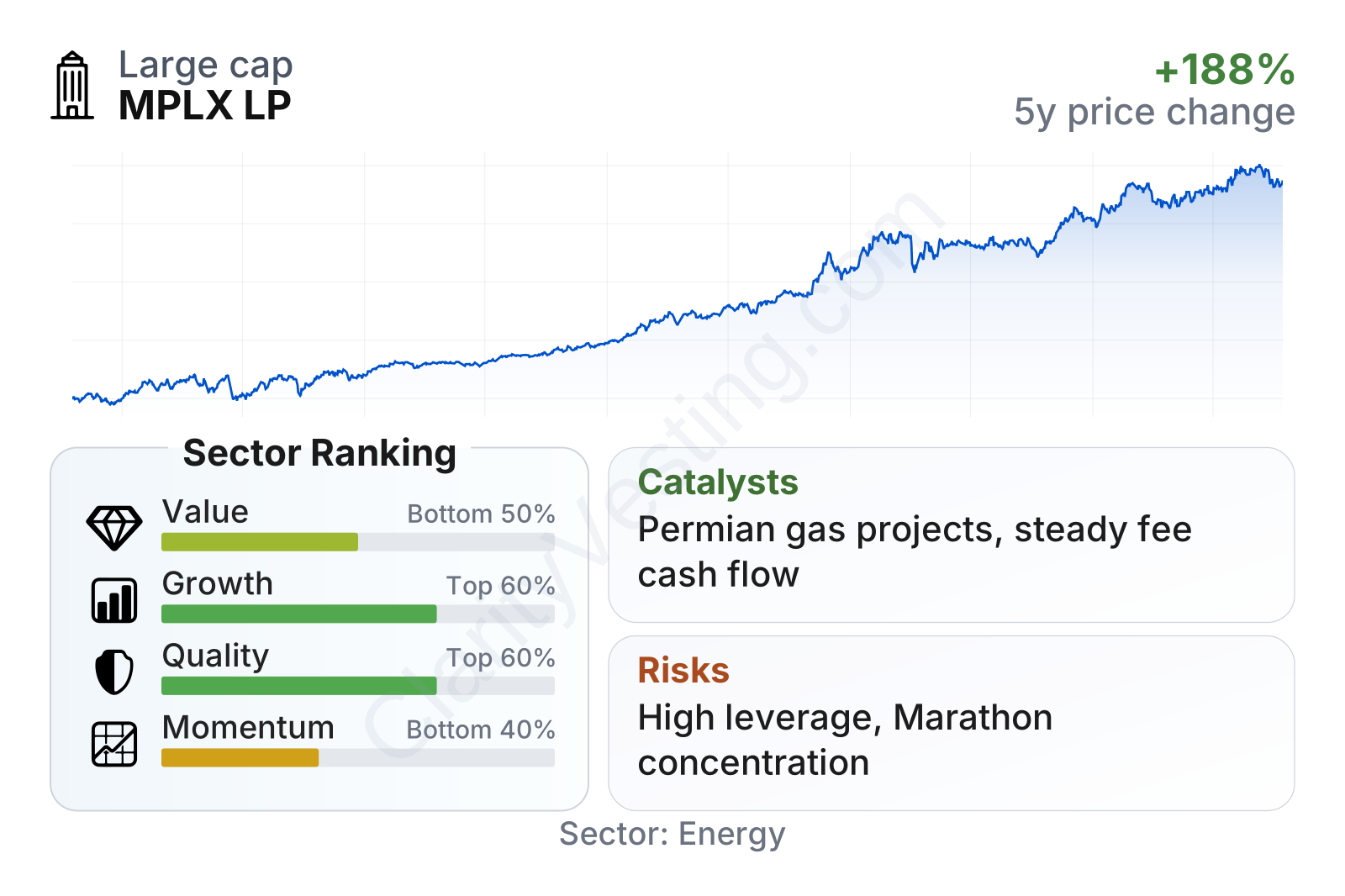
MPLX is a very large midstream operator with a market value in the tens of billions of dollars and a low beta, which points to lower share-price volatility than many energy stocks. On the factor breakdown, quality and growth rank around the upper-middle of the sector, while value and momentum are less compelling. The mix behind that is important: profitability and returns on capital are strong, but leverage is clearly higher than the sector median, and the recent valuation is not especially discounted relative to the underlying growth pace.
The stock’s longer-term performance has been strong, with the share price rising substantially over the past five years. At the same time, the dividend yield has compressed from much higher levels in earlier periods to around 7% to 9% recently, mostly because the stock price has advanced. That usually signals that the market is assigning a higher quality premium to the business than it did a few years ago.
Growth
MPLX operates in a sector that still has room for durable growth, even though it is not usually seen as a classic high-growth industry. U.S. oil and gas production remains large, natural gas demand is supported by power generation and industrial use, and export infrastructure for liquefied natural gas and natural gas liquids continues to expand. For a midstream company, that matters because more production and more exports can mean more volumes moving through pipelines, plants, terminals, and fractionators.
MPLX’s strategy is logical for this environment. The partnership continues to invest in natural gas and natural gas liquids infrastructure, especially in major producing regions such as the Permian, Marcellus, and Utica. These are some of the most economically resilient basins in North America, which supports the case for steady throughput over time. The company’s relationship with Marathon Petroleum also adds an important layer of demand stability for parts of its logistics network.
Revenue growth has not been smooth every quarter, which is normal for this type of business, but the overall direction has remained positive. Recent year-over-year growth moved back into a healthier range after some softer periods, and the broader trend in annual revenue has been upward.
Free cash flow is one of the clearest positives. Over the last several years, MPLX has consistently produced roughly $4.3 billion to $5.0 billion in trailing free cash flow. That kind of stability matters because it supports distributions, debt service, and project spending without relying heavily on outside financing. It also suggests that the company’s assets are mature, productive, and capable of generating cash through different market conditions.
Recent company updates have also pointed to continued project development across processing, fractionation, and pipeline infrastructure. In practical terms, these projects can create growth through higher volumes and incremental fee income rather than requiring a dramatic shift in commodity prices. For a long-term view, that is a more durable growth model than one that depends primarily on favorable market swings.
Risks
This article is for informational purposes only and does not constitute financial advice. Some content is AI-generated. See Disclaimer


