Stock Analysis · Morningstar Inc (MORN)
Overview
Morningstar is a financial information and analytics company best known for its investment research, fund ratings, portfolio tools, and data platforms used across the asset management and wealth industries. In simple terms, it helps advisors, asset managers, retirement-plan providers, institutions, and individual investors analyze investments, build portfolios, manage risk, and report results. Over time, the company has expanded beyond research into software, indexes, private-market intelligence, credit ratings, and outsourced investment services.
The business is diversified across several operating lines. Based on the company’s recent annual reporting structure, revenue is mainly generated from recurring subscriptions, licenses, managed services, and transaction-related fees across these areas:
- PitchBook: approximately 20% to 25% of revenue. This unit provides private-market data, research, and workflows covering venture capital, private equity, M&A, and leveraged finance.
- Morningstar Data and Analytics: approximately 20% to 25%. This includes investment data, research, screening tools, and analytics sold to financial institutions and professionals.
- Morningstar Wealth: approximately 15% to 20%. This segment includes advisor software, investment planning tools, model portfolios, and wealth-management solutions.
- Morningstar Credit: approximately 10% to 15%. This business includes credit ratings and related analytics, mainly through DBRS Morningstar.
- Morningstar Sustainalytics: approximately 10% to 15%. It provides ESG, stewardship, and sustainability-related research and risk tools.
- Morningstar Indexes: approximately 5% to 10%. This unit licenses indexes used in investment products and benchmarks.
- Morningstar Retirement: approximately 5% to 10%. It serves retirement-plan providers, recordkeepers, and plan sponsors with managed accounts and related services.
That mix matters because Morningstar is no longer dependent on one flagship product. It now earns money from several parts of the investment ecosystem, with a large share tied to recurring contracts rather than one-time sales. The broader financial flow in recent years also shows a favorable pattern: revenue has kept rising, gross profit has expanded faster than direct costs, and operating income improved sharply after a weaker period in 2022 and 2023.
The business model has become more scalable as revenue has grown from roughly $1.7 billion in 2021 to about $2.4 billion in 2025, while operating income more than doubled over that span. That suggests Morningstar has been improving efficiency as its platforms mature.
Key Figures
| Metric | Value | Sector ⓘ |
|---|---|---|
| Date | Nov 02, 2026 | |
| Context | ||
| Sector | Financial Services | |
| Industry | Financial Data & Stock Exchanges | |
| Market Cap ⓘ | $8.39B | |
| Beta ⓘ | 1.02 | |
Value (Cheapness) | ||
| P/E Ratio ⓘ | 19.84 | 12.21 |
| P/B Ratio ⓘ | 8.34 | 1.26 |
| FCF Yield ⓘ | 5.87% | 9.99% |
| Dividend Yield ⓘ | 0.90% | 2.87% |
| EBIT / EV ⓘ | 6.71% | 8.24% |
| PEG ⓘ | 2.31 | |
Growth (Business expansion) | ||
| Revenue Growth ⓘ | 8.90% | 8.20% |
| RPS Growth (5Y CAGR) ⓘ | 10.30% | 12.31% |
| EPS Growth (5Y CAGR) ⓘ | 27.47% | -3.82% |
| BVPS Growth (5Y CAGR) ⓘ | -2.94% | 4.96% |
| Margin Growth (5Y Trend) ⓘ | 6.79% | -4.14% |
| FCF Growth (5Y CAGR) ⓘ | 6.19% | 4.70% |
| DPS Growth (5Y CAGR) ⓘ | 9.91% | 8.85% |
Quality (Business durability) | ||
| ROIC (Latest) ⓘ | 18.75% | 9.35% |
| ROE (Latest) ⓘ | 39.64% | 14.02% |
| ROA (Latest) ⓘ | 11.81% | 1.57% |
| ROIC (5Y Median) ⓘ | 11.20% | 7.78% |
| ROE (5Y Median) ⓘ | 13.98% | 12.12% |
| ROA (5Y Median) ⓘ | 6.95% | 1.28% |
| Net Debt / EBIT (Latest) ⓘ | 2.08 | 0.99 |
| Net Debt / EBIT (5Y Median) ⓘ | 1.73 | 0.73 |
| Net Debt / EBITDA (Latest) ⓘ | 1.59 | 0.77 |
| Operating Margin (Latest) ⓘ | 24.96% | 22.64% |
| Operating Margin (5Y Median) ⓘ | 15.25% | 24.52% |
| Debt to Equity (Latest) ⓘ | 181.30% | 58.67% |
| Profit Margin (Latest) ⓘ | 17.00% | 26.18% |
| Free Cash Flow (Latest) ⓘ | $492.80M | |
Momentum (Price trend) | ||
| 3Y Return ⓘ | -8.62% | +95.38% |
| 12M Return (excl. last month) ⓘ | -17.24% | +16.18% |
| 6M Return ⓘ | +34.83% | +7.10% |
| Price vs. 200-Day MA ⓘ | +22.39% | +5.51% |
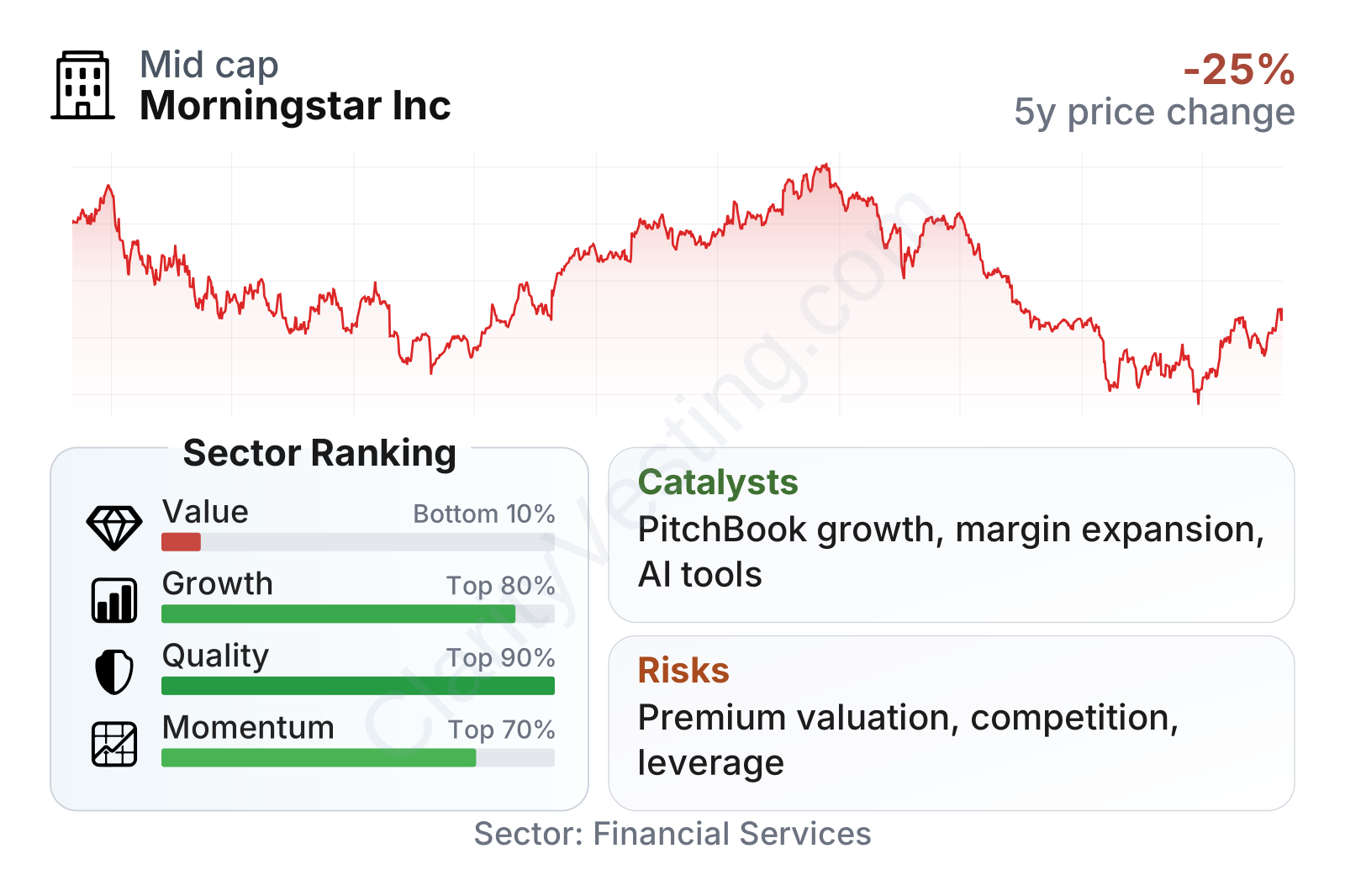
Morningstar sits in an interesting position on the scoreboard. Quality metrics are notably strong relative to the broader financial-services group, with returns on capital, equity, and assets well above sector medians. Growth indicators are also solid, especially earnings, free cash flow, and margin improvement over the last five years. The weaker area is valuation: the shares trade at noticeably higher earnings and book multiples than typical sector levels, while the cash flow yield and dividend yield are lower than average. Price performance has also been mixed over longer periods, even though the recent rebound has been strong.
The stock-price history reflects that uneven path. After trading near $300 in late 2021, the shares fell sharply into early 2026 before recovering meaningfully in recent months. That pattern suggests the market has been reassessing both the company’s growth profile and the price it is willing to pay for it.
Growth
Morningstar operates in a part of financial services that still has attractive long-term demand drivers. Asset managers, advisors, retirement platforms, banks, and institutional investors all need more data, better workflow software, stronger risk controls, and broader coverage across both public and private markets. Those needs tend to increase as regulation grows, portfolios become more complex, and investment choices multiply. This supports a business model built on research subscriptions, licensed data, embedded software, and recurring service relationships.
The company’s strategy also has a clear logic. It has spent years building a connected product set rather than a single-point solution. A client might use Morningstar data, then analytics, then advisor tools, then model portfolios, or adopt private-market intelligence through PitchBook. That cross-selling potential is important because it can raise client retention and increase revenue per customer without relying only on new client wins.
One of the strongest growth assets inside the group is PitchBook. Private markets remain a large and structurally important area for investment firms, lenders, and corporate deal teams. Even if deal activity moves in cycles, demand for data, market maps, valuation references, and sourcing tools can remain durable because firms need intelligence throughout the cycle, not just when markets are booming.
Recent earnings progression also supports the case that Morningstar’s operating model is strengthening. Earnings per share dipped in 2022 and stayed soft in 2023, but then accelerated sharply in 2024 and 2025, with trailing results in 2026 remaining strong. That matters because it suggests the company is not only growing sales but also converting more of those sales into profit.
The picture is more mixed on book value per share. It improved through 2024 but fell back in 2025, and the five-year trend is slightly negative. For a company like Morningstar, book value is less informative than for a bank or insurer because much of its worth comes from intangible assets, software, data platforms, and customer relationships. Even so, the weaker book-value trend is a reminder that growth has been driven more by earnings power than by steady balance-sheet compounding.
As for catalysts, several stand out. The continued expansion of private-market data products, wider use of advisor technology, growth in retirement solutions, and monetization of indexes and credit analytics all support future revenue opportunities. Morningstar has also been benefiting from stronger margins, which means even moderate revenue growth can have an outsized effect on earnings. In addition, a more favorable market backdrop for fund flows, issuance, and institutional activity could lift demand across several of its business lines at once.
Recent company communications have also pointed to ongoing product development around artificial intelligence and workflow efficiency. For a data-rich business, AI can improve search, research assistance, data extraction, and client productivity. That is not automatically a near-term revenue surge, but it can reinforce the value of Morningstar’s platforms if execution is strong.
Risks
This article is for informational purposes only and does not constitute financial advice. Some content is AI-generated. See Disclaimer