Stock Analysis · Molina Healthcare Inc (MOH)
Overview
Molina Healthcare is a managed care company focused mainly on people who receive health coverage through government-sponsored programs. In simple terms, it works with state governments and other public programs to organize and pay for medical care for members, while trying to manage costs and quality. Its core markets are Medicaid and Medicare, and it also serves members through the Health Insurance Marketplace created under the Affordable Care Act.
This is an important distinction for long-term analysis: Molina is not a broad healthcare conglomerate. It is a specialized health insurer whose performance depends heavily on public healthcare programs, state contracts, member growth, and its ability to price medical costs correctly.
Based on recent company reporting, revenue comes overwhelmingly from premium revenue paid for health plan members. A much smaller portion comes from pharmacy services and other operating revenue. Within premiums, the business mix is concentrated in government-backed coverage categories, with Medicaid clearly the largest contributor.
- Medicaid premium revenue: approximately 75% to 80% of total revenue. This includes managed care plans for low-income individuals and families, seniors, and people with disabilities under state Medicaid contracts.
- Medicare premium revenue: approximately 10% to 15% of total revenue. This mainly includes Medicare Advantage plans and related products for eligible seniors and other beneficiaries.
- Marketplace premium revenue: approximately 10% to 15% of total revenue. This covers Affordable Care Act exchange plans for individuals and families who buy coverage directly, often with government subsidies.
- Other revenue, including pharmacy and miscellaneous items: typically below 5% of total revenue.
Molina has expanded over time by entering new states, winning contracts, and acquiring health plans. That has allowed it to grow into a sizable national player, though it remains smaller than the largest diversified managed care companies. Financially, one notable pattern is that revenue has risen strongly over the last several years, but profitability became much thinner more recently as medical costs and operating pressure increased.
The multi-year business flow shows a company that significantly increased revenue from 2021 through 2025, but it also shows that a much larger share of that revenue was absorbed by medical and operating costs in the latest period. That matters because Molina’s business can look healthy on top-line growth while still facing pressure on earnings if claims costs rise faster than premiums.
Key Figures
| Metric | Value | Sector ⓘ |
|---|---|---|
| Date | Oct 17, 2026 | |
| Context | ||
| Sector | Healthcare | |
| Industry | Healthcare Plans | |
| Market Cap ⓘ | $10.92B | |
| Beta ⓘ | 0.78 | |
Value (Cheapness) | ||
| P/E Ratio ⓘ | N/A | 24.79 |
| P/B Ratio ⓘ | 2.61 | 3.08 |
| FCF Yield ⓘ | 2.48% | 3.15% |
| Dividend Yield ⓘ | N/A | 1.94% |
| EBIT / EV ⓘ | 4.05% | 0.57% |
| PEG ⓘ | 0.89 | |
Growth (Business expansion) | ||
| Revenue Growth ⓘ | -5.70% | 7.45% |
| RPS Growth (5Y CAGR) ⓘ | 17.21% | 8.61% |
| EPS Growth (5Y CAGR) ⓘ | -33.60% | -17.81% |
| BVPS Growth (5Y CAGR) ⓘ | 15.59% | 3.72% |
| Margin Growth (5Y Trend) ⓘ | -1.86% | -0.62% |
| FCF Growth (5Y CAGR) ⓘ | N/A | 1.04% |
| DPS Growth (5Y CAGR) ⓘ | N/A | 6.77% |
Quality (Business durability) | ||
| ROIC (Latest) ⓘ | 1.68% | 3.24% |
| ROA (Latest) ⓘ | -0.04% | 3.01% |
| ROIC (5Y Median) ⓘ | 17.58% | 4.60% |
| ROA (5Y Median) ⓘ | 6.46% | 1.89% |
| Net Debt / EBIT (Latest) ⓘ | -5.08 | 1.34 |
| Net Debt / EBIT (5Y Median) ⓘ | -1.38 | 1.84 |
| Net Debt / EBITDA (Latest) ⓘ | -2.78 | 1.00 |
| Net Debt / Assets ⓘ | -6.45% | 5.45% |
| EBITDA / Interest ⓘ | 1.78 | 9.64 |
| Operating Margin (Latest) ⓘ | 0.46% | 9.27% |
| Operating Margin (5Y Median) ⓘ | 3.67% | 7.38% |
| Debt to Equity (Latest) ⓘ | 94.77% | 28.58% |
| Profit Margin (Latest) ⓘ | -0.02% | 3.59% |
| Free Cash Flow (Latest) ⓘ | $271.00M | |
Momentum (Price trend) | ||
| 3Y Return ⓘ | -40.26% | +42.80% |
| 12M Return (excl. last month) ⓘ | +17.53% | +18.50% |
| 6M Return ⓘ | +44.75% | +7.57% |
| Price vs. 200-Day MA ⓘ | +15.87% | +5.12% |
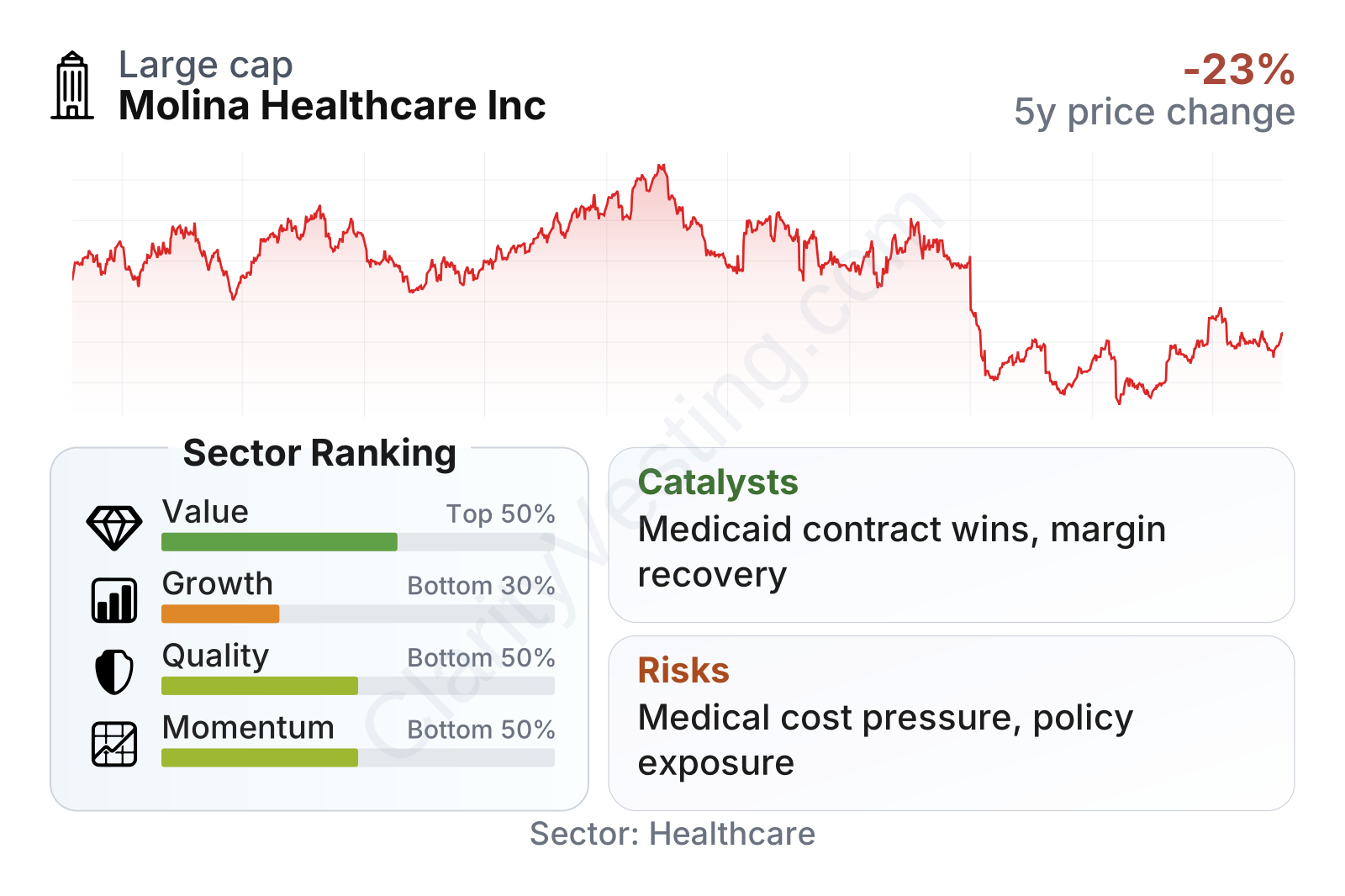
Molina is a mid-sized healthcare company by market value, and its share price volatility has been lower than the broader market, as shown by a beta below 1. In valuation terms, the picture is mixed but not obviously stretched: price-to-book is below the sector median, EBIT relative to enterprise value is stronger than the sector median, and the PEG ratio sits in a range that usually suggests the market is not assigning a rich premium to future growth. At the same time, the growth and quality readings are weaker than Molina’s own longer-term record, reflecting the sharp slowdown in recent revenue growth, lower current profitability, and a thinner return profile than many healthcare peers.
Growth
Molina operates in a sector with durable long-term demand. Medicaid managed care remains a large and essential part of the U.S. healthcare system, Medicare Advantage continues to benefit from an aging population, and the Marketplace business still serves a meaningful number of subsidized individual enrollees. Those are structurally supportive areas because they are tied to public health coverage rather than discretionary consumer spending.
The company’s strategy also makes sense on paper for future expansion. Molina has historically grown through a combination of organic membership gains, new state contract wins, and selected acquisitions. Its scale in government-sponsored plans can help when bidding for contracts, administering benefits, and spreading administrative costs over a larger base. In a fragmented state-based Medicaid market, that can still create room for further expansion.
That said, the recent operating trend is less clean than the long-term industry backdrop. Revenue growth was strong for several years, often in the double digits, but turned negative in the most recent periods shown. This likely reflects a mix of membership normalization, redeterminations in Medicaid after the pandemic-era coverage protections ended, and business mix changes. The contrast between strong five-year revenue-per-share growth and recent year-over-year contraction shows that Molina still has a meaningful long-term growth record, but momentum has clearly cooled.
Cash generation tells a similar story. Molina remains free-cash-flow positive, which is important, but the trailing trend has weakened materially from the levels seen a few years ago. For a managed care company, this does not automatically signal a broken model, because working capital and regulated capital flows can move around significantly. Still, a falling cash cushion reduces flexibility if profitability remains under pressure.
A key catalyst is continued success in winning or renewing Medicaid contracts across states. Another is stabilization in the medical cost ratio after a difficult period for the industry. If claim trends become more predictable, Molina’s earnings power could look materially stronger than the latest margin numbers suggest. The company has also continued to emphasize disciplined pricing and operational execution, which are central drivers in this business.
Recent company updates have also highlighted ongoing state procurement activity and membership positioning across core programs. For Molina, these contract decisions matter more than headline healthcare trends because each win, renewal, or loss can directly affect member counts and revenue in a given state.
Risks
This article is for informational purposes only and does not constitute financial advice. Some content is AI-generated. See Disclaimer


