Stock Analysis · Mongolian Mining Corporation (MOGLF)
Overview
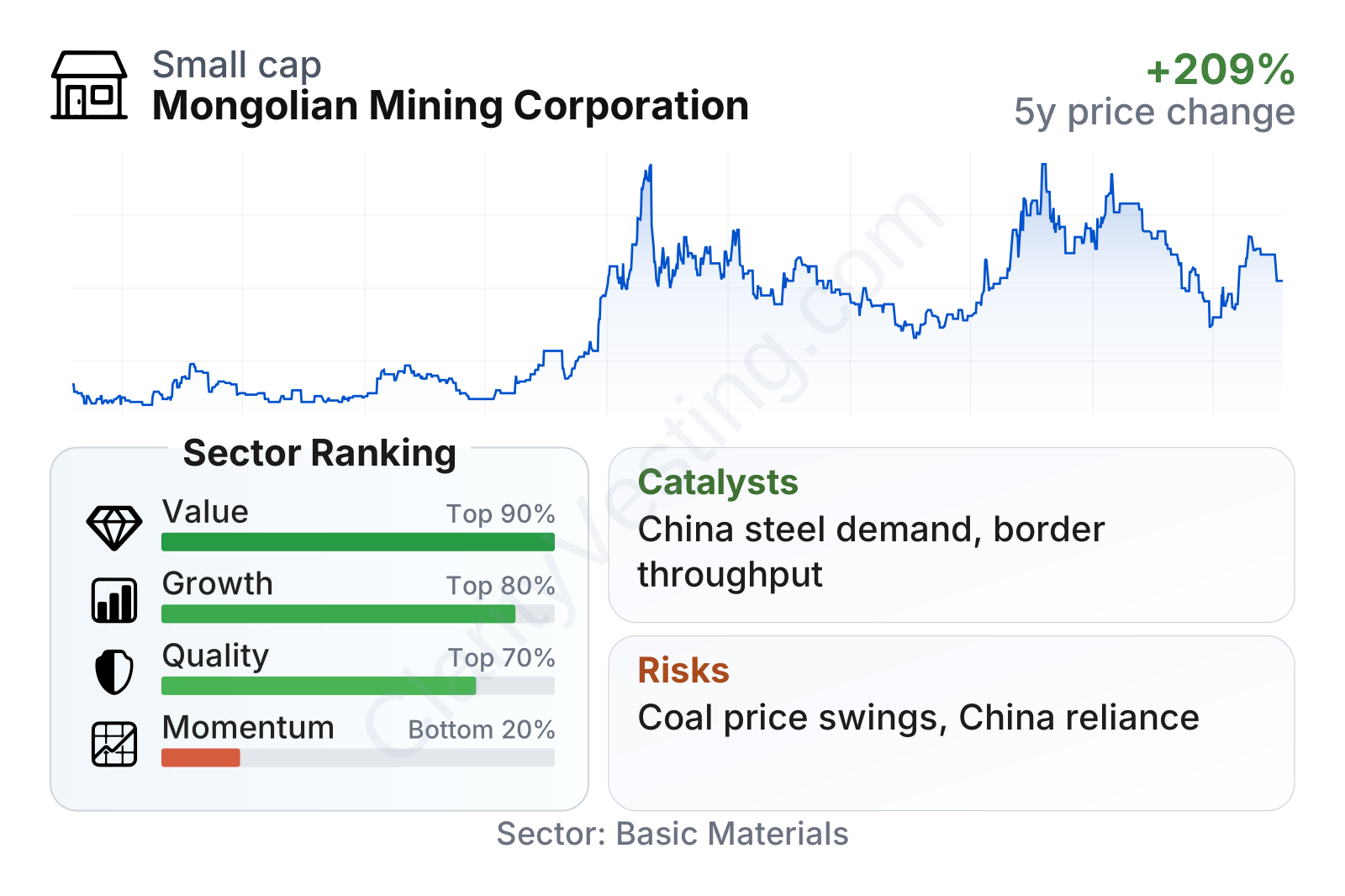
Mongolian Mining Corporation is a Mongolia-based mining company focused mainly on producing and selling coking coal, the grade of coal used to make steel. Its core assets are in the South Gobi region of Mongolia, close to the Chinese border, which matters because China is the company’s main export market and one of the world’s largest steel producers. The group has also developed related infrastructure and logistics capabilities to move coal from mine sites to customers.
The business is concentrated, which makes it relatively easy to understand: most of the company’s economics are tied to coal volumes sold, coal quality, export pricing, transportation conditions, and demand from Chinese steelmakers. Public disclosures also show some revenue from by-products and other coal-related products, but the investment case remains overwhelmingly linked to coking coal.
Based on recent annual reporting, revenue is primarily generated from the sale of coal products, with the mix broadly centered on hard coking coal and related washed coal products, supplemented by smaller contributions from thermal coal and other products when marketed.
- Coking coal and washed coal products: approximately 85% to 95% of revenue in recent years. This is the company’s main product family and includes the higher-value metallurgical coal used in blast furnace steelmaking.
- Thermal coal and other coal products: approximately 5% to 15% of revenue. These sales are more secondary and can vary based on mining output mix and market conditions.
- Other activities: limited contribution. These may include ancillary services or miscellaneous items, but they are not a major driver of group revenue.
The business model is straightforward but cyclical. When Chinese steel production is healthy and border logistics are smooth, revenue and margins can rise quickly. When steel demand weakens or prices fall, profits can compress just as fast. Over the last several years, the company has shown that it can generate very strong earnings during favorable coal markets, but that strength is not evenly distributed across the cycle.
The multi-year financial flow shows a sharp recovery after the weak 2021 period, with revenue and operating profit surging in 2022 through 2024 as volumes and pricing improved. It also shows how sensitive the company is to coal market conditions: in 2025, revenue stayed substantial, but gross profit and net income fell sharply, indicating much tighter margins even before considering financing costs.
Key Figures
| Metric | Value | Sector ⓘ |
|---|---|---|
| Date | Oct 17, 2026 | |
| Context | ||
| Sector | Basic Materials | |
| Industry | Coking Coal | |
| Market Cap ⓘ | $1.07B | |
| Beta ⓘ | 1.27 | |
Value (Cheapness) | ||
| P/E Ratio ⓘ | 9.55 | 16.90 |
| P/B Ratio ⓘ | 1.01 | 1.65 |
| FCF Yield ⓘ | 15.52% | 5.76% |
| Dividend Yield ⓘ | N/A | 2.13% |
| EBIT / EV ⓘ | 36.68% | 6.30% |
| PEG ⓘ | N/A | |
Growth (Business expansion) | ||
| Revenue Growth ⓘ | 69.10% | 11.10% |
| RPS Growth (5Y CAGR) ⓘ | 45.25% | 4.49% |
| EPS Growth (5Y CAGR) ⓘ | N/A | -13.47% |
| BVPS Growth (5Y CAGR) ⓘ | 4.45% | 5.51% |
| Margin Growth (5Y Trend) ⓘ | 15.41% | -1.54% |
| FCF Growth (5Y CAGR) ⓘ | -35.35% | 0.37% |
| DPS Growth (5Y CAGR) ⓘ | N/A | 6.08% |
Quality (Business durability) | ||
| ROIC (Latest) ⓘ | N/A | 9.26% |
| ROA (Latest) ⓘ | 13.31% | 4.91% |
| ROIC (5Y Median) ⓘ | 8.12% | 7.70% |
| ROA (5Y Median) ⓘ | 3.20% | 3.86% |
| Net Debt / EBIT (Latest) ⓘ | 0.38 | 1.40 |
| Net Debt / EBIT (5Y Median) ⓘ | 1.46 | 1.70 |
| Net Debt / EBITDA (Latest) ⓘ | 0.29 | 0.95 |
| Net Debt / Assets ⓘ | 7.25% | 13.69% |
| EBITDA / Interest ⓘ | N/A | 12.34 |
| Operating Margin (Latest) ⓘ | 34.13% | 13.20% |
| Operating Margin (5Y Median) ⓘ | 18.31% | 11.80% |
| Debt to Equity (Latest) ⓘ | N/A | 40.56% |
| Profit Margin (Latest) ⓘ | 11.14% | 6.43% |
| Free Cash Flow (Latest) ⓘ | $166.78M | |
Momentum (Price trend) | ||
| 3Y Return ⓘ | +84.21% | +68.89% |
| 12M Return (excl. last month) ⓘ | -5.38% | +30.21% |
| 6M Return ⓘ | -24.46% | -4.16% |
| Price vs. 200-Day MA ⓘ | -15.12% | -1.27% |
Mongolian Mining is a mid-sized materials company with above-average share-price volatility. The recent metric profile looks strongest on valuation, operating efficiency, and balance-sheet leverage. Relative to many peers in basic materials, the stock screens inexpensive on earnings and book value, while free cash flow yield is notably high. Profitability also stands out, with operating and net margins well ahead of sector medians in the latest trailing period.
Growth indicators are more mixed than the headline numbers first suggest. Recent revenue growth and five-year revenue-per-share expansion have been very strong, but free cash flow growth over five years has been negative, which is a reminder that mining cash generation can swing sharply with the commodity cycle and working-capital needs. Momentum is weaker: the stock has delivered a strong multi-year rise, but more recent performance has cooled and sits below the stronger part of the sector.
Leverage appears manageable at the moment. Net debt relative to EBIT and EBITDA is low for the industry, which gives the company more resilience than many commodity producers when prices soften. That said, the income statement still shows that interest expense remains meaningful, so balance-sheet progress matters because cyclical downturns can quickly test financing flexibility.
Growth
The company operates in a sector that is mature rather than structurally high-growth, but demand for coking coal remains tied to blast-furnace steel production, especially in China. That creates a different kind of growth profile: not a secular expansion theme, but a business that can still produce strong earnings and cash flow when its market is favorable. For Mongolian Mining, the real opportunity comes from being a low-distance supplier to northern China rather than from global coal demand growth alone.
Its strategy makes practical sense in that context. The company has focused on coal quality, processing, production efficiency, and logistics access to Chinese customers. Geography is a genuine strategic asset here. Compared with seaborne exporters shipping from Australia or other distant origins, a Mongolian producer can benefit from land-based access and potentially lower delivery times to some Chinese buyers. That advantage becomes especially important when border operations are functioning well and Chinese customers want supply diversification.
A major catalyst is the ongoing importance of steelmaking coal in Asia. Even as energy-transition policies reduce enthusiasm around thermal coal, coking coal has remained harder to replace at scale in conventional steel production. Another positive factor is the company’s improved financial position versus earlier years: lower leverage gives management more room to handle price swings, maintain operations, and potentially fund mine development or infrastructure improvements.
Recent operating history also suggests the asset base can support large earnings when market conditions cooperate. Revenue crossed the $1 billion mark in 2023 and remained around that level in 2024 before pulling back in 2025. That pattern shows both the earnings power of the mines and the central challenge: long-term growth is likely to be uneven, depending more on realized coal pricing, customer demand, and transport conditions than on simple production volume expansion.
In terms of recent opportunity signals, the clearest one is operational rather than speculative: the company has already demonstrated that normalized border flows and stronger coal pricing can transform its profit profile very quickly. If Chinese steel demand stabilizes and coking coal pricing improves from weaker levels, the business has shown that earnings can recover materially from compressed periods.
Risks
This article is for informational purposes only and does not constitute financial advice. Some content is AI-generated. See Disclaimer


