Stock Analysis · Moog Inc (MOG-A)
Overview
Moog Inc is a specialized engineering company that designs and manufactures high-performance motion and control systems. In simple terms, it builds the parts and systems that help aircraft, satellites, military equipment, industrial machines, and medical devices move with high precision and reliability. Its products include flight control actuation systems, servo valves, motors, sensors, avionics, and related components that are often used in demanding environments where failure is not acceptable.
The company operates mainly in aerospace and defense, with additional exposure to industrial and medical markets. That mix matters because it gives Moog access to long product cycles, recurring aftermarket demand, and government-funded programs, while also keeping a foothold in non-defense applications.
Based on Moog’s recent annual reporting structure, revenue is primarily generated from the following sources:
- Aircraft Controls: approximately 35% to 40% of revenue. This includes primary and secondary flight control actuation, engine controls, and related systems for commercial and military aircraft.
- Space and Defense Controls: approximately 25% to 30%. This covers missile controls, military vehicle and naval applications, and components used in satellites and launch vehicles.
- Military Aircraft: approximately 20% to 25%. This segment serves fighter jets, rotorcraft, trainer aircraft, and sustainment programs.
- Industrial Systems: approximately 10% to 15%. This includes motion control products for industrial automation, simulation, test equipment, and energy-related uses.
Over the last few years, the business mix has also shown improving profitability, with revenue rising steadily and gross profit expanding faster than sales. That suggests Moog has been getting better operating leverage from its installed base and program portfolio, even while increasing engineering spending.
Key Figures
| Metric | Value | Sector ⓘ |
|---|---|---|
| Date | Oct 17, 2026 | |
| Context | ||
| Sector | Industrials | |
| Industry | Aerospace & Defense | |
| Market Cap ⓘ | $11.83B | |
| Beta ⓘ | 0.96 | |
Value (Cheapness) | ||
| P/E Ratio ⓘ | 31.55 | 22.10 |
| P/B Ratio ⓘ | 5.34 | 1.97 |
| FCF Yield ⓘ | 2.96% | 6.38% |
| Dividend Yield ⓘ | 0.32% | 1.94% |
| EBIT / EV ⓘ | 4.02% | 4.79% |
| PEG ⓘ | 1.49 | |
Growth (Business expansion) | ||
| Revenue Growth ⓘ | 15.20% | 9.30% |
| RPS Growth (5Y CAGR) ⓘ | 8.05% | 7.81% |
| EPS Growth (5Y CAGR) ⓘ | 13.62% | -13.06% |
| BVPS Growth (5Y CAGR) ⓘ | 9.40% | 6.14% |
| Margin Growth (5Y Trend) ⓘ | 1.63% | 0.88% |
| FCF Growth (5Y CAGR) ⓘ | -6.01% | 11.01% |
| DPS Growth (5Y CAGR) ⓘ | 3.38% | 9.48% |
Quality (Business durability) | ||
| ROIC (Latest) ⓘ | 13.80% | 10.84% |
| ROA (Latest) ⓘ | 8.20% | 5.41% |
| ROIC (5Y Median) ⓘ | 9.27% | 9.38% |
| ROA (5Y Median) ⓘ | 4.72% | 4.95% |
| Net Debt / EBIT (Latest) ⓘ | 2.14 | 2.08 |
| Net Debt / EBIT (5Y Median) ⓘ | 2.84 | 2.27 |
| Net Debt / EBITDA (Latest) ⓘ | 1.76 | 1.39 |
| Net Debt / Assets ⓘ | 22.59% | 19.28% |
| EBITDA / Interest ⓘ | 9.26 | 9.58 |
| Operating Margin (Latest) ⓘ | 11.66% | 10.50% |
| Operating Margin (5Y Median) ⓘ | 8.42% | 10.29% |
| Debt to Equity (Latest) ⓘ | 51.56% | 65.48% |
| Profit Margin (Latest) ⓘ | 8.73% | 6.67% |
| Free Cash Flow (Latest) ⓘ | $350.16M | |
Momentum (Price trend) | ||
| 3Y Return ⓘ | +227.59% | +61.68% |
| 12M Return (excl. last month) ⓘ | +83.69% | +12.58% |
| 6M Return ⓘ | +18.12% | 0.00% |
| Price vs. 200-Day MA ⓘ | +6.65% | +0.02% |
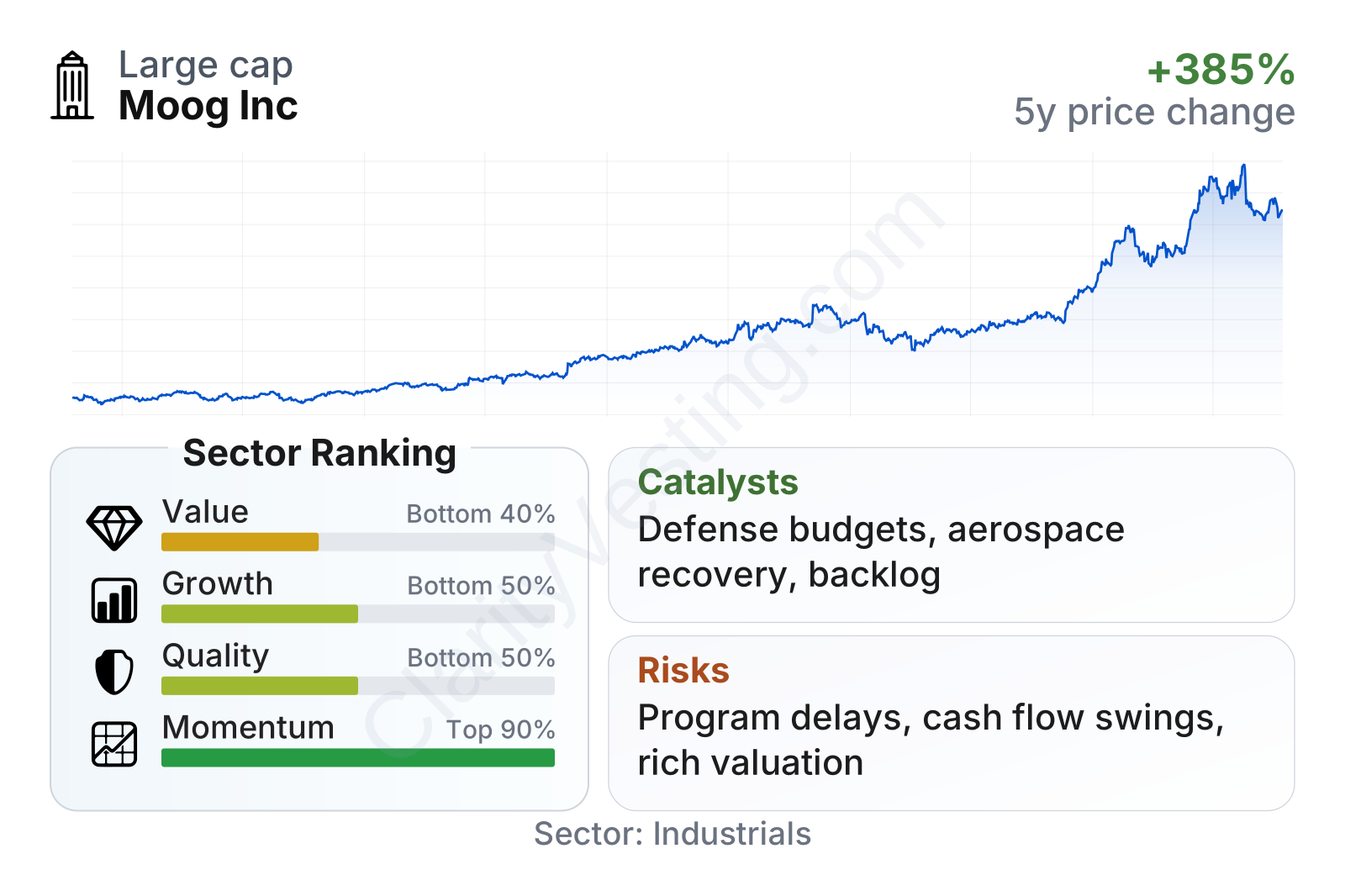
Moog is now a large mid-cap industrial company with a share price that has risen sharply over the last three years. The operating profile looks stronger than it used to: profitability and returns on capital are above many sector peers, while leverage is moderate rather than excessive. At the same time, the valuation is clearly richer than the industry median, and free cash flow measures still look less favorable than the broader aerospace and defense group. In other words, the market is giving Moog credit for better business quality and momentum, but not at a cheap price.
Growth
Moog operates in a sector with durable long-term demand drivers. Commercial aerospace continues to benefit from global aircraft production and fleet upgrades. Defense spending remains supported by elevated geopolitical tension, missile demand, military aircraft modernization, and the need to replenish inventories. Space is a smaller but strategically important market where precision control systems remain mission-critical. These are not fast-changing consumer markets; they are engineering-heavy end markets with long qualification cycles and high switching costs.
Moog’s strategy also fits those trends well. The company focuses on niche, high-performance components rather than broad commodity manufacturing. That can support pricing discipline, sticky customer relationships, and recurring revenue from spare parts, repairs, and follow-on production. It also means growth does not have to come from dominating an entire platform; being designed into a critical subsystem can be enough to create years of revenue.
Recent revenue growth has been strong, with the latest year-over-year pace running in the mid-teens, well ahead of the sector median. The longer pattern is also encouraging: growth accelerated in several periods after a softer phase, suggesting that demand across aerospace and defense programs has remained solid rather than purely one-off.
Cash generation has been more uneven than revenue growth, which is common for companies tied to large programs, inventory builds, and contract timing. Even so, free cash flow has recovered meaningfully from earlier weak or negative periods and is currently positive at a healthy level. If this improvement proves sustainable, it would strengthen the case that earnings quality is improving alongside sales.
A meaningful catalyst is Moog’s exposure to defense and military aircraft platforms that can benefit from multi-year procurement and sustainment budgets. Another is commercial aerospace production recovery, which tends to support both original equipment and aftermarket demand. The company’s growing engineering content in complex systems can also help it capture more value per platform over time.
Recent company updates and filings have pointed to continued backlog support, solid demand in core aerospace and defense programs, and margin improvement efforts. Those developments matter because Moog’s growth case is not only about more revenue, but about converting that revenue into better operating income over time.
Risks
This article is for informational purposes only and does not constitute financial advice. Some content is AI-generated. See Disclaimer


