Stock Analysis · Altria Group (MO)
Overview
Altria Group is one of the largest tobacco companies in the United States. Its core business is selling nicotine products, led by cigarettes under the Marlboro brand, along with cigars, moist smokeless tobacco, and oral nicotine pouches. The company also owns NJOY, which gives it a direct position in the U.S. e-vapor category. Altria mainly operates in the U.S. market rather than as a global tobacco exporter, which makes its results closely tied to U.S. consumer habits, regulation, and pricing.
Its revenue base is still dominated by traditional smokeable products, even though management has been trying to build exposure to reduced-risk categories. Based on recent annual reporting, the main sources of revenue are approximately:
- Smokeable products: about 89% of net revenues. This includes cigarettes, with Marlboro as the flagship brand, and cigars.
- Oral tobacco products: about 11% of net revenues. This primarily includes moist smokeless tobacco and on! nicotine pouches.
- E-vapor: currently a very small share of consolidated revenue. This comes mainly from NJOY and remains too small to change the overall mix in a meaningful way.
The business model is straightforward: Altria sells highly profitable nicotine products through strong brands and broad retail distribution. The important point for long-term analysis is that cigarette volumes have been declining for years, so the company depends heavily on price increases, disciplined cost control, and the expansion of smoke-free categories to protect earnings and cash flow.
The long-term pattern visible here is a business with shrinking revenue compared with a few years ago, but still generating very large gross profit and net income. That reflects one of Altria’s defining traits: volume pressure is real, yet pricing power and high margins keep the cash engine substantial.
Key Figures
| Metric | Value | Sector ⓘ |
|---|---|---|
| Date | Oct 24, 2026 | |
| Context | ||
| Sector | Consumer Defensive | |
| Industry | Tobacco | |
| Market Cap ⓘ | $123.71B | |
| Beta ⓘ | 0.46 | |
Value (Cheapness) | ||
| P/E Ratio ⓘ | 15.80 | 18.68 |
| P/B Ratio ⓘ | N/A | 1.24 |
| FCF Yield ⓘ | 7.37% | 12.11% |
| Dividend Yield ⓘ | 5.65% | 2.67% |
| EBIT / EV ⓘ | 8.42% | 6.40% |
| PEG ⓘ | 2.64 | |
Growth (Business expansion) | ||
| Revenue Growth ⓘ | 1.20% | 4.10% |
| RPS Growth (5Y CAGR) ⓘ | -3.93% | 6.22% |
| EPS Growth (5Y CAGR) ⓘ | -13.59% | -13.59% |
| BVPS Growth (5Y CAGR) ⓘ | N/A | 3.27% |
| Margin Growth (5Y Trend) ⓘ | 33.20% | -0.13% |
| FCF Growth (5Y CAGR) ⓘ | 2.45% | 4.10% |
| DPS Growth (5Y CAGR) ⓘ | 4.40% | 6.83% |
Quality (Business durability) | ||
| ROIC (Latest) ⓘ | 40.12% | 12.34% |
| ROA (Latest) ⓘ | 23.32% | 6.30% |
| ROIC (5Y Median) ⓘ | 34.83% | 10.53% |
| ROA (5Y Median) ⓘ | 19.79% | 5.44% |
| Net Debt / EBIT (Latest) ⓘ | 1.92 | 1.98 |
| Net Debt / EBIT (5Y Median) ⓘ | 2.01 | 2.35 |
| Net Debt / EBITDA (Latest) ⓘ | 1.88 | 1.38 |
| Net Debt / Assets ⓘ | 66.55% | 21.70% |
| EBITDA / Interest ⓘ | 9.90 | 9.49 |
| Operating Margin (Latest) ⓘ | 54.79% | 8.88% |
| Operating Margin (5Y Median) ⓘ | 50.31% | 9.57% |
| Debt to Equity (Latest) ⓘ | -921.18% | 72.35% |
| Profit Margin (Latest) ⓘ | 39.00% | 5.40% |
| Free Cash Flow (Latest) ⓘ | $9.11B | |
Momentum (Price trend) | ||
| 3Y Return ⓘ | +118.26% | +24.53% |
| 12M Return (excl. last month) ⓘ | +14.38% | +1.93% |
| 6M Return ⓘ | +19.12% | +1.61% |
| Price vs. 200-Day MA ⓘ | +12.35% | +2.99% |
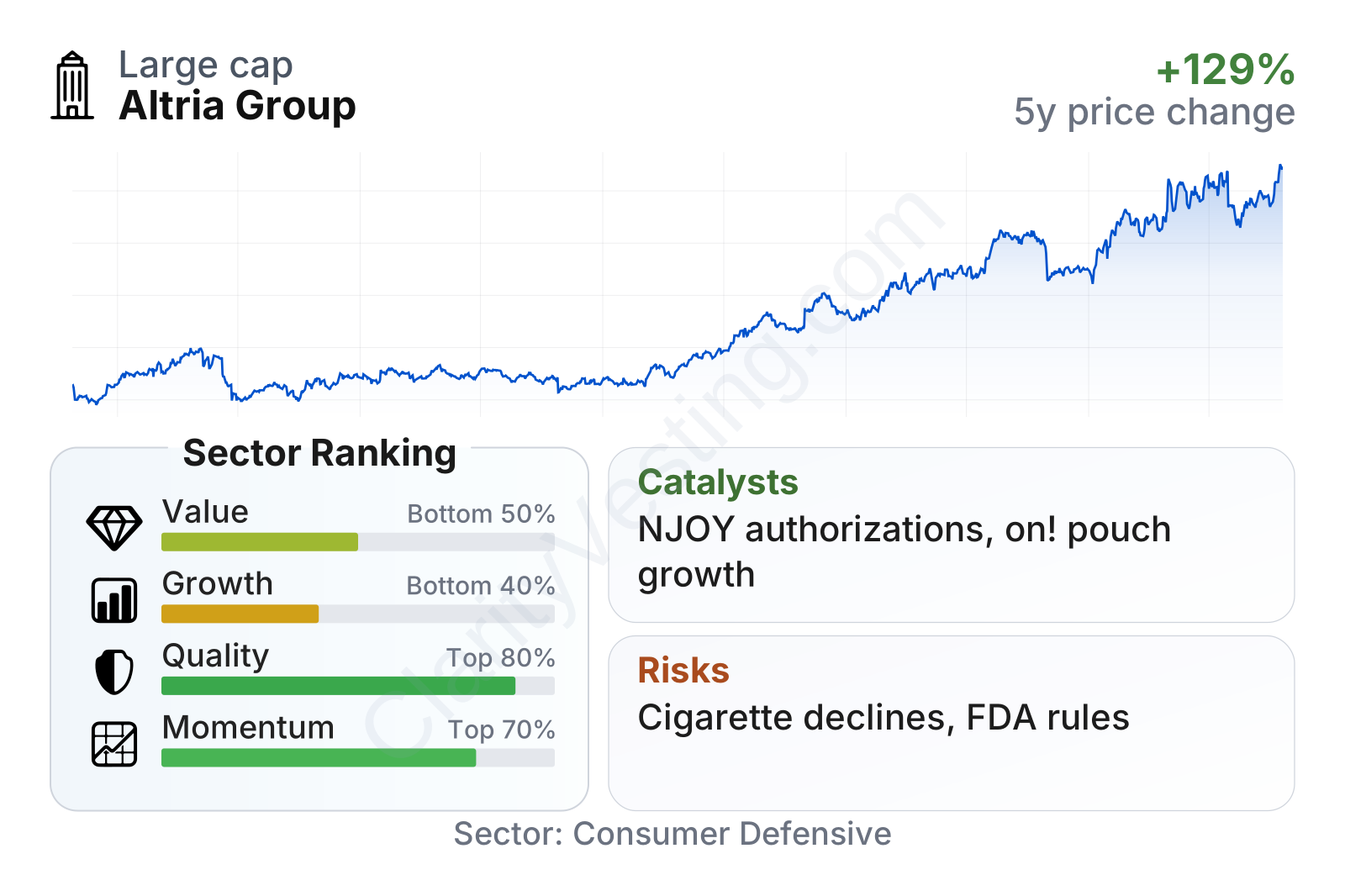
Altria stands out as a very large consumer defensive company with unusually strong profitability and a relatively low share-price volatility, as reflected by a beta well below 1. In the factor breakdown, quality is clearly the strongest area, supported by high returns on assets, very strong margins, and solid interest coverage. Growth is the weakest area, which fits a mature tobacco business. Value looks mixed rather than outright cheap: the earnings multiple sits below the sector median, but the free-cash-flow yield is not especially low compared with the broader sector, and the stock’s recent strength has reduced some of the earlier valuation cushion.
Growth
Altria operates in a sector that is mature, not structurally high-growth. In cigarettes, the long-term direction is still negative because fewer people smoke and many existing smokers consume less. That means the company is not growing because its main market is expanding. Instead, its growth case depends on three levers: raising prices faster than volume falls, shifting users into smoke-free products, and maintaining very high efficiency.
That strategy is logical, but it comes with limits. Price increases have supported the business for years, yet there is a point where consumers can trade down, quit, or move to illicit or discount alternatives. The more interesting piece for future expansion is smoke-free nicotine. Altria already has a meaningful oral tobacco platform and is trying to build a stronger e-vapor presence through NJOY. If it can gain scale in oral nicotine pouches and establish a durable position in authorized e-vapor products, that would improve its long-term revenue mix.
Recent revenue growth has been uneven for several years, which is typical for a business facing secular volume decline. More recently, the pace has improved sharply, but that kind of jump deserves careful interpretation because tobacco results can be affected by timing, inventory movements, and comparisons against weaker prior periods. The broader takeaway is that Altria’s top line has shown pockets of resilience, but it is not yet following a steady expansion path.
Cash generation remains one of the company’s biggest strengths. Free cash flow has stayed in a very high range, around the mid-single-digit to high-single-digit billions of dollars, which matters more than raw revenue growth for a company like Altria. It gives the business room to fund dividends, invest in smoke-free categories, and manage debt without needing aggressive external financing.
One of the clearest potential catalysts is the U.S. regulatory environment for e-vapor. Altria’s NJOY products hold marketing authorization for certain products from the FDA, which is important in a category where many competing products have faced enforcement pressure. If the legal market becomes more tightly controlled, authorized products could gain shelf space and credibility. In oral nicotine, on! also gives Altria exposure to one of the more active reduced-risk segments in the U.S. nicotine market.
Risks
This article is for informational purposes only and does not constitute financial advice. Some content is AI-generated. See Disclaimer


