Stock Analysis · Monster Beverage Corp (MNST)
Overview
Monster Beverage is a global beverage company best known for energy drinks sold under the Monster brand. It operates in the non-alcoholic beverage industry and focuses on products positioned around energy, performance, hydration, and lifestyle branding. The company sells its products through a broad international distribution network, with a particularly important relationship with The Coca-Cola Company system, which helps place Monster products in supermarkets, convenience stores, clubs, restaurants, and other retail channels around the world.
The business is still heavily centered on energy drinks, but the portfolio is broader than many people assume. Based on recent annual disclosures, revenue is mainly generated from the following activities:
- Monster Energy Drinks – about 90% to 95%: the core business, including flagship Monster Energy products and many line extensions such as zero-sugar, ultra, juice, coffee-energy, and performance-oriented varieties.
- Strategic brands and other beverages – about 5% to 10%: includes brands such as Reign, NOS, Full Throttle, Burn, Bang, Predator, and certain alcohol-related products and other beverage lines acquired or developed over time.
- Flavor concentrate and other sales – a small share: includes sales tied to concentrates or other arrangements linked to third-party bottling and distribution structures.
Geographically, Monster is not only a U.S. company anymore. North America remains the biggest market, but international operations have become an increasingly important engine of expansion as the company adds countries, flavors, package sizes, and retail points of sale.
Over the last several years, revenue has expanded meaningfully while gross profit and operating income have also grown, despite periods of cost pressure. The overall picture is a business with strong pricing power, high brand recognition, and a simple model: create popular beverages, market them aggressively, and use a very large outside distribution network instead of carrying the full burden of a traditional bottling system.
The operating picture shows a business that has kept growing sales and gross profit over time. After margin pressure in 2022 from higher input costs, profitability recovered, and by 2025 both revenue and net income had moved well above earlier levels.
Key Figures
| Metric | Value | Sector ⓘ |
|---|---|---|
| Date | Oct 17, 2026 | |
| Context | ||
| Sector | Consumer Defensive | |
| Industry | Beverages - Non-Alcoholic | |
| Market Cap ⓘ | $84.85B | |
| Beta ⓘ | 0.49 | |
Value (Cheapness) | ||
| P/E Ratio ⓘ | 40.10 | 17.88 |
| P/B Ratio ⓘ | 9.14 | 1.29 |
| FCF Yield ⓘ | 2.47% | 12.39% |
| Dividend Yield ⓘ | N/A | 2.85% |
| EBIT / EV ⓘ | 3.29% | 6.43% |
| PEG ⓘ | 2.26 | |
Growth (Business expansion) | ||
| Revenue Growth ⓘ | 20.20% | 4.10% |
| RPS Growth (5Y CAGR) ⓘ | 12.97% | 6.18% |
| EPS Growth (5Y CAGR) ⓘ | -4.64% | -13.59% |
| BVPS Growth (5Y CAGR) ⓘ | 8.14% | 3.20% |
| Margin Growth (5Y Trend) ⓘ | -2.43% | -0.15% |
| FCF Growth (5Y CAGR) ⓘ | 15.67% | 4.10% |
| DPS Growth (5Y CAGR) ⓘ | N/A | 6.79% |
Quality (Business durability) | ||
| ROIC (Latest) ⓘ | 24.98% | 12.34% |
| ROA (Latest) ⓘ | 20.27% | 6.30% |
| ROIC (5Y Median) ⓘ | 21.02% | 10.49% |
| ROA (5Y Median) ⓘ | 18.14% | 5.44% |
| Net Debt / EBIT (Latest) ⓘ | -0.79 | 1.96 |
| Net Debt / EBIT (5Y Median) ⓘ | -0.82 | 2.35 |
| Net Debt / EBITDA (Latest) ⓘ | -0.76 | 1.38 |
| Net Debt / Assets ⓘ | -19.26% | 21.51% |
| EBITDA / Interest ⓘ | 1,317.20 | 9.46 |
| Operating Margin (Latest) ⓘ | 30.13% | 8.87% |
| Operating Margin (5Y Median) ⓘ | 26.92% | 9.53% |
| Debt to Equity (Latest) ⓘ | N/A | 72.35% |
| Profit Margin (Latest) ⓘ | 23.08% | 5.40% |
| Free Cash Flow (Latest) ⓘ | $2.10B | |
Momentum (Price trend) | ||
| 3Y Return ⓘ | +81.52% | +20.92% |
| 12M Return (excl. last month) ⓘ | +34.18% | +2.13% |
| 6M Return ⓘ | +15.23% | +1.26% |
| Price vs. 200-Day MA ⓘ | +1.71% | +1.39% |
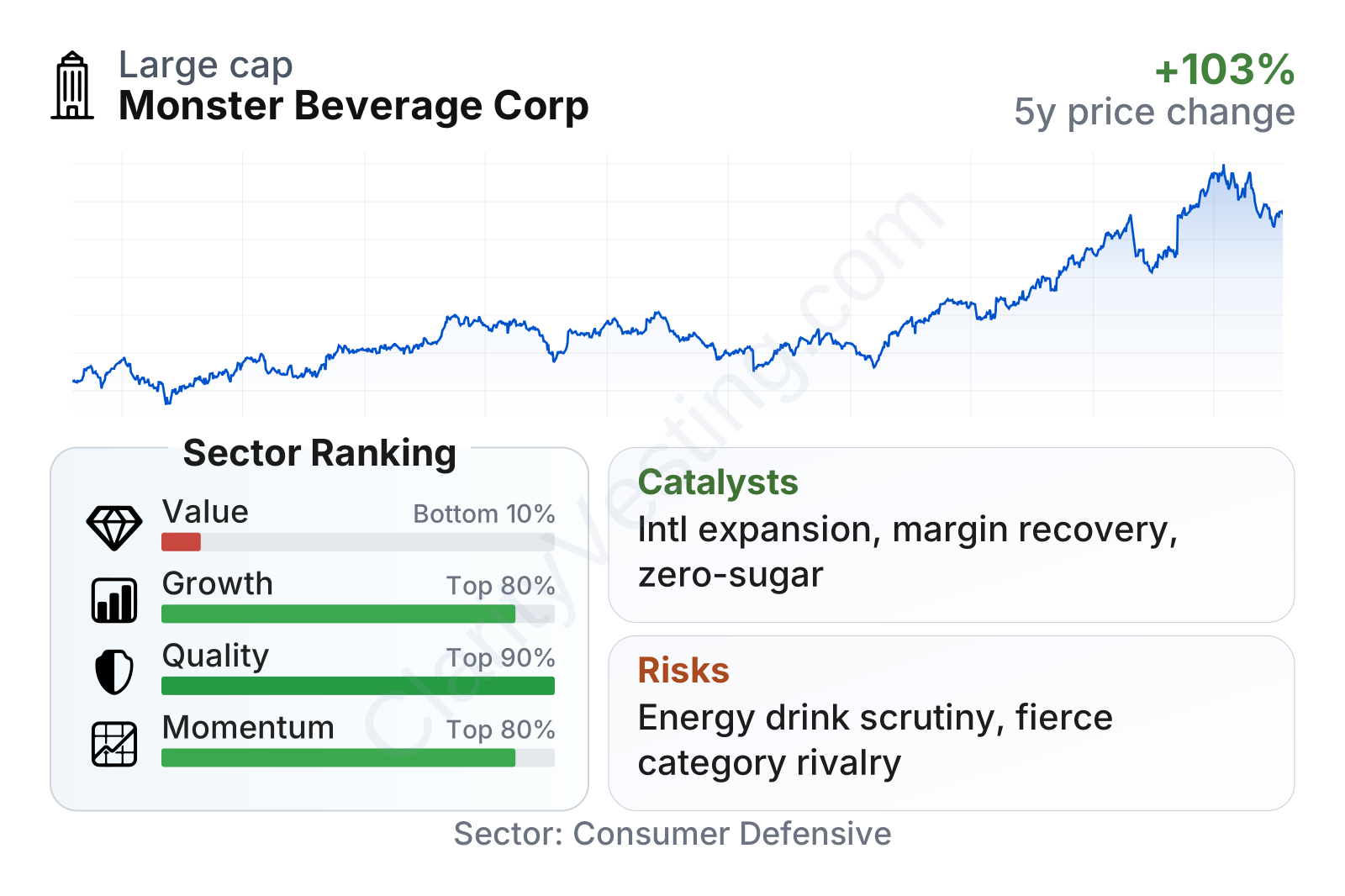
Monster stands out for business quality rather than cheapness. Profitability, returns on capital, balance-sheet strength, and price momentum all rank near the top of its sector, while valuation metrics sit near the bottom because the shares trade at a large premium to typical beverage peers. It is also a very large company with relatively low share-price volatility for a brand often associated with a faster-growing product category.
The stock’s multi-year price trend has been strong, especially over the last 12 months, reflecting improving revenue growth and confidence in earnings durability. At the same time, the premium valuation means the market is already recognizing many of the company’s strengths.
Growth
Energy drinks remain an attractive category within packaged beverages. Compared with carbonated soft drinks or many traditional grocery staples, energy drinks have often delivered better volume growth, more innovation, and stronger pricing. Consumer demand has been supported by convenience-store traffic, sugar-free product adoption, broader age demographics, and expansion outside the United States.
Monster’s strategy fits this environment well. The company keeps extending its brand family, refreshes flavors and formats regularly, and uses a marketing approach built around sports, gaming, music, and lifestyle culture. Just as important, it benefits from the Coca-Cola distribution system, which gives it scale advantages in shelf access and international rollout without requiring Monster to own the same level of manufacturing and logistics infrastructure as some beverage giants.
Recent sales trends point to renewed momentum. After a softer stretch in parts of 2024 and an uneven start to 2025, year-over-year revenue growth accelerated back into a much stronger range by late 2025 and the first half of 2026, clearly above the sector median. That matters because it suggests demand is still expanding even from an already large revenue base.
Cash generation has also moved higher in a steady way. Free cash flow has climbed from below $1 billion a few years ago to above $2 billion on a trailing basis, which gives Monster substantial flexibility to invest in marketing, product development, acquisitions, manufacturing support, and share repurchases while still maintaining a very conservative financial profile.
One meaningful catalyst is international expansion. Monster has continued pushing deeper into markets where energy drinks are still underpenetrated relative to the U.S. Another is mix improvement: premium products, zero-sugar variants, and acquired brands can lift revenue faster than unit growth alone. The company has also been building its alcohol-related beverage presence, which adds optionality, although it is still small compared with the core energy business.
A recent opportunity worth noting is the continued normalization of input costs after the inflationary period that weighed on margins. When a company with strong brand equity gets both volume growth and easing cost pressure at the same time, profit growth can improve faster than revenue growth.
Risks
This article is for informational purposes only and does not constitute financial advice. Some content is AI-generated. See Disclaimer


