Stock Analysis · Merit Medical Systems Inc (MMSI)
Overview
Merit Medical Systems is a mid-sized healthcare equipment company that designs and sells disposable medical devices and related systems used mainly in hospitals, outpatient centers, and physician offices. Its products are used in procedures such as cardiology, radiology, oncology, critical care, and endoscopy. In simple terms, the company makes many of the tools that doctors use during minimally invasive procedures, where treatment is delivered through catheters, tubes, and small access points instead of major surgery.
Merit operates across a broad catalog rather than relying on a single blockbuster product. That diversification matters because it reduces dependence on one therapy area and helps the company benefit from the broader shift toward less invasive care, shorter hospital stays, and more outpatient procedures.
Based on the company’s recent annual reporting, revenue is spread across several product families, with the largest categories ranked approximately as follows:
- Cardiovascular: about 44% of revenue. This includes products used in cardiac and vascular procedures such as catheters, inflation devices, procedure kits, and access-related tools.
- Endoscopy: about 22% of revenue. This area includes devices used in gastrointestinal and pulmonary procedures, including systems that help physicians manage bleeding and close tissue.
- Interventional Oncology and Spine: about 16% of revenue. This group includes products used in embolization, ablation support, and vertebral compression fracture treatment.
- Original Equipment Manufacturer, or OEM: about 9% of revenue. These are components or products manufactured for other medical companies.
- Peripheral Intervention: about 9% of revenue. This includes products used in peripheral vascular procedures outside the heart, such as drainage, access, and intervention support tools.
The business mix also shows a company that earns most of its money from repeat procedure volume rather than from large capital equipment sales. That generally makes revenue more recurring and tied to healthcare activity levels.
Over the last several years, revenue has climbed from a little over $1.0 billion to above $1.5 billion, while operating income and net income have also improved. Gross profit has expanded faster than cost of revenue, suggesting better scale and a healthier product mix, although selling and administrative costs remain substantial because medical device companies need large commercial and clinical support organizations.
The financial flow highlights a favorable trend: sales, gross profit, and operating income have all moved higher over time, with profitability improving faster than revenue. That points to a business that has been gaining efficiency as it scales.
Key Figures
| Metric | Value | Sector ⓘ |
|---|---|---|
| Date | Oct 10, 2026 | |
| Context | ||
| Sector | Healthcare | |
| Industry | Medical Instruments & Supplies | |
| Market Cap ⓘ | $5.08B | |
| Beta ⓘ | 0.51 | |
Value (Cheapness) | ||
| P/E Ratio ⓘ | 35.02 | 24.79 |
| P/B Ratio ⓘ | 3.05 | 2.97 |
| FCF Yield ⓘ | 4.01% | 3.11% |
| Dividend Yield ⓘ | N/A | 2.04% |
| EBIT / EV ⓘ | 4.05% | 0.57% |
| PEG ⓘ | 1.58 | |
Growth (Business expansion) | ||
| Revenue Growth ⓘ | 9.50% | 7.35% |
| RPS Growth (5Y CAGR) ⓘ | 7.53% | 8.61% |
| EPS Growth (5Y CAGR) ⓘ | -7.24% | -18.43% |
| BVPS Growth (5Y CAGR) ⓘ | 9.65% | 3.94% |
| Margin Growth (5Y Trend) ⓘ | 7.53% | -0.61% |
| FCF Growth (5Y CAGR) ⓘ | 15.53% | 0.88% |
| DPS Growth (5Y CAGR) ⓘ | N/A | 6.74% |
Quality (Business durability) | ||
| ROIC (Latest) ⓘ | 7.24% | 3.34% |
| ROA (Latest) ⓘ | 5.30% | 2.95% |
| ROIC (5Y Median) ⓘ | 6.18% | 4.60% |
| ROA (5Y Median) ⓘ | 4.73% | 1.89% |
| Net Debt / EBIT (Latest) ⓘ | 1.64 | 1.36 |
| Net Debt / EBIT (5Y Median) ⓘ | 2.49 | 1.86 |
| Net Debt / EBITDA (Latest) ⓘ | 1.03 | 1.02 |
| Net Debt / Assets ⓘ | 12.97% | 5.85% |
| EBITDA / Interest ⓘ | 11.40 | 9.60 |
| Operating Margin (Latest) ⓘ | 14.33% | 9.19% |
| Operating Margin (5Y Median) ⓘ | 10.15% | 7.53% |
| Debt to Equity (Latest) ⓘ | 48.82% | 29.44% |
| Profit Margin (Latest) ⓘ | 9.22% | 3.52% |
| Free Cash Flow (Latest) ⓘ | $203.50M | |
Momentum (Price trend) | ||
| 3Y Return ⓘ | +25.11% | +34.80% |
| 12M Return (excl. last month) ⓘ | -5.36% | +19.33% |
| 6M Return ⓘ | +23.12% | +7.18% |
| Price vs. 200-Day MA ⓘ | +11.15% | +3.20% |
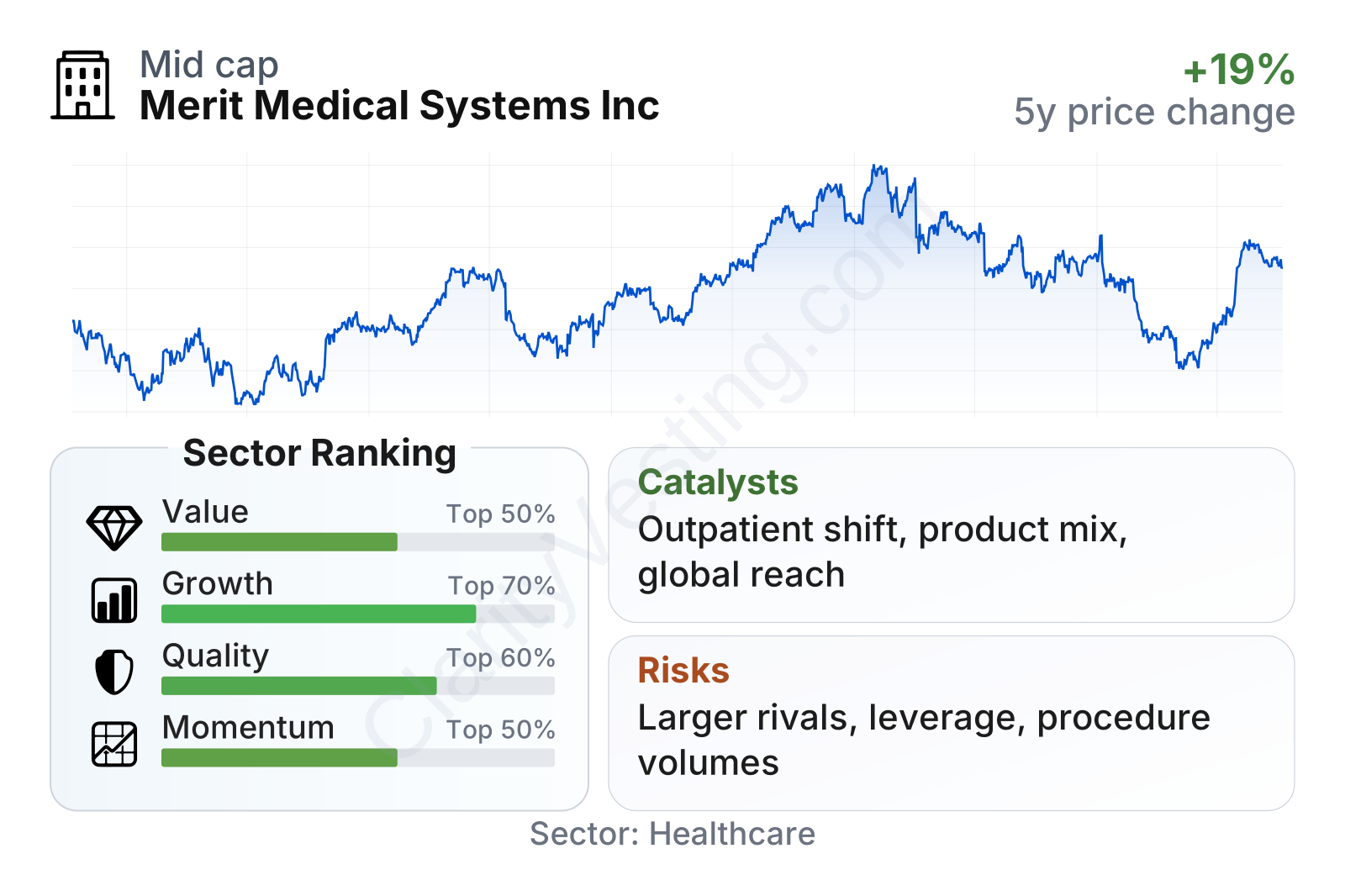
Merit Medical stands out more for improving business quality than for deep valuation appeal. Profitability, returns on capital, and cash generation compare well with much of the healthcare equipment group, while growth is above the sector median but not among the very fastest. The stock’s recent valuation remains elevated versus the sector on earnings, even though the company also shows stronger margins and free cash flow than many peers. Market behavior has been mixed: the longer-term share performance has been positive, but the last year has been uneven despite a stronger rebound over the past six months.
Growth
Merit operates in a part of healthcare that still has structural growth behind it. Minimally invasive procedures continue to gain share because they can lower recovery time, reduce complications, and often shift treatment into outpatient settings. An aging population also supports demand in cardiology, peripheral vascular care, oncology, and gastrointestinal procedures. Those trends do not guarantee rapid expansion every year, but they do create a favorable long-term backdrop.
The company’s strategy appears consistent with that environment. Management has focused on a combination of internal product development, international expansion, and targeted acquisitions that add adjacent technologies. Merit has also built franchises around procedural workflows, which can make its products easier to adopt because hospitals often prefer integrated solutions rather than isolated single-use items.
Revenue growth has been fairly steady, mostly landing in the high-single-digit to low-double-digit range. More importantly, recent growth has stayed above the sector median, which suggests the company is not simply riding industry demand but also taking share or executing better than many peers.
Cash generation has improved sharply. Free cash flow has risen from below $100 million a few years ago to well above $200 million on a trailing basis. That matters because rising cash flow gives the company more flexibility to invest in research, support acquisitions, reduce debt, and absorb temporary pressure in procedure volumes.
A meaningful catalyst is the continued scaling of higher-margin product categories, especially in areas where Merit has differentiated devices or a strong physician presence. The company has also been active in expanding product indications and commercial reach. In recent company communications through 2026, management continued to emphasize portfolio expansion, operating discipline, and the integration of acquired technologies, all of which can support growth if execution remains solid.
Another important opening is international growth. Merit already has a broad footprint, but penetration outside the United States still leaves room for expansion, particularly as hospitals in more markets adopt interventional and outpatient treatment pathways that use the company’s devices.
Risks
This article is for informational purposes only and does not constitute financial advice. Some content is AI-generated. See Disclaimer