Stock Analysis · Maximus Inc (MMS)
Overview
Maximus Inc is a government services company that helps public agencies run large, complex programs. Its work is centered on health and human services, including administering eligibility and enrollment processes, customer support, clinical assessments, program modernization, and employment-related services. In simple terms, Maximus is a contractor that governments hire when they need outside expertise and large-scale operational support.
The business is mainly driven by long-term contracts with federal, state, and local governments in the United States, as well as selected international public-sector customers. That creates recurring revenue, but it also means results depend heavily on government budgets, contract renewals, and policy priorities.
Based on recent annual reporting, revenue is primarily organized by operating segment. The mix can shift from year to year, but the business is broadly concentrated as follows:
- U.S. Federal Services: approximately 40% to 45% of revenue. This includes work for federal agencies, especially clinical services, program administration, appeals support, and other outsourced operations.
- U.S. Services: approximately 35% to 40% of revenue. This segment mainly supports state and local government programs such as Medicaid, public assistance, customer contact centers, and related administrative services.
- Outside the U.S.: approximately 15% to 20% of revenue. This includes government services contracts in markets such as the United Kingdom, Australia, Canada, and other selected international locations.
Over the last few years, revenue has grown, and profit conversion has improved meaningfully after a weaker 2023 period. The business model is not asset-heavy, so cash generation can become strong when margins stabilize and working capital is favorable.
The revenue base has expanded steadily from 2022 through 2025, while operating income and net income recovered sharply after a softer 2023. One useful takeaway is that profit improved faster than revenue, which suggests better contract mix, stronger execution, or both.
Key Figures
| Metric | Value | Sector ⓘ |
|---|---|---|
| Date | Oct 17, 2026 | |
| Context | ||
| Sector | Industrials | |
| Industry | Specialty Business Services | |
| Market Cap ⓘ | $3.04B | |
| Beta ⓘ | 0.59 | |
Value (Cheapness) | ||
| P/E Ratio ⓘ | 8.59 | 22.10 |
| P/B Ratio ⓘ | 1.76 | 1.97 |
| FCF Yield ⓘ | 14.25% | 6.38% |
| Dividend Yield ⓘ | 2.14% | 1.94% |
| EBIT / EV ⓘ | 12.72% | 4.79% |
| PEG ⓘ | 2.06 | |
Growth (Business expansion) | ||
| Revenue Growth ⓘ | -5.10% | 9.30% |
| RPS Growth (5Y CAGR) ⓘ | 8.28% | 7.81% |
| EPS Growth (5Y CAGR) ⓘ | 14.60% | -13.06% |
| BVPS Growth (5Y CAGR) ⓘ | 5.05% | 6.14% |
| Margin Growth (5Y Trend) ⓘ | 0.37% | 0.88% |
| FCF Growth (5Y CAGR) ⓘ | -6.58% | 11.01% |
| DPS Growth (5Y CAGR) ⓘ | 1.82% | 9.48% |
Quality (Business durability) | ||
| ROIC (Latest) ⓘ | 13.58% | 10.84% |
| ROA (Latest) ⓘ | 8.79% | 5.41% |
| ROIC (5Y Median) ⓘ | 12.53% | 9.38% |
| ROA (5Y Median) ⓘ | 7.56% | 4.95% |
| Net Debt / EBIT (Latest) ⓘ | 2.88 | 2.08 |
| Net Debt / EBIT (5Y Median) ⓘ | 3.89 | 2.27 |
| Net Debt / EBITDA (Latest) ⓘ | 2.34 | 1.39 |
| Net Debt / Assets ⓘ | 38.35% | 19.28% |
| EBITDA / Interest ⓘ | 8.02 | 9.58 |
| Operating Margin (Latest) ⓘ | 11.06% | 10.50% |
| Operating Margin (5Y Median) ⓘ | 9.21% | 10.29% |
| Debt to Equity (Latest) ⓘ | 99.50% | 65.48% |
| Profit Margin (Latest) ⓘ | 7.07% | 6.67% |
| Free Cash Flow (Latest) ⓘ | $433.23M | |
Momentum (Price trend) | ||
| 3Y Return ⓘ | -21.01% | +61.68% |
| 12M Return (excl. last month) ⓘ | -32.40% | +12.58% |
| 6M Return ⓘ | -14.33% | 0.00% |
| Price vs. 200-Day MA ⓘ | -12.48% | +0.02% |
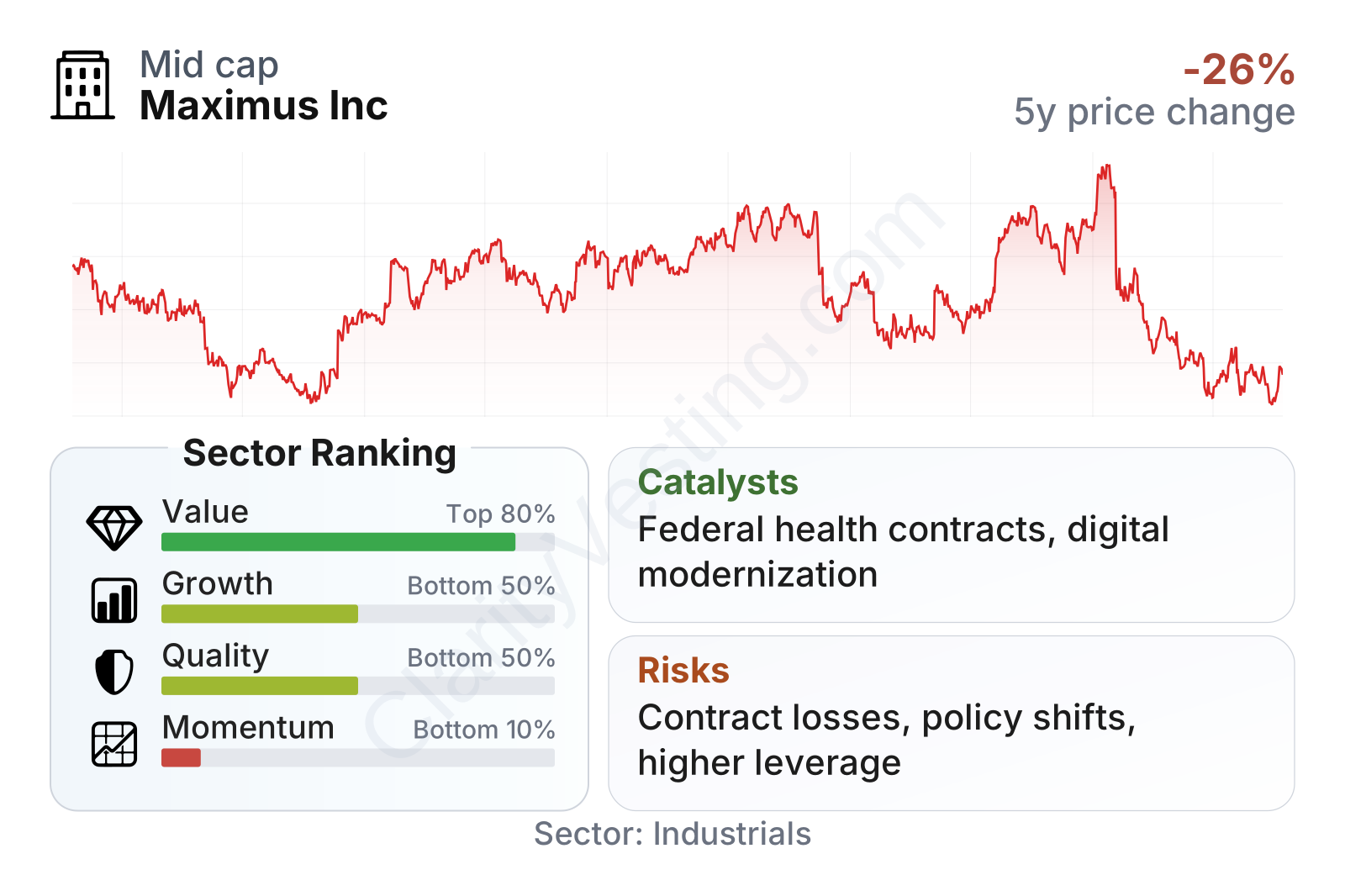
Maximus currently stands out more for valuation and cash generation than for market momentum. The stock trades at earnings and cash flow multiples well below the sector median, while free cash flow yield is notably stronger than many peers. Growth and quality measures are more mixed: long-term earnings growth has been solid, but recent revenue growth has turned negative, and leverage remains higher than the sector median. Share-price performance has also been weak over the past year and over three years, which helps explain why valuation multiples have compressed so much.
Growth
Maximus operates in a part of the market that benefits from durable demand rather than rapid expansion. Governments continue to outsource administrative complexity in healthcare, benefits management, and citizen services because these programs are large, regulated, and expensive to run internally. That gives the company exposure to a sector with long-term need, especially as aging populations, digital modernization, and cost pressure push agencies toward specialist contractors.
The company’s strategy appears logical for future growth. It has built scale in regulated services where execution, compliance, and past performance matter. That can support new contract wins and extensions because public agencies often prefer proven operators for mission-critical work. Maximus has also increased its presence in higher-value clinical and federal work, which can carry better margins than more basic administrative contracts.
Near-term growth has clearly slowed. After a long stretch of positive year-over-year expansion, revenue turned negative in the most recent quarters, with the latest decline running around 5%. That does not automatically signal structural weakness, but it does show the company is in a softer phase, likely tied to contract timing, redetermination work rolling off, or uneven award activity.
Cash generation has improved materially. Free cash flow, which had fallen earlier, has rebounded strongly and recently moved back into the several-hundred-million-dollar range. For a company of this size, that is important because it gives management more room to reduce debt, support dividends, repurchase shares, or fund acquisitions without relying heavily on outside financing.
A meaningful catalyst is the continued modernization of government services. Agencies are under pressure to improve customer experience, automate workflows, and manage healthcare and benefit programs more efficiently. Maximus is positioned where administration, technology-enabled service delivery, and compliance overlap. Another potential growth driver is federal health-related work, particularly contracts that require specialized operational scale and clinical capabilities.
Recent company updates have also highlighted ongoing contract awards and renewals across core government programs. For this type of business, a steady flow of wins matters more than headline-grabbing product launches. The key issue is whether new awards can offset work that is ending and return the company to sustained top-line growth.
Risks
This article is for informational purposes only and does not constitute financial advice. Some content is AI-generated. See Disclaimer


