Stock Analysis · MiniMed Group Inc (MMED)
Overview
MiniMed Group Inc operates in medical technology, with a focus on diabetes care. The company is best known for insulin pumps, continuous glucose monitoring systems, and the software and services that connect those devices. In simple terms, it sells products that help people with diabetes monitor glucose levels and automate part of insulin delivery.
The business model is a mix of hardware sales and recurring revenue from supplies and related services. Public company materials describe MiniMed as a diabetes-focused platform business rather than a one-product company, which matters because long-term demand is tied not only to new device launches but also to the ongoing use of consumables by existing customers.
Based on company reporting structure and the nature of the business, the main revenue sources appear to be:
- Diabetes devices and systems: insulin pumps, continuous glucose monitoring devices, infusion sets, reservoirs, transmitters, and related hardware. This is the core of the business and likely represents the vast majority of revenue.
- Recurring supplies and accessories: replacement and disposable items used with installed devices, typically a meaningful and steadier revenue stream within the diabetes segment.
- Software, services, and other diabetes-related revenue: patient support, digital tools, and other smaller items tied to the ecosystem.
One important feature of this model is that an installed base of patients can create repeat demand over time. That tends to make revenue more durable than a pure one-time equipment business, although it also raises the stakes for product quality, reimbursement, and regulatory execution.
The income flow over the last four fiscal years shows a company still expanding revenue, from about $2.2 billion to just above $3.1 billion, but not yet converting that growth into profits. Gross profit has continued to rise, while selling and administrative costs remain very large, and research spending has stayed elevated. That combination suggests MiniMed is investing to defend and expand its position, but efficiency has not yet caught up with scale.
Key Figures
| Metric | Value | Sector ⓘ |
|---|---|---|
| Date | Oct 24, 2026 | |
| Context | ||
| Sector | Healthcare | |
| Industry | Medical Instruments & Supplies | |
| Market Cap ⓘ | $5.01B | |
| Beta ⓘ | N/A | |
Value (Cheapness) | ||
| P/E Ratio ⓘ | N/A | 25.42 |
| P/B Ratio ⓘ | 1.42 | 3.08 |
| FCF Yield ⓘ | -6.31% | 3.12% |
| Dividend Yield ⓘ | N/A | 1.85% |
| EBIT / EV ⓘ | 0.20% | 0.56% |
| PEG ⓘ | N/A | |
Growth (Business expansion) | ||
| Revenue Growth ⓘ | 16.60% | 7.50% |
| RPS Growth (5Y CAGR) ⓘ | 14.78% | 8.60% |
| EPS Growth (5Y CAGR) ⓘ | N/A | -17.73% |
| BVPS Growth (5Y CAGR) ⓘ | 7.06% | 3.72% |
| Margin Growth (5Y Trend) ⓘ | N/A | -0.57% |
| FCF Growth (5Y CAGR) ⓘ | N/A | 0.96% |
| DPS Growth (5Y CAGR) ⓘ | N/A | 6.69% |
Quality (Business durability) | ||
| ROIC (Latest) ⓘ | -0.58% | 3.17% |
| ROA (Latest) ⓘ | -7.35% | 2.98% |
| ROIC (5Y Median) ⓘ | N/A | 4.56% |
| ROA (5Y Median) ⓘ | N/A | 1.87% |
| Net Debt / EBIT (Latest) ⓘ | -13.45 | 1.34 |
| Net Debt / EBIT (5Y Median) ⓘ | N/A | 1.86 |
| Net Debt / EBITDA (Latest) ⓘ | -0.88 | 1.00 |
| Net Debt / Assets ⓘ | -3.14% | 5.06% |
| EBITDA / Interest ⓘ | N/A | 9.55 |
| Operating Margin (Latest) ⓘ | 0.34% | 9.25% |
| Operating Margin (5Y Median) ⓘ | -2.08% | 7.33% |
| Debt to Equity (Latest) ⓘ | 1.63% | 26.68% |
| Profit Margin (Latest) ⓘ | -9.74% | 3.34% |
| Free Cash Flow (Latest) ⓘ | -$316.00M | |
Momentum (Price trend) | ||
| 3Y Return ⓘ | N/A | +51.61% |
| 12M Return (excl. last month) ⓘ | N/A | +19.90% |
| 6M Return ⓘ | +38.67% | +10.10% |
| Price vs. 200-Day MA ⓘ | N/A | +6.44% |
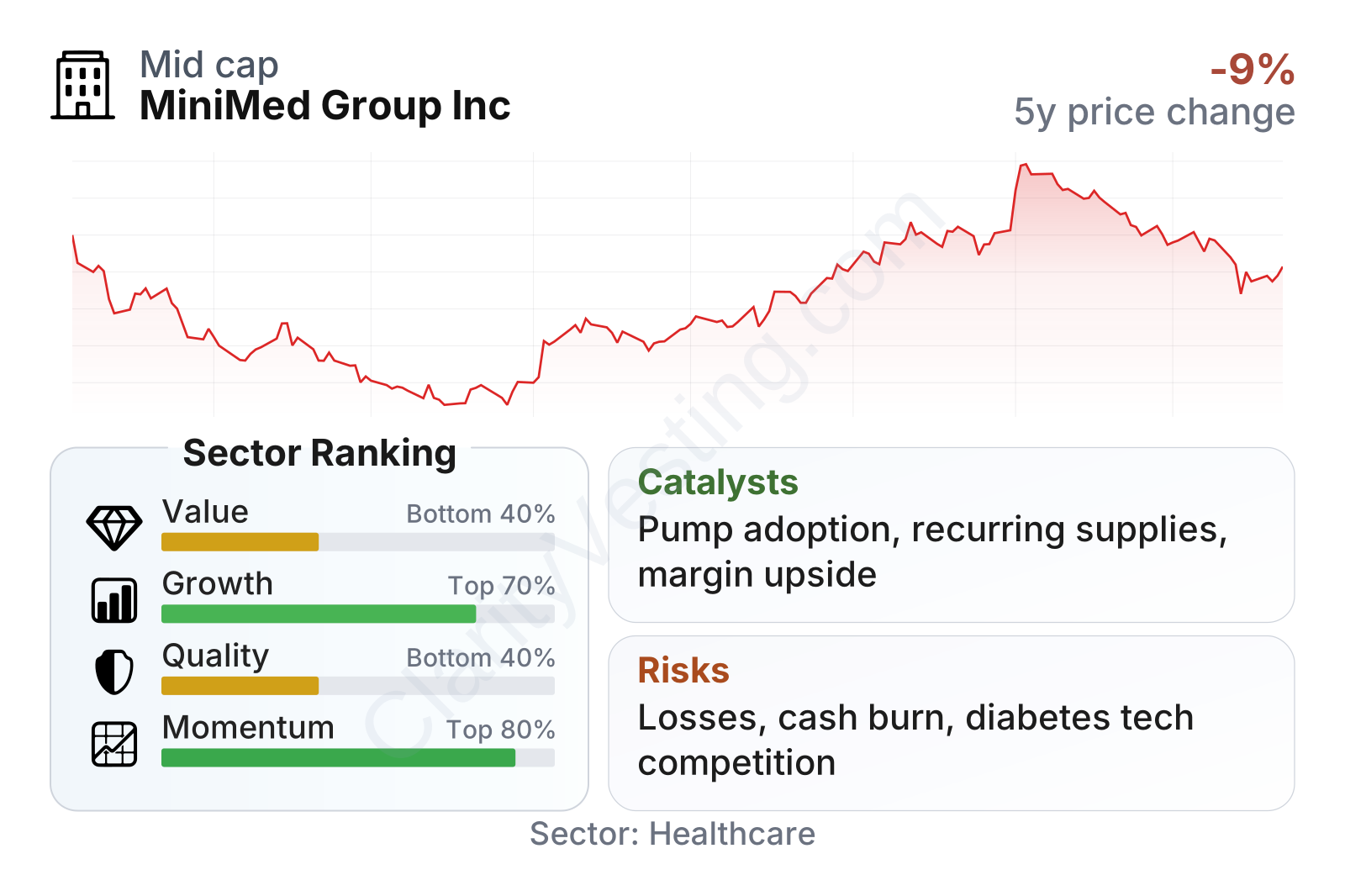
MiniMed is a mid-sized healthcare company by market value. The overall picture is mixed: growth and market momentum look stronger than much of the healthcare equipment sector, while profitability and valuation support are weaker. Revenue growth is running around the mid-teens year over year, comfortably above the sector median, and the five-year revenue-per-share trend is also ahead of the industry. On the other hand, returns on capital, margins, and free cash flow remain negative, which helps explain why value metrics rank in the lower part of the sector despite a low price-to-book ratio.
The share price has also been volatile in 2026, falling sharply in the spring before rebounding strongly by early September. That kind of move usually signals that the market is reacting to changing expectations around product execution, demand, or profitability rather than treating the business as a stable compounder.
Growth
MiniMed operates in a sector with durable long-term demand. Diabetes remains one of the world’s largest chronic disease markets, and technology that improves glucose control, convenience, and automation continues to gain relevance. The broader trend is favorable: more patients are using connected devices, more clinicians are relying on continuous data, and payers increasingly recognize the value of better disease management when it reduces complications and hospital use.
The company’s strategy broadly makes sense for this environment. It is building an ecosystem around pumps, glucose sensing, and software rather than depending on a single product cycle. That matters because the strongest diabetes technology companies often benefit from network effects at the patient level: once someone is trained on a platform and using recurring supplies, switching can become inconvenient unless a competing system is clearly better.
A major positive point is the company’s revenue trajectory. Sales have increased every year in the period shown, and the latest year reached roughly $3.1 billion. That is a healthy pace for a medical device company of this size. Gross profit has also increased, showing that demand is present and that the core products still carry attractive economics before overhead and commercial spending.
The most important catalysts are likely to come from three areas: new product adoption, expansion of the installed customer base, and improving reimbursement or geographic reach. If MiniMed can turn revenue growth into better operating leverage, even modest margin improvement could have an outsized effect because operating losses are not extremely large relative to total sales.
Recent market behavior also suggests that expectations have improved. The stock’s strong six-month performance versus the sector median indicates that the market has recently become more constructive on the business outlook, even though the company remains unprofitable.
Risks
This article is for informational purposes only and does not constitute financial advice. Some content is AI-generated. See Disclaimer


