Stock Analysis · Metals X Limited (MLXEF)
Overview
Metals X Limited is an Australian mining company focused mainly on tin. Its core asset is a majority interest in the Renison tin operation in Tasmania, one of the better-known primary tin mines outside China, Indonesia, and Myanmar. The group also has exposure to exploration and development projects linked to tin and base metals, but the operating business is centered on producing and selling tin concentrate.
For a long-term view, the important point is that Metals X is not a diversified global miner. It is largely a single-commodity company with tin at the center of the business. That gives it strong leverage to tin prices and to any tightening in global tin supply, but it also makes results more sensitive to disruptions in one market and one main operation.
The latest annual disclosures indicate revenue is overwhelmingly tied to tin production and sales, with smaller contributions from other mining interests and investment-related items that can vary by period. Based on the company’s recent reporting, the revenue picture can be summarized approximately as follows:
- Tin concentrate sales: about 90% to 95% of revenue. This is the sale of concentrate produced mainly from the Renison operation.
- Other mining and related income: about 5% to 10% of revenue. This can include smaller operational items, treatment-related adjustments, and other mining-linked receipts depending on the year.
- Investment, interest, and miscellaneous income: typically a very small share of total revenue and earnings, but these items can still affect net profit.
Over the last several years, the company’s revenue and profit flow has been volatile, which is typical for a miner, but the broader pattern has improved again recently. Revenue recovered strongly after a weaker 2022, and operating income remained robust into 2024 and 2025. Costs have risen with activity, yet profitability stayed high, helped by the combination of stronger sales and disciplined overhead.
The business mix is fairly straightforward: a concentrated mining asset base, very high exposure to tin, and a cost structure that has recently translated into strong cash generation. That simplicity can be attractive for readers who want direct exposure to a specific metal rather than a broad basket of commodities.
Key Figures
| Metric | Value | Sector ⓘ |
|---|---|---|
| Date | Oct 17, 2026 | |
| Context | ||
| Sector | Basic Materials | |
| Industry | Other Industrial Metals & Mining | |
| Market Cap ⓘ | $1.13B | |
| Beta ⓘ | 0.96 | |
Value (Cheapness) | ||
| P/E Ratio ⓘ | 10.62 | 16.90 |
| P/B Ratio ⓘ | 1.60 | 1.65 |
| FCF Yield ⓘ | 22.94% | 5.76% |
| Dividend Yield ⓘ | N/A | 2.13% |
| EBIT / EV ⓘ | N/A | 6.30% |
| PEG ⓘ | N/A | |
Growth (Business expansion) | ||
| Revenue Growth ⓘ | 38.80% | 11.10% |
| RPS Growth (5Y CAGR) ⓘ | 6.23% | 4.49% |
| EPS Growth (5Y CAGR) ⓘ | N/A | -13.47% |
| BVPS Growth (5Y CAGR) ⓘ | 15.17% | 5.51% |
| Margin Growth (5Y Trend) ⓘ | -15.91% | -1.54% |
| FCF Growth (5Y CAGR) ⓘ | N/A | 0.37% |
| DPS Growth (5Y CAGR) ⓘ | -76.27% | 6.08% |
Quality (Business durability) | ||
| ROIC (Latest) ⓘ | N/A | 9.26% |
| ROA (Latest) ⓘ | 47.65% | 4.91% |
| ROIC (5Y Median) ⓘ | 19.11% | 7.70% |
| ROA (5Y Median) ⓘ | 18.62% | 3.86% |
| Net Debt / EBIT (Latest) ⓘ | N/A | 1.40 |
| Net Debt / EBIT (5Y Median) ⓘ | -2.39 | 1.70 |
| Net Debt / EBITDA (Latest) ⓘ | -1.06 | 0.95 |
| Net Debt / Assets ⓘ | -50.48% | 13.69% |
| EBITDA / Interest ⓘ | N/A | 12.34 |
| Operating Margin (Latest) ⓘ | N/A | 13.20% |
| Operating Margin (5Y Median) ⓘ | 42.65% | 11.80% |
| Debt to Equity (Latest) ⓘ | 0.17% | 40.56% |
| Profit Margin (Latest) ⓘ | 45.46% | 6.43% |
| Free Cash Flow (Latest) ⓘ | $259.27M | |
Momentum (Price trend) | ||
| 3Y Return ⓘ | +489.74% | +68.89% |
| 12M Return (excl. last month) ⓘ | +202.33% | +30.21% |
| 6M Return ⓘ | +13.30% | -4.16% |
| Price vs. 200-Day MA ⓘ | +12.20% | -1.27% |
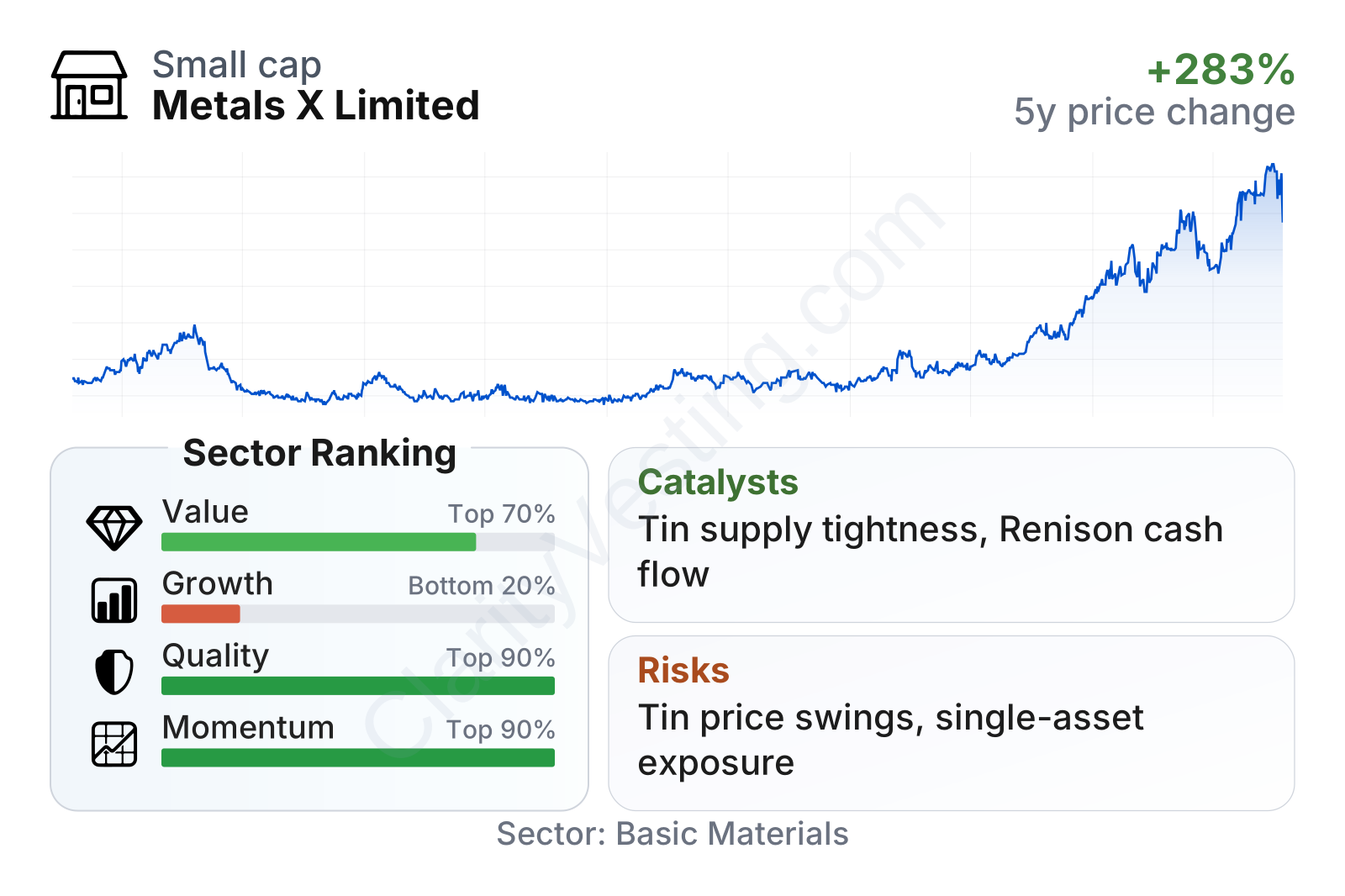
The market is valuing Metals X as a mid-sized materials company with a share price trend that has turned sharply upward over the last two years. The stock’s recent momentum has been exceptionally strong versus much of the sector, reflecting both stronger operating performance and rising interest in tin exposure.
On valuation, the earnings multiple sits below the sector median, while free cash flow yield is much higher than typical peers. That combination usually points to a company generating substantial cash relative to its market value. At the same time, the price-to-book ratio is somewhat above the sector median, which suggests the market is already recognizing the quality of the asset base and recent profitability.
Balance-sheet quality stands out. Debt is extremely low, net debt is negative, and free cash flow is strong. Profitability metrics are also unusually high for the sector. The weaker area is growth consistency: while recent revenue growth has been strong, longer-term operating margin and dividend trends have been less stable, which is a reminder that mining results can swing sharply with commodity prices and mine performance.
Growth
Tin is a relatively small global metal market, but it serves several durable end uses. It remains essential in solder for electronics, and it is also tied to industrial applications linked to electrification, renewable energy systems, and advanced manufacturing. That does not make tin a fast-growing commodity every year, but it does support a favorable long-term demand case, especially if supply remains constrained.
Metals X’s strategy is logical within that setting. Rather than spreading capital across many commodities, the company is concentrated on a metal where high-quality, scalable supply is limited. Renison is an established producing asset, which matters because existing producers are typically in a much better position than early-stage developers when supply tightens.
A meaningful catalyst is the broader industry backdrop. Global tin supply has faced recurring disruption in several producing regions, while demand from electronics and industrial uses has remained important. In that environment, a producing asset in a stable jurisdiction such as Tasmania can become more strategically valuable.
Another favorable point is financial flexibility. The company’s strong cash generation and net cash position create room for project development, mine-life extension work, exploration, or additional shareholder returns without depending heavily on external financing. That matters in mining because companies with weaker balance sheets often have to issue equity or add debt at less favorable times.
Recent company reporting also supports the idea of significant opportunity. Revenue rebounded strongly in the latest period, free cash flow remained substantial, and the balance sheet stayed very clean. For a miner of this size, that combination gives Metals X more optionality than many peers.
Risks
This article is for informational purposes only and does not constitute financial advice. Some content is AI-generated. See Disclaimer


