Stock Analysis · MoonLake Immunotherapeutics (MLTX)
Overview
MoonLake Immunotherapeutics is a clinical-stage biotechnology company focused on inflammatory diseases. Its lead asset is sonelokimab, an investigational antibody designed to target IL-17A and IL-17F, two proteins involved in immune-driven inflammation. The company is studying this drug candidate in several conditions, with the biggest commercial focus on hidradenitis suppurativa, a chronic and often painful skin disease, while also advancing programs in psoriatic arthritis and other inflammatory indications.
At this stage, MoonLake is still developing its product pipeline and does not yet generate recurring commercial product revenue. Based on recent annual reporting, revenue remains effectively absent, which means the business is currently financed mainly through its cash reserves and capital raised from shareholders and financing activities rather than sales of approved medicines.
The current economic model can therefore be summarized as follows:
- Product revenue: 0% — the company has no approved product on the market yet.
- Collaboration or licensing revenue: not currently a meaningful recurring source — no major ongoing revenue stream has been established from partnerships in recent reporting.
- Financing inflows: the dominant source of funding — cash has come primarily from equity issuance and other financing activity used to fund research, clinical trials, and corporate operations.
That makes MoonLake a classic development-stage biotech: the investment case depends much more on clinical progress, regulatory milestones, and future commercial potential than on present-day sales.
The cost structure reflects that profile clearly. Operating spending has risen sharply over the last several years, led mainly by research and development. Administrative costs have also increased, but the core driver is the expansion of clinical programs. In other words, MoonLake is not a company trying to optimize a mature business; it is spending aggressively to prove that its lead drug can support a large future franchise.
Key Figures
| Metric | Value | Sector ⓘ |
|---|---|---|
| Date | Oct 17, 2026 | |
| Context | ||
| Sector | Healthcare | |
| Industry | Biotechnology | |
| Market Cap ⓘ | $995.75M | |
| Beta ⓘ | 1.03 | |
Value (Cheapness) | ||
| P/E Ratio ⓘ | N/A | 24.79 |
| P/B Ratio ⓘ | 2.02 | 3.08 |
| FCF Yield ⓘ | -22.61% | 3.15% |
| Dividend Yield ⓘ | N/A | 1.94% |
| EBIT / EV ⓘ | -38.35% | 0.57% |
| PEG ⓘ | N/A | |
Growth (Business expansion) | ||
| Revenue Growth ⓘ | N/A | 7.45% |
| RPS Growth (5Y CAGR) ⓘ | N/A | 8.61% |
| EPS Growth (5Y CAGR) ⓘ | N/A | -17.81% |
| BVPS Growth (5Y CAGR) ⓘ | N/A | 3.72% |
| Margin Growth (5Y Trend) ⓘ | N/A | -0.62% |
| FCF Growth (5Y CAGR) ⓘ | N/A | 1.04% |
| DPS Growth (5Y CAGR) ⓘ | N/A | 6.77% |
Quality (Business durability) | ||
| ROIC (Latest) ⓘ | -48.87% | 3.24% |
| ROA (Latest) ⓘ | -53.36% | 3.01% |
| ROIC (5Y Median) ⓘ | -31.03% | 4.60% |
| ROA (5Y Median) ⓘ | -23.68% | 1.89% |
| Net Debt / EBIT (Latest) ⓘ | N/A | 1.34 |
| Net Debt / EBIT (5Y Median) ⓘ | N/A | 1.84 |
| Net Debt / EBITDA (Latest) ⓘ | N/A | 1.00 |
| Net Debt / Assets ⓘ | -65.58% | 5.45% |
| EBITDA / Interest ⓘ | N/A | 9.64 |
| Operating Margin (Latest) ⓘ | N/A | 9.27% |
| Operating Margin (5Y Median) ⓘ | N/A | 7.38% |
| Debt to Equity (Latest) ⓘ | 23.71% | 28.58% |
| Profit Margin (Latest) ⓘ | N/A | 3.59% |
| Free Cash Flow (Latest) ⓘ | -$225.18M | |
Momentum (Price trend) | ||
| 3Y Return ⓘ | -79.47% | +42.80% |
| 12M Return (excl. last month) ⓘ | -73.00% | +18.50% |
| 6M Return ⓘ | -37.23% | +7.57% |
| Price vs. 200-Day MA ⓘ | -30.36% | +5.12% |
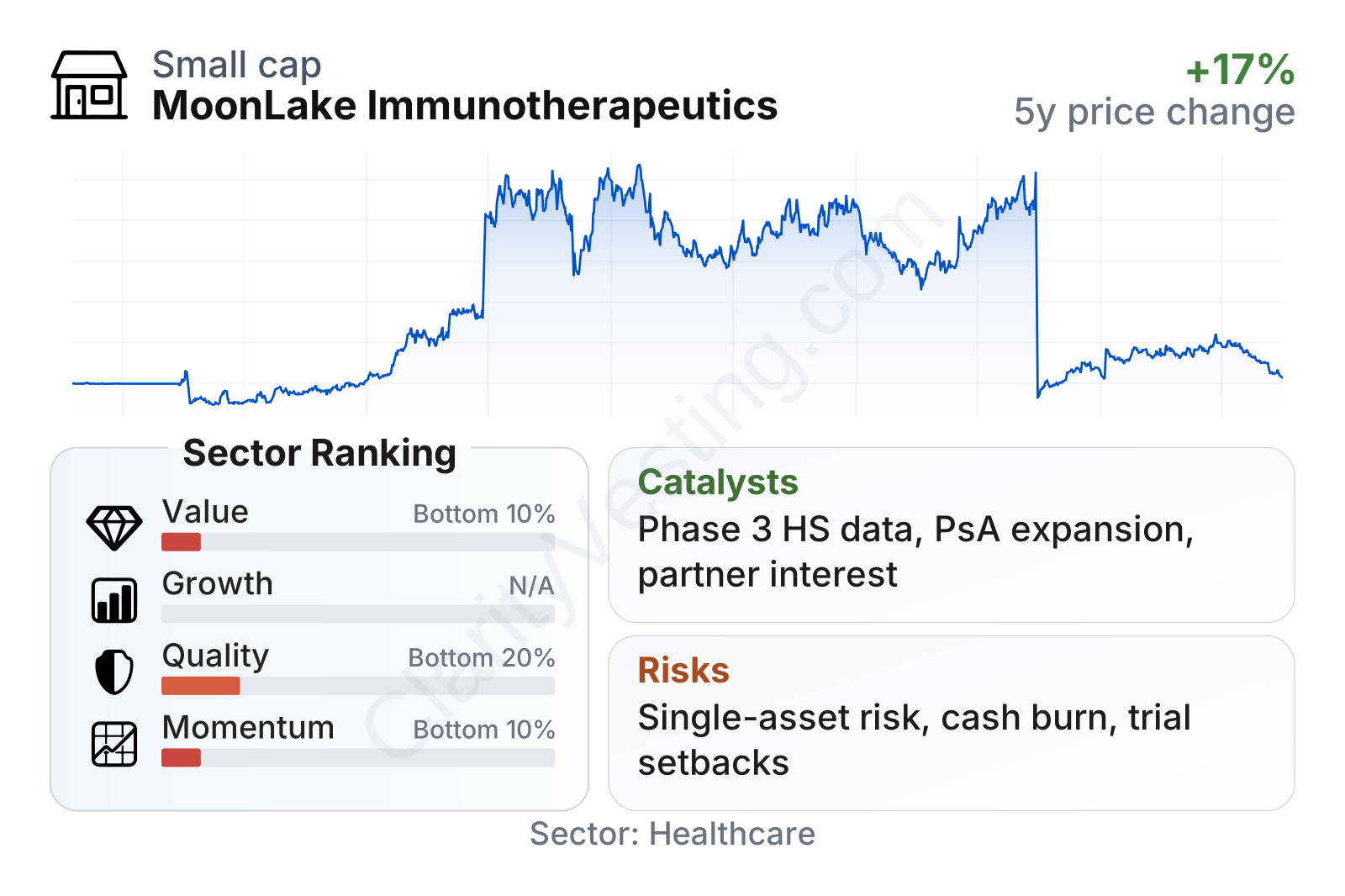
MoonLake remains a small-cap biotechnology company with share price behavior that has been highly volatile. After a very strong run in 2023 and parts of 2024, the stock experienced a deep reset and only partial recovery afterward. That pattern is common in clinical-stage biotech, where expectations can change abruptly around trial design, timelines, and interpretation of medical results.
The table points to a business that currently screens weak on traditional valuation, profitability, and momentum measures. That is not unusual for a company without commercial revenue, but it matters for context. Value metrics rank near the bottom of the healthcare sector largely because earnings and free cash flow are still negative. Quality measures also appear weak on paper for the same reason: return on assets, return on invested capital, and profit metrics remain deeply negative while the company is still in heavy development mode.
One notable offset is the balance sheet structure. Debt remains moderate relative to equity for the sector, and net cash characteristics still help reduce immediate financial pressure compared with many biotech peers. The challenge is that the company’s market profile is being shaped far more by cash burn and pipeline confidence than by standard financial ratios.
Growth
MoonLake operates in a sector with substantial long-term growth potential. Immune-mediated inflammatory diseases represent a large and durable market because they often require chronic treatment, patients can cycle through multiple therapies, and there is continuous demand for drugs with better efficacy, safety, convenience, or speed of response. Hidradenitis suppurativa in particular has become an increasingly important area in biotechnology and large-cap pharma because treatment options remain limited relative to patient need.
The company’s strategy is coherent for this market. Rather than building a broad early-stage platform with many unproven assets, MoonLake is concentrating resources around one lead candidate with potential across multiple indications. That can be a strong model when the science translates well from one inflammatory disease to another. If sonelokimab continues to produce encouraging data, the same molecule could support several value-creating clinical and regulatory paths.
A major reason the market follows MoonLake closely is the possibility that sonelokimab could become a meaningful competitor in hidradenitis suppurativa. The company has highlighted differentiated features such as its Nanobody-based design, drug exposure profile, and clinical potential in skin inflammation. It has also continued late-stage development efforts intended to support a future regulatory filing if pivotal results are successful. In practical terms, the central growth catalyst is simple: strong Phase 3 or other registrationally relevant evidence in hidradenitis suppurativa could move MoonLake from a research-stage company toward a commercial launch profile.
There is also optionality beyond dermatology. Psoriatic arthritis and related inflammatory conditions offer additional expansion opportunities if clinical data remain supportive. This matters because a single successful indication can justify a company’s existence, but multiple viable indications can transform the scale of the opportunity.
The main financial constraint on that growth path is visible in cash generation. Free cash flow has become progressively more negative as development spending accelerated, which is exactly what would be expected as larger trials move forward. The key question is not whether the company is currently generating cash — it is not — but whether the spending is building enough clinical and strategic value before further capital is needed.
Recent company updates have reinforced that the next several milestones are heavily tied to execution in late-stage studies and continued advancement of sonelokimab across prioritized indications. For MoonLake, meaningful upside would likely come from additional strong efficacy and safety data, regulatory progress, or strategic interest from larger pharmaceutical companies seeking exposure to inflammatory disease assets.
Risks
This article is for informational purposes only and does not constitute financial advice. Some content is AI-generated. See Disclaimer


