Stock Analysis · Melrose Industries PLC (MLSPF)
Overview
Melrose Industries PLC is a UK-based industrial company focused on aerospace structures and engine components through its GKN Aerospace business. In recent years, Melrose has become far more focused than it used to be. After a long period of buying, improving, and selling industrial businesses, it now mainly operates as an aerospace supplier. That makes the company easier to understand than in the past: its performance is now tied largely to commercial aviation, defense programs, and long-cycle aircraft production.
The company’s revenue comes primarily from supplying parts and systems used in aircraft. Based on recent annual reporting, the business mix is concentrated in a few areas:
- Engines: approximately 40% to 45% of revenue. This includes engine structures and components used on major civil and defense aircraft platforms.
- Aerostructures: approximately 30% to 35% of revenue. This covers wing components, fuselage structures, transparencies, and other structural assemblies.
- Electrical wiring interconnection systems and other aerospace systems: approximately 20% to 25% of revenue. These products support aircraft electrical architecture and related systems.
- Aftermarket and services: an important cross-business contributor, with exposure to spare parts, repairs, and long-term support. This is not always reported as a separate top-line segment, but it matters because aftermarket activity is usually higher margin and less cyclical than original equipment supply.
Geographically, Melrose serves global aerospace customers, with demand linked especially to North America and Europe, where the largest aircraft and engine programs are designed and assembled. The customer base is concentrated around major aerospace manufacturers and engine makers, which gives Melrose access to large multiyear programs but also creates dependence on a limited set of customers.
The broad financial picture has improved meaningfully since the heavy losses seen earlier in the decade. Revenue has stabilized around a much narrower business base, gross profit has improved, and operating performance moved back into clearly positive territory in 2025. That shift is important because it suggests the current Melrose is no longer the mixed industrial group shown in older records, but a more focused aerospace supplier working through an operational recovery.
The business mix has become much cleaner over time. Revenue dropped sharply as non-core activities were exited, but the more recent trend shows a smaller company with better gross profitability and a return to operating profit in 2025. In practical terms, Melrose now depends less on conglomerate complexity and more on whether aerospace demand stays strong.
Key Figures
| Metric | Value | Sector ⓘ |
|---|---|---|
| Date | Oct 17, 2026 | |
| Context | ||
| Sector | Industrials | |
| Industry | Specialty Industrial Machinery | |
| Market Cap ⓘ | $7.17B | |
| Beta ⓘ | 0.89 | |
Value (Cheapness) | ||
| P/E Ratio ⓘ | 33.82 | 22.10 |
| P/B Ratio ⓘ | 2.61 | 1.97 |
| FCF Yield ⓘ | 1.04% | 6.38% |
| Dividend Yield ⓘ | 1.31% | 1.94% |
| EBIT / EV ⓘ | N/A | 4.79% |
| PEG ⓘ | 0.53 | |
Growth (Business expansion) | ||
| Revenue Growth ⓘ | 8.90% | 9.30% |
| RPS Growth (5Y CAGR) ⓘ | -9.80% | 7.81% |
| EPS Growth (5Y CAGR) ⓘ | -38.28% | -13.06% |
| BVPS Growth (5Y CAGR) ⓘ | -17.56% | 6.14% |
| Margin Growth (5Y Trend) ⓘ | N/A | 0.88% |
| FCF Growth (5Y CAGR) ⓘ | N/A | 11.01% |
| DPS Growth (5Y CAGR) ⓘ | 9.87% | 9.48% |
Quality (Business durability) | ||
| ROIC (Latest) ⓘ | N/A | 10.84% |
| ROA (Latest) ⓘ | 6.22% | 5.41% |
| ROIC (5Y Median) ⓘ | -0.09% | 9.38% |
| ROA (5Y Median) ⓘ | -2.20% | 4.95% |
| Net Debt / EBIT (Latest) ⓘ | 1.60 | 2.08 |
| Net Debt / EBIT (5Y Median) ⓘ | N/A | 2.27 |
| Net Debt / EBITDA (Latest) ⓘ | 0.95 | 1.39 |
| Net Debt / Assets ⓘ | 23.43% | 19.28% |
| EBITDA / Interest ⓘ | 7.64 | 9.58 |
| Operating Margin (Latest) ⓘ | 15.98% | 10.50% |
| Operating Margin (5Y Median) ⓘ | -0.14% | 10.29% |
| Debt to Equity (Latest) ⓘ | 71.81% | 65.48% |
| Profit Margin (Latest) ⓘ | 4.28% | 6.67% |
| Free Cash Flow (Latest) ⓘ | $74.71M | |
Momentum (Price trend) | ||
| 3Y Return ⓘ | +8.30% | +61.68% |
| 12M Return (excl. last month) ⓘ | -13.92% | +12.58% |
| 6M Return ⓘ | -16.46% | 0.00% |
| Price vs. 200-Day MA ⓘ | -15.22% | +0.02% |
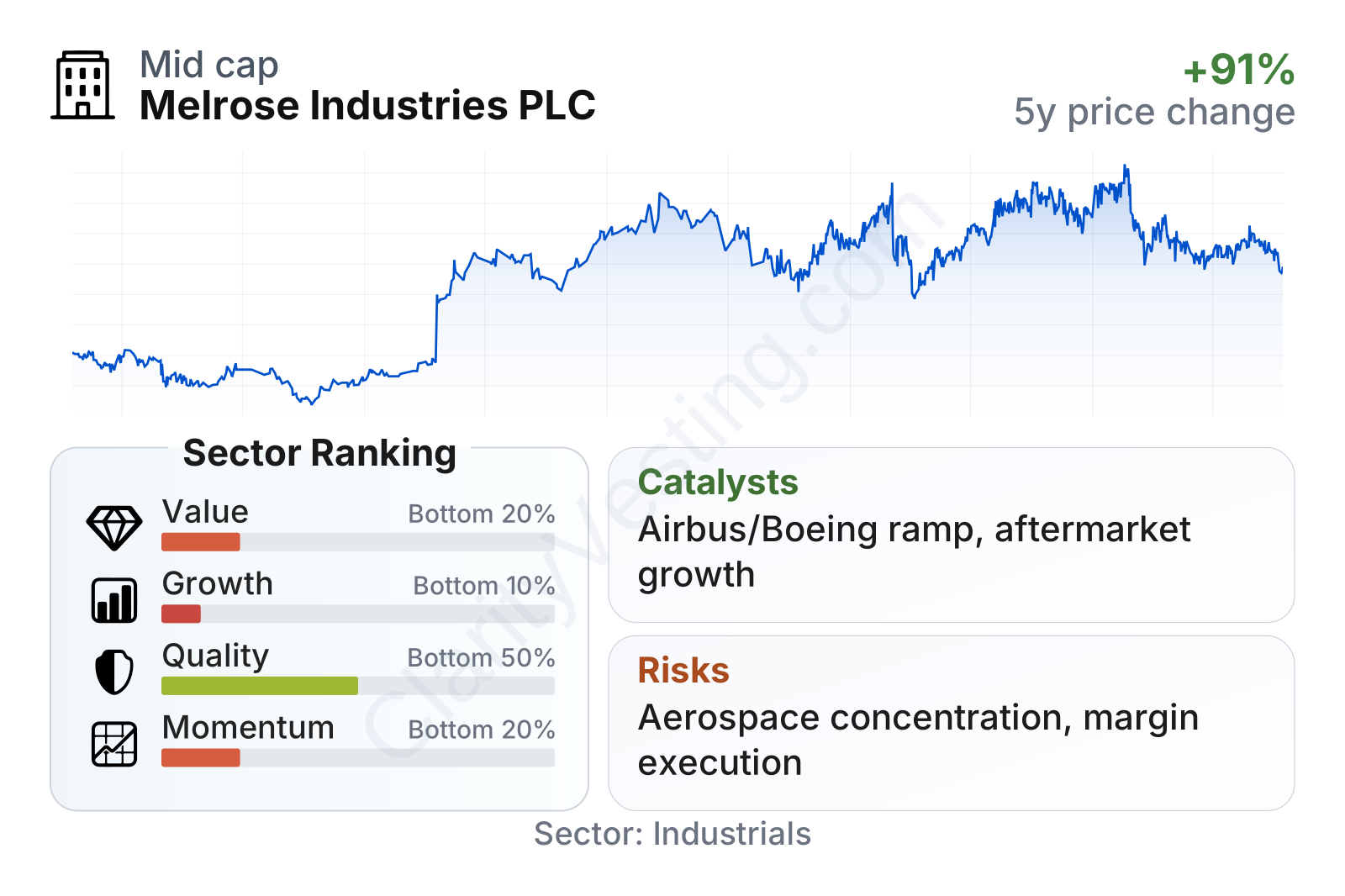
Melrose is now a mid-sized industrial company by market value, and its share price history shows a sharp recovery from 2022 lows followed by renewed volatility. The metrics table points to a mixed profile. Profitability has improved recently, with operating margin above the sector median, and leverage is not extreme for an aerospace supplier. However, growth rankings remain weak because the five-year comparison still reflects restructuring, divestments, and past losses. Valuation multiples look demanding versus the sector, especially on earnings, while free cash flow yield and dividend yield remain relatively modest.
Growth
Melrose operates in an attractive part of the industrial economy. Commercial aerospace remains supported by long-term air traffic growth, large aircraft backlogs, and the need for more fuel-efficient fleets. Defense spending has also strengthened in many Western markets, which supports some engine and structures programs. These are favorable industry conditions for a supplier with established positions on major platforms.
The company’s current strategy also makes industrial sense. Instead of managing unrelated businesses, Melrose is now centered on aerospace, where product qualification is difficult, contracts can last many years, and replacement demand can continue well after an aircraft enters service. That can create durable revenue streams once a supplier is embedded on a program.
Near-term revenue growth has been positive and broadly in line with the industry, but the longer-term record still looks weak because today’s company is much smaller than the old group. That means the headline five-year growth profile understates the recovery in the remaining aerospace operations. What matters more now is whether production rates at Airbus, Boeing, and major engine programs continue to rise.
Cash generation is an area to watch closely. Melrose has returned to positive free cash flow, but the level is still fairly modest relative to its market value. For a long-term business case, stronger and more consistent cash conversion would be an important sign that recent operating improvements are becoming durable rather than temporary.
One meaningful catalyst is the continued normalization of civil aerospace supply chains. As aircraft build rates recover and maintenance demand remains active, suppliers with approved content on installed platforms can benefit from both new production and aftermarket activity. Another potential tailwind is the company’s work on advanced engine structures and lightweight composite technologies, areas that fit the industry’s push for efficiency and lower emissions. Recent company communications have also emphasized improving operational execution, which matters because margin recovery in aerospace can be powerful when fixed costs are spread over higher volumes.
Risks
This article is for informational purposes only and does not constitute financial advice. Some content is AI-generated. See Disclaimer


