Stock Analysis · Martin Marietta Materials Inc (MLM)
Overview
Martin Marietta Materials is a large U.S. producer of construction aggregates and other building materials. In simple terms, it supplies the crushed stone, sand, gravel, cement, asphalt, and ready mixed concrete that go into highways, roads, bridges, homes, warehouses, data centers, and other infrastructure projects. Its business is tied to physical construction activity, especially in fast-growing Sun Belt and infrastructure-heavy regions of the United States.
The company’s largest business by far is aggregates, which is usually the most important product category in this industry because quarries are difficult to replicate and transportation costs create strong local market positions. Martin Marietta also operates downstream businesses that use aggregates as inputs, such as asphalt and ready mixed concrete, and it has a cement operation as well. Based on recent annual reporting, the revenue mix is approximately:
- Aggregates: about 68% of revenue. This includes crushed stone, sand, and gravel sold for public infrastructure, nonresidential construction, and residential building.
- Cement: about 12% of revenue. Cement is a key binding material used in concrete and major construction projects.
- Ready mixed concrete: about 10% of revenue. This is concrete produced and delivered directly to job sites.
- Asphalt and paving services: about 9% of revenue. This supports road construction and resurfacing work.
- Other products and services: about 1% of revenue. This includes smaller activities adjacent to its core operations.
That mix matters because aggregates tends to carry the strongest long-term strategic value. A quarry near an expanding metro area can become more valuable over time as land use intensifies, replacement becomes harder, and trucking distances remain a major cost for customers.
Over the past several years, the company’s revenue expanded from a little above $5.4 billion in 2021 to roughly $6.5 billion in 2025. Operating profit and cash generation also improved materially over that period, although results have not moved in a straight line. The broad pattern is a business with strong pricing power in core materials and a meaningful exposure to public infrastructure spending.
The long-term picture shows a clear improvement in profitability from 2021 through 2023, with revenue rising and gross profit expanding faster than sales. Results in 2024 and 2025 include less clean comparisons because of unusual items, so the underlying takeaway is more useful than any single year: Martin Marietta has generally become a larger and more profitable enterprise, but short-term earnings can be distorted by one-off gains, charges, or acquisition-related effects.
Key Figures
| Metric | Value | Sector ⓘ |
|---|---|---|
| Date | Nov 14, 2026 | |
| Context | ||
| Sector | Basic Materials | |
| Industry | Building Materials | |
| Market Cap ⓘ | $37.28B | |
| Beta ⓘ | 1.03 | |
Value (Cheapness) | ||
| P/E Ratio ⓘ | 39.11 | 16.36 |
| P/B Ratio ⓘ | 1.93 | 2.33 |
| FCF Yield ⓘ | 2.35% | 5.13% |
| Dividend Yield ⓘ | 0.63% | 1.93% |
| EBIT / EV ⓘ | 2.64% | 7.80% |
| PEG ⓘ | 2.31 | |
Growth (Business expansion) | ||
| Revenue Growth ⓘ | 28.30% | 11.40% |
| RPS Growth (5Y CAGR) ⓘ | 5.75% | 4.52% |
| EPS Growth (5Y CAGR) ⓘ | 0.66% | -8.98% |
| BVPS Growth (5Y CAGR) ⓘ | 12.26% | 5.55% |
| Margin Growth (5Y Trend) ⓘ | 4.74% | -1.48% |
| FCF Growth (5Y CAGR) ⓘ | 8.16% | 0.40% |
| DPS Growth (5Y CAGR) ⓘ | 8.37% | 6.02% |
Quality (Business durability) | ||
| ROIC (Latest) ⓘ | 5.35% | 9.26% |
| ROA (Latest) ⓘ | 8.26% | 5.01% |
| ROIC (5Y Median) ⓘ | 15.30% | 7.95% |
| ROA (5Y Median) ⓘ | 6.17% | 3.88% |
| Net Debt / EBIT (Latest) ⓘ | 9.79 | 1.25 |
| Net Debt / EBIT (5Y Median) ⓘ | 3.46 | 1.65 |
| Net Debt / EBITDA (Latest) ⓘ | 6.20 | 0.94 |
| Net Debt / Assets ⓘ | 35.35% | 12.26% |
| EBITDA / Interest ⓘ | 6.82 | 13.02 |
| Operating Margin (Latest) ⓘ | 18.57% | 13.20% |
| Operating Margin (5Y Median) ⓘ | 23.18% | 11.86% |
| Debt to Equity (Latest) ⓘ | 75.03% | 40.38% |
| Profit Margin (Latest) ⓘ | 31.88% | 6.68% |
| Free Cash Flow (Latest) ⓘ | $875.00M | |
Momentum (Price trend) | ||
| 3Y Return ⓘ | +15.62% | +58.61% |
| 12M Return (excl. last month) ⓘ | -27.88% | +18.38% |
| 6M Return ⓘ | -10.44% | -7.11% |
| Price vs. 200-Day MA ⓘ | -9.64% | -2.58% |
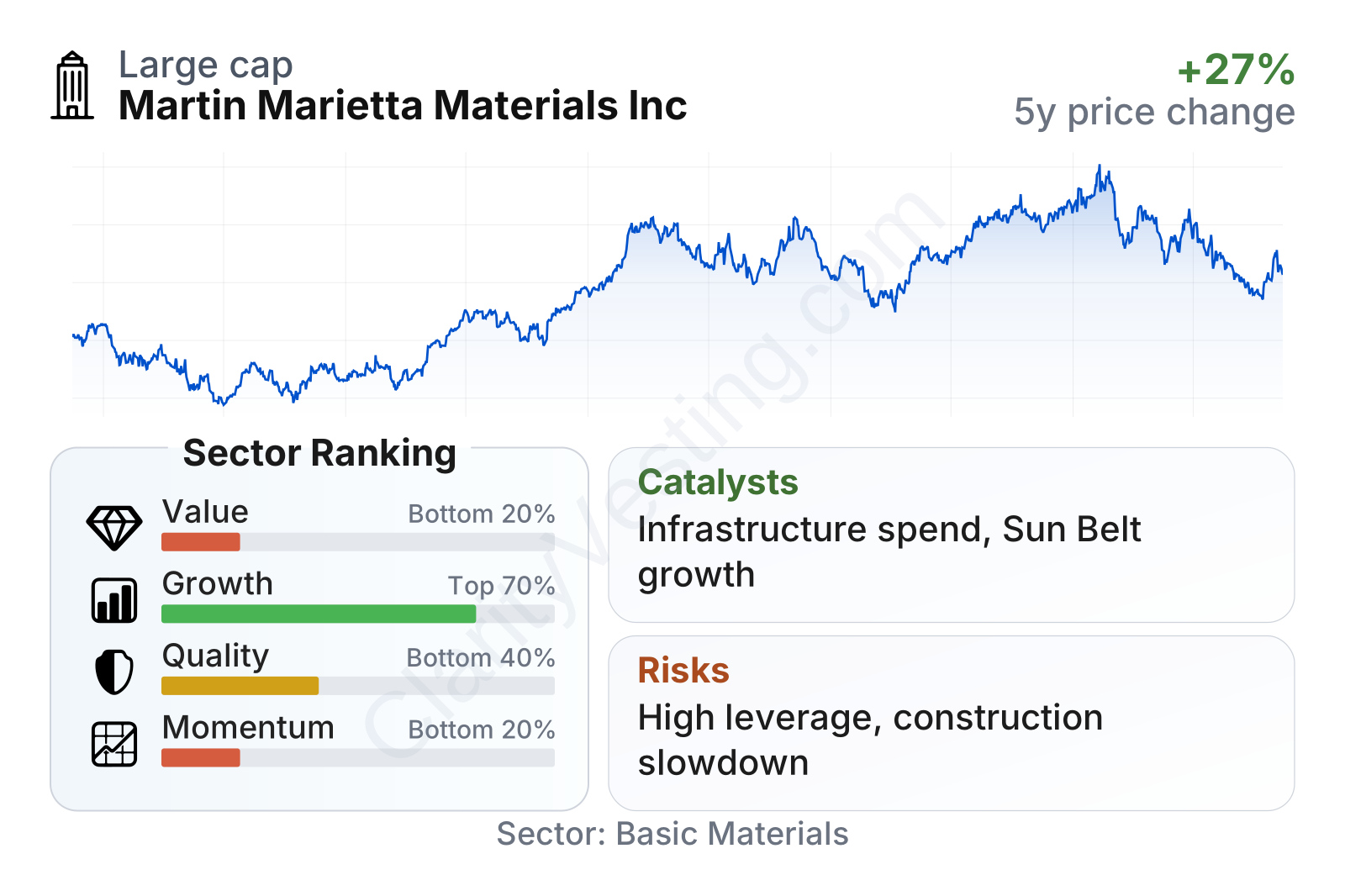
Martin Marietta is a very large building materials company with a stock that has been more volatile than a utility but not unusually erratic for an economically sensitive industrial name. The table points to a mixed profile: growth has been better than much of the sector, margins remain strong, but current valuation measures look demanding relative to peers. Momentum is also weak, meaning the share price has recently lagged much of the basic materials group.
The stock price history reflects this pattern well. The shares climbed strongly through 2023 and much of 2024, then gave back a notable portion of those gains in 2025 and 2026. That pullback reduces some of the heat that had built into the stock, but it does not automatically make the company statistically cheap compared with its sector.
Growth
Martin Marietta operates in a sector with long-duration support rather than rapid technological disruption. Construction materials is not a high-growth industry in the usual sense, but it can still produce durable expansion when a company owns scarce reserves in attractive regions and can lift prices faster than costs. That is the central appeal here: the business is tied to infrastructure renewal, population migration to the South and West, industrial reshoring, logistics facilities, and heavy civil projects that require enormous volumes of aggregate.
The company’s strategy is broadly coherent for long-term growth. Management has emphasized aggregates-led expansion, disciplined acquisitions, and operating efficiency. That approach makes sense because aggregates usually offers the best competitive economics in this industry. Acquiring or developing reserves near high-demand markets can support growth for many years, especially where permitting new quarries is difficult.
Revenue growth has been uneven quarter to quarter, which is normal in a construction-linked business affected by weather, project timing, and housing demand. Even so, the recent trajectory improved sharply, and the latest year-over-year increase is well above the sector median. Over a five-year view, revenue per share growth has also been modestly ahead of the sector, which suggests the business has expanded without relying only on financial engineering.
Cash generation has also strengthened over time, although not smoothly. Free cash flow was much higher in the latest trailing period than it was several years ago, which supports the idea that Martin Marietta is not just growing accounting earnings but still converting a meaningful amount of profit into cash. That matters in a capital-intensive business where quarries, plants, and transportation assets require ongoing spending.
Several catalysts could support future growth. U.S. federal and state infrastructure programs continue to create demand for roads, bridges, and public works. Data center construction and manufacturing projects can also raise demand for aggregates and cement-intensive work. In addition, population growth in many of the company’s core markets supports long-term needs for highways, subdivisions, distribution centers, and utilities.
Recent company developments also point to expansion opportunities. Martin Marietta has continued to reshape its portfolio around core materials and strategic geographies, and its acquisitions over time have deepened its positions in attractive regional markets. For a business like this, stronger density in local markets can improve pricing, reduce logistics friction, and make fixed assets more productive.
Risks
This article is for informational purposes only and does not constitute financial advice. Some content is AI-generated. See Disclaimer