Stock Analysis · Mueller Industries Inc (MLI)
Overview
Mueller Industries is a U.S.-based manufacturer of metal and plastic products used mainly in building construction, heating and cooling systems, refrigeration, plumbing, fire suppression, medical gas systems, and parts for industrial and transportation applications. In simple terms, it makes many of the components that help move water, air, gas, and refrigerants through buildings and equipment. Its operations are tied closely to nonresidential construction, residential repair and remodeling, HVAC replacement, refrigeration demand, and broader industrial activity.
The company reports through three main business segments. Based on recent annual reporting, revenue is spread across the business in a fairly diversified way:
- Piping Systems: approximately 45% to 50% of revenue. This is the largest segment and includes copper tube, plastic pipe and fittings, valves, and related products used in plumbing, HVAC, refrigeration, and infrastructure applications.
- Industrial Metals: approximately 25% to 30% of revenue. This segment includes brass, copper, aluminum, and other metal products, rods, bars, forgings, and impact extrusions used in industrial, electrical, and transportation markets.
- Climate: approximately 20% to 25% of revenue. This business supplies components for air-conditioning and refrigeration systems, including line sets, coils, and related parts.
- Other and intersegment activity: typically a small remainder, generally below 5%, depending on period and classification.
One important point for long-term readers is that Mueller is not a single-product company. It sits across several everyday end markets, with a particularly strong position in copper and brass-based products that are difficult to replace in many applications. The business also benefits from a large manufacturing footprint and long-standing relationships with distributors, OEMs, and contractors.
Profitability has stayed unusually strong for an industrial manufacturer. Over the last several years, revenue moved up and down with metal prices and demand cycles, but operating income and net income remained robust, helped by scale, manufacturing efficiency, and disciplined costs.
The business mix shows a company that converts a meaningful share of sales into operating profit, while interest expense has become almost negligible. That matters because it means more of the company’s earnings power is coming from operations rather than financial leverage.
Key Figures
| Metric | Value | Sector ⓘ |
|---|---|---|
| Date | Oct 24, 2026 | |
| Context | ||
| Sector | Industrials | |
| Industry | Metal Fabrication | |
| Market Cap ⓘ | $12.57B | |
| Beta ⓘ | 1.09 | |
Value (Cheapness) | ||
| P/E Ratio ⓘ | 15.82 | 22.29 |
| P/B Ratio ⓘ | 3.61 | 1.98 |
| FCF Yield ⓘ | 3.16% | 6.26% |
| Dividend Yield ⓘ | N/A | 1.92% |
| EBIT / EV ⓘ | 9.58% | 4.83% |
| PEG ⓘ | 3.41 | |
Growth (Business expansion) | ||
| Revenue Growth ⓘ | 25.50% | 9.30% |
| RPS Growth (5Y CAGR) ⓘ | 3.22% | 7.76% |
| EPS Growth (5Y CAGR) ⓘ | -12.39% | -13.17% |
| BVPS Growth (5Y CAGR) ⓘ | 20.80% | 6.13% |
| Margin Growth (5Y Trend) ⓘ | 7.22% | 0.74% |
| FCF Growth (5Y CAGR) ⓘ | 25.15% | 10.79% |
| DPS Growth (5Y CAGR) ⓘ | 39.92% | 9.41% |
Quality (Business durability) | ||
| ROIC (Latest) ⓘ | 25.84% | 10.75% |
| ROA (Latest) ⓘ | 23.61% | 5.41% |
| ROIC (5Y Median) ⓘ | 30.08% | 9.37% |
| ROA (5Y Median) ⓘ | 24.26% | 4.95% |
| Net Debt / EBIT (Latest) ⓘ | -1.24 | 2.04 |
| Net Debt / EBIT (5Y Median) ⓘ | -1.22 | 2.27 |
| Net Debt / EBITDA (Latest) ⓘ | -1.17 | 1.39 |
| Net Debt / Assets ⓘ | -33.07% | 19.27% |
| EBITDA / Interest ⓘ | 3,687.72 | 9.58 |
| Operating Margin (Latest) ⓘ | 22.89% | 10.49% |
| Operating Margin (5Y Median) ⓘ | 22.02% | 10.30% |
| Debt to Equity (Latest) ⓘ | 0.76% | 64.82% |
| Profit Margin (Latest) ⓘ | 18.25% | 6.67% |
| Free Cash Flow (Latest) ⓘ | $397.36M | |
Momentum (Price trend) | ||
| 3Y Return ⓘ | +238.83% | +67.77% |
| 12M Return (excl. last month) ⓘ | +21.58% | +12.05% |
| 6M Return ⓘ | -14.11% | 0.00% |
| Price vs. 200-Day MA ⓘ | -7.55% | +0.67% |
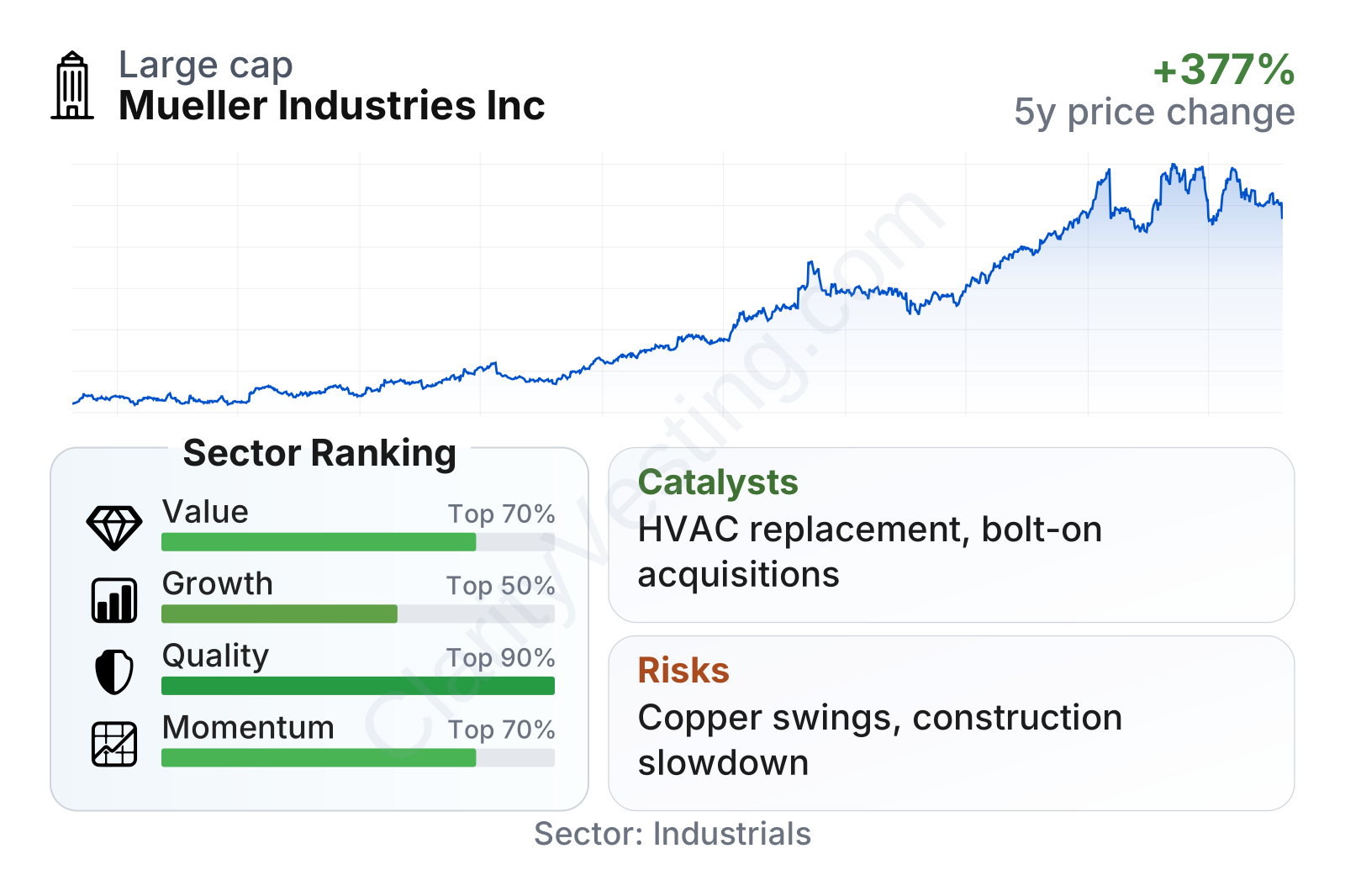
Mueller stands out most on business quality. Profitability, returns on capital, returns on assets, and balance-sheet strength all rank well above much of the industrial sector. Growth is more mixed: recent revenue growth has been strong, but longer-term revenue-per-share and earnings growth have been less consistent because the company operates in cyclical markets. On valuation, the stock trades at a lower earnings multiple than the sector median, although other measures suggest the market is already recognizing the company’s higher quality.
Growth
Mueller operates in sectors that should remain relevant for many years: plumbing, HVAC, refrigeration, data-center cooling, building upgrades, and repair work. These are not niche markets dependent on one technology trend. Instead, they are tied to basic physical infrastructure. That makes the long-term demand base more durable than in many product categories, even if year-to-year results can swing with construction cycles and commodity prices.
The company’s strategy for growth is sensible because it combines organic expansion with selective acquisitions. Mueller has regularly used its strong cash generation to add adjacent product lines and strengthen distribution reach. That approach tends to work well in fragmented industrial markets where scale, plant efficiency, and procurement matter.
Recent revenue growth has clearly reaccelerated after a weaker stretch in 2023. The latest year-over-year trend is running well above the industrial sector median, suggesting that current demand and pricing have turned more favorable. For a cyclical manufacturer, this kind of rebound is important because it shows the business still has volume and mix momentum rather than relying only on cost cutting.
Cash generation has also remained strong over time, even with some normal fluctuations from working capital and cycle effects. Free cash flow in recent years has stayed at levels that give the company room for dividends, acquisitions, plant investment, and continued financial flexibility. That is a useful growth feature because Mueller does not need to stretch its balance sheet to fund expansion.
A meaningful catalyst is the continued need for HVAC replacement and upgrades in North America. Older systems eventually need to be replaced, and more efficient cooling equipment typically requires related components that Mueller supplies. Another catalyst is infrastructure and commercial construction tied to manufacturing reshoring and data-center buildouts, both of which need piping, valves, and thermal-management components. The company has also benefited from keeping capacity available in product categories where reliability and delivery times matter.
Recent company communications have also shown an ongoing focus on acquisitions and capacity investment, which supports the idea that management sees room to expand share in core categories rather than simply harvest mature operations.
Risks
This article is for informational purposes only and does not constitute financial advice. Some content is AI-generated. See Disclaimer


