Stock Analysis · Millicom International Cellular S.A (MLCMF)
Overview
Millicom International Cellular S.A., best known through the Tigo brand, is a telecom and digital infrastructure company focused on Latin America. It provides mobile services, fixed broadband, cable television, business connectivity, mobile financial services, and data center and tower-related infrastructure. Its markets include countries such as Guatemala, Honduras, El Salvador, Nicaragua, Costa Rica, Panama, Colombia, Bolivia, and Paraguay, although the exact mix has changed over time through acquisitions, partnerships, and asset sales.
In simple terms, Millicom earns money by connecting households and businesses to communication networks. Its business is no longer just about mobile phone plans. A growing part of the model is selling home internet, bundled telecom services, enterprise connectivity, and infrastructure capacity that can support rising data usage across the region.
Based on recent annual reporting, revenue is mainly split between mobile services and home or fixed-line connectivity, with smaller contributions from business services and other activities. The mix varies by country, but a practical company-wide view is roughly the following:
- Mobile services: about 50% to 55% — prepaid and postpaid voice, mobile data, text, handset-related activity, and other wireless services.
- Fixed services: about 35% to 40% — residential broadband, pay TV, voice, and bundled home packages delivered through cable or fiber networks.
- B2B, infrastructure, and other revenue: about 10% to 15% — enterprise connectivity, cloud and data services, wholesale, mobile financial services, towers, and related activities.
What stands out in the business model is the high share of recurring service revenue. Telecom customers typically pay monthly or recharge regularly, which can make cash generation more stable than in many cyclical industries. The flow of revenue to profit has also improved in recent years, with lower operating cost pressure and a stronger operating margin than the sector median.
The multi-year revenue flow shows a business that has expanded sales from roughly $4.3 billion in 2021 to about $5.8 billion in 2025, while gross profit also moved higher. Cost of revenue has become a smaller share of sales over time, and selling and administrative costs have not risen as fast as revenue. The biggest drag remains interest expense, which stays elevated and explains why net income has been more volatile than operating income.
Key Figures
| Metric | Value | Sector ⓘ |
|---|---|---|
| Date | Oct 03, 2026 | |
| Context | ||
| Sector | Communication Services | |
| Industry | Telecom Services | |
| Market Cap ⓘ | $5.03B | |
| Beta ⓘ | 0.90 | |
Value (Cheapness) | ||
| P/E Ratio ⓘ | 14.35 | 18.20 |
| FCF Yield ⓘ | 24.19% | 14.71% |
| Dividend Yield ⓘ | N/A | 2.86% |
| EBIT / EV ⓘ | 6.52% | 4.85% |
| PEG ⓘ | 0.44 | |
Growth (Business expansion) | ||
| Revenue Growth ⓘ | 59.40% | 5.50% |
| RPS Growth (5Y CAGR) ⓘ | 1.06% | 4.55% |
| EPS Growth (5Y CAGR) ⓘ | N/A | -18.01% |
| Margin Growth (5Y Trend) ⓘ | 24.58% | 1.32% |
| FCF Growth (5Y CAGR) ⓘ | 83.58% | 5.96% |
| DPS Growth (5Y CAGR) ⓘ | N/A | 5.09% |
Quality (Business durability) | ||
| ROIC (Latest) ⓘ | 12.48% | 8.64% |
| ROIC (5Y Median) ⓘ | N/A | 8.11% |
| Net Debt / EBIT (Latest) ⓘ | 4.57 | 1.92 |
| Net Debt / EBIT (5Y Median) ⓘ | 5.90 | 2.85 |
| Net Debt / EBITDA (Latest) ⓘ | 2.32 | 1.25 |
| Net Debt / Assets ⓘ | 38.11% | 18.77% |
| EBITDA / Interest ⓘ | 4.44 | 8.75 |
| Operating Margin (Latest) ⓘ | 23.81% | 15.58% |
| Operating Margin (5Y Median) ⓘ | 16.75% | 13.53% |
| Debt to Equity (Latest) ⓘ | N/A | 59.53% |
| Profit Margin (Latest) ⓘ | 9.18% | 8.78% |
| Free Cash Flow (Latest) ⓘ | $1.22B | |
Momentum (Price trend) | ||
| 3Y Return ⓘ | N/A | +43.39% |
| 12M Return (excl. last month) ⓘ | 0.00% | +1.92% |
| 6M Return ⓘ | 0.00% | +2.94% |
| Price vs. 200-Day MA ⓘ | 0.00% | +0.74% |
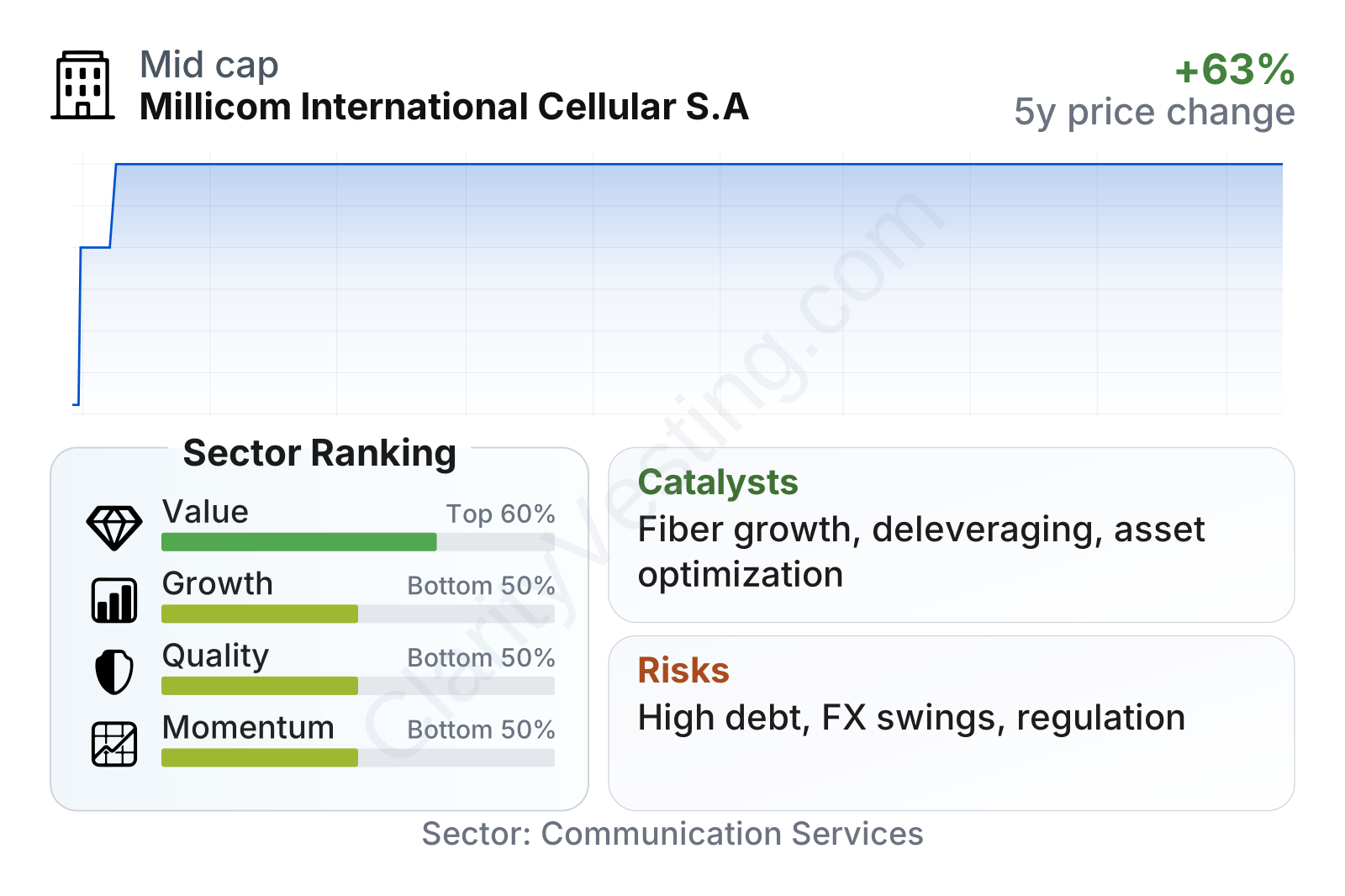
Millicom currently sits in a middle-to-better relative position on valuation, supported by a lower earnings multiple than the sector median and a notably strong free cash flow yield. Profitability is mixed but not weak: operating margin and return on invested capital compare well with many peers, while leverage remains clearly heavier than average. Growth metrics are uneven. Recent revenue and cash flow growth are strong, yet the longer five-year revenue-per-share trend is much more modest. The market picture is calmer, with recent share-price momentum lagging the broader telecom group after a sharp re-rating earlier in the period.
At a high level, this is a mid-sized telecom operator with meaningful cash generation, improving operating efficiency, and balance-sheet constraints that still matter. The stock’s beta is below 1, which suggests price swings have historically been somewhat less aggressive than the broader market, although country and currency risks can still create sharp moves.
Growth
Millicom operates in a sector with durable long-term demand. In Latin America, mobile data consumption, household broadband adoption, digital payments, cloud connectivity, and enterprise network needs continue to grow as economies digitize. Telecom is not a fast-changing consumer fad business; it is a utility-like service tied to everyday communication, streaming, remote work, and business operations. That gives the company exposure to a structurally relevant market, even if growth can be uneven by country.
The strategy broadly makes sense for future expansion. Management has been emphasizing higher-value customers, broadband network quality, fiber expansion, convergence between mobile and fixed services, and monetization of infrastructure assets. This is important because telecom growth increasingly comes from deeper customer relationships rather than simply adding more prepaid mobile lines. A household that uses broadband, mobile, and entertainment services together is usually more valuable and harder to lose than a single-service user.
Another favorable point is cash generation. Free cash flow is strong relative to the company’s size, and operating margins have improved meaningfully over the last several years. That combination creates room for debt reduction, network upgrades, shareholder distributions, or selective investment. For a telecom operator, the ability to self-fund a large part of its infrastructure needs is a meaningful advantage.
Recent company reporting has also highlighted actions around portfolio simplification and infrastructure optimization. Those moves can unlock value because telecom groups often carry assets that are worth more when separated, shared, or run more efficiently. In Millicom’s case, catalysts are less about a single breakthrough product and more about steady execution: better broadband penetration, stronger postpaid and fixed-line mix, efficiency gains, and gradual deleveraging.
Risks
This article is for informational purposes only and does not constitute financial advice. Some content is AI-generated. See Disclaimer