Stock Analysis · McCormick & Company Incorporated (MKC-V)
Overview
McCormick & Company is a global food company focused on flavor. It sells spices, seasonings, condiments, sauces, and flavor solutions used both at home and in restaurants or packaged food manufacturing. Its business is built around well-known consumer brands such as McCormick, French’s, Frank’s RedHot, and Cholula, alongside an industrial segment that supplies food manufacturers and foodservice customers.
The company reports two main operating segments. Based on recent annual reporting, revenue is split approximately as follows:
- Consumer segment: about 60% of revenue — packaged spices and herbs, recipe mixes, condiments, hot sauces, mustard, and related flavor products sold through grocery, mass retail, e-commerce, and other retail channels.
- Flavor Solutions segment: about 40% of revenue — seasoning blends, sauces, coatings, and flavor systems sold to food manufacturers, restaurant chains, and foodservice operators.
Geographically, McCormick is diversified across the Americas, Europe, the Middle East and Africa, and Asia-Pacific, though the Americas remain the largest contributor. The business mix matters because the retail side tends to benefit from household brand loyalty, while the industrial side can provide scale and long-term customer relationships with large food companies.
Over the last several years, revenue has moved gradually higher, while profitability has recovered after a tougher inflation period. Gross profit and operating income improved meaningfully from the 2022 pressure point, showing that pricing, mix, and supply chain normalization helped offset higher input costs. Interest expense remains material, but net income has stabilized at a solid level for a company of McCormick’s size.
The overall picture is that of a mature but resilient staples company: slow-to-moderate top-line expansion, strong brand presence, and a business model that converts a large share of sales into steady cash generation.
Key Figures
| Metric | Value | Sector ⓘ |
|---|---|---|
| Date | Oct 17, 2026 | |
| Context | ||
| Sector | Consumer Defensive | |
| Industry | Packaged Foods | |
| Market Cap ⓘ | $12.49B | |
| Beta ⓘ | 0.64 | |
Value (Cheapness) | ||
| P/E Ratio ⓘ | 8.39 | 17.88 |
| P/B Ratio ⓘ | 1.75 | 1.29 |
| FCF Yield ⓘ | 8.02% | 12.39% |
| Dividend Yield ⓘ | 4.08% | 2.85% |
| EBIT / EV ⓘ | 6.74% | 6.43% |
| PEG ⓘ | 1.95 | |
Growth (Business expansion) | ||
| Revenue Growth ⓘ | 17.40% | 4.10% |
| RPS Growth (5Y CAGR) ⓘ | 2.06% | 6.18% |
| EPS Growth (5Y CAGR) ⓘ | 17.98% | -13.59% |
| BVPS Growth (5Y CAGR) ⓘ | 6.70% | 3.20% |
| Margin Growth (5Y Trend) ⓘ | -0.13% | -0.15% |
| FCF Growth (5Y CAGR) ⓘ | 7.70% | 4.10% |
| DPS Growth (5Y CAGR) ⓘ | 7.44% | 6.79% |
Quality (Business durability) | ||
| ROIC (Latest) ⓘ | 8.49% | 12.34% |
| ROA (Latest) ⓘ | 10.03% | 6.30% |
| ROIC (5Y Median) ⓘ | 8.88% | 10.49% |
| ROA (5Y Median) ⓘ | 6.01% | 5.44% |
| Net Debt / EBIT (Latest) ⓘ | 3.26 | 1.96 |
| Net Debt / EBIT (5Y Median) ⓘ | 4.59 | 2.35 |
| Net Debt / EBITDA (Latest) ⓘ | 2.66 | 1.38 |
| Net Debt / Assets ⓘ | 23.51% | 21.51% |
| EBITDA / Interest ⓘ | 7.04 | 9.46 |
| Operating Margin (Latest) ⓘ | 15.64% | 8.87% |
| Operating Margin (5Y Median) ⓘ | 16.22% | 9.53% |
| Debt to Equity (Latest) ⓘ | 60.63% | 72.35% |
| Profit Margin (Latest) ⓘ | 19.39% | 5.40% |
| Free Cash Flow (Latest) ⓘ | $1.00B | |
Momentum (Price trend) | ||
| 3Y Return ⓘ | -17.54% | +20.92% |
| 12M Return (excl. last month) ⓘ | -15.16% | +2.13% |
| 6M Return ⓘ | -14.60% | +1.26% |
| Price vs. 200-Day MA ⓘ | -15.32% | +1.39% |
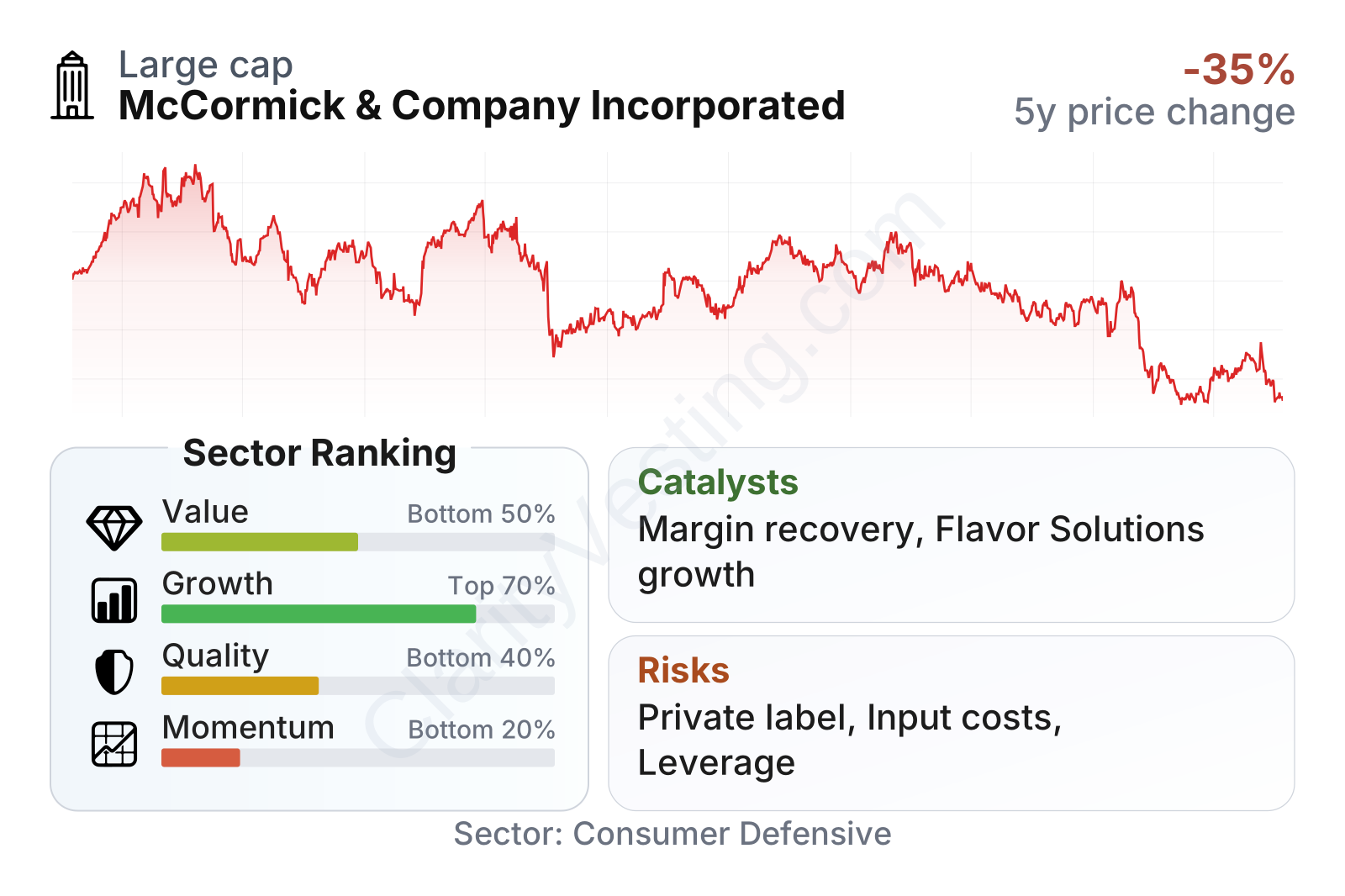
McCormick stands out as a relatively low-volatility consumer staples company, with a beta well below 1, which is consistent with the defensive nature of its products. The broader factor profile is mixed. Growth and cash generation look better than many sector peers, while balance-sheet-related quality measures remain less favorable because leverage is still elevated versus much of the packaged foods group. Momentum is weak, reflecting a multi-year share price decline, but that has also pushed the dividend yield above the sector median.
The stock’s recent trading history shows a large derating from the premium multiples seen in 2021 through 2025. That decline has happened even as the operating business remained profitable and cash generative, which is important context when looking at valuation later.
Growth
McCormick operates in a sector with structural stability rather than rapid expansion. People continue to buy seasonings, sauces, and flavor products in most economic environments, and food companies continue to outsource flavor systems and product development. That does not make packaged foods a high-growth industry, but it does make it durable. Within that setting, flavor is one of the more attractive niches because it is a small part of the consumer’s grocery bill yet a meaningful driver of taste, brand identity, and repeat purchase behavior.
The company’s strategy for future growth is coherent. Management has continued to lean on brand investment, product innovation, distribution expansion, and category participation in faster-growing areas such as hot sauce, convenient meal flavoring, and international seasoning demand. On the industrial side, long-standing relationships with food manufacturers and restaurant operators create opportunities to grow alongside customer product launches.
Recent revenue growth has accelerated sharply on a trailing basis, well above the sector median. That does not automatically mean McCormick has become a high-growth company, because short-term comparisons can be helped by timing, pricing, or prior-year softness. Still, it suggests the business has regained momentum after the inflation-heavy period that weighed on volumes and purchasing behavior.
Cash generation is one of the more supportive parts of the growth case. Free cash flow improved materially from earlier lows and remains strong enough to support dividends, debt reduction, and ongoing brand spending. Over a five-year view, free cash flow growth has outpaced the sector median, which is notable for a mature staples company.
A practical catalyst is margin recovery. McCormick has already shown that when input-cost pressure eases, earnings can improve meaningfully because of its pricing power and scale. Another catalyst is international expansion, especially where rising middle-class consumption supports greater use of branded seasonings and sauces. In addition, the company’s portfolio includes several brands with room for line extensions and premiumization, which can lift sales without requiring entirely new categories.
Recent company updates have also highlighted continued productivity efforts and portfolio focus, both of which can help protect profits even if volume growth remains uneven. For a long-term view, that matters as much as raw sales growth.
Risks
This article is for informational purposes only and does not constitute financial advice. Some content is AI-generated. See Disclaimer


