Stock Analysis · Middleby Corp (MIDD)
Overview
Middleby Corporation is an industrial equipment company focused on foodservice, food processing, and residential kitchen products. In simple terms, it designs and sells ovens, fryers, beverage systems, conveyors, refrigeration-related solutions, preparation equipment, and a wide range of premium kitchen appliances. Its customers span restaurants, chain operators, institutional kitchens, food manufacturers, and households. The business has grown over many years through a mix of product development and acquisitions, giving it a broad portfolio of brands across commercial and residential cooking.
The company’s revenue is mainly split across three operating segments. Based on recent annual reporting, the largest source is commercial foodservice equipment, followed by residential kitchen equipment, with food processing equipment as the smallest of the three.
- Commercial Foodservice Equipment: approximately 50% to 55% of revenue. This segment includes cooking, warming, beverage, ice, preparation, and automation equipment used by restaurants, convenience stores, institutional kitchens, and other foodservice operators.
- Residential Kitchen Equipment: approximately 25% to 30% of revenue. This business includes premium and luxury home kitchen brands, such as ranges, ovens, cooktops, refrigeration, and outdoor cooking products.
- Food Processing Equipment: approximately 20% to 25% of revenue. This segment supplies machinery for large-scale food production, including thermal processing, slicing, mixing, packaging-related handling, and other systems used by food manufacturers.
What stands out in Middleby’s model is diversification inside a narrow theme: food equipment. That gives the company exposure to restaurant capital spending, packaged food manufacturing, and premium home renovation demand rather than relying on one end market alone. At the same time, all three segments are linked by similar engineering, manufacturing, and service capabilities.
Over the last several years, revenue and gross profit expanded meaningfully from 2021 through 2024 before dropping in 2025. Operating income stayed comparatively resilient for most of that period, but net income turned sharply negative in 2025 despite still-positive operating profit, which points to non-operating charges or unusual items rather than a collapse of the underlying business alone. That distinction matters when assessing the company’s long-term earning power.
Key Figures
| Metric | Value | Sector ⓘ |
|---|---|---|
| Date | Oct 24, 2026 | |
| Context | ||
| Sector | Industrials | |
| Industry | Specialty Industrial Machinery | |
| Market Cap ⓘ | $5.00B | |
| Beta ⓘ | 1.34 | |
Value (Cheapness) | ||
| P/E Ratio ⓘ | 16.04 | 22.29 |
| P/B Ratio ⓘ | 2.28 | 1.98 |
| FCF Yield ⓘ | 9.92% | 6.26% |
| Dividend Yield ⓘ | N/A | 1.92% |
| EBIT / EV ⓘ | -1.66% | 4.83% |
| PEG ⓘ | 1.51 | |
Growth (Business expansion) | ||
| Revenue Growth ⓘ | 9.90% | 9.30% |
| RPS Growth (5Y CAGR) ⓘ | 1.95% | 7.76% |
| EPS Growth (5Y CAGR) ⓘ | -17.10% | -13.17% |
| BVPS Growth (5Y CAGR) ⓘ | 5.12% | 6.13% |
| Margin Growth (5Y Trend) ⓘ | -2.82% | 0.74% |
| FCF Growth (5Y CAGR) ⓘ | 10.70% | 10.79% |
| DPS Growth (5Y CAGR) ⓘ | N/A | 9.41% |
Quality (Business durability) | ||
| ROIC (Latest) ⓘ | -2.97% | 10.75% |
| ROA (Latest) ⓘ | -8.05% | 5.41% |
| ROIC (5Y Median) ⓘ | 12.35% | 9.37% |
| ROA (5Y Median) ⓘ | 6.04% | 4.95% |
| Net Debt / EBIT (Latest) ⓘ | N/A | 2.04 |
| Net Debt / EBIT (5Y Median) ⓘ | 3.39 | 2.27 |
| Net Debt / EBITDA (Latest) ⓘ | N/A | 1.39 |
| Net Debt / Assets ⓘ | 33.96% | 19.27% |
| EBITDA / Interest ⓘ | N/A | 9.58 |
| Operating Margin (Latest) ⓘ | -3.21% | 10.49% |
| Operating Margin (5Y Median) ⓘ | 17.28% | 10.30% |
| Debt to Equity (Latest) ⓘ | 89.57% | 64.82% |
| Profit Margin (Latest) ⓘ | -13.91% | 6.67% |
| Free Cash Flow (Latest) ⓘ | $495.68M | |
Momentum (Price trend) | ||
| 3Y Return ⓘ | -3.99% | +67.77% |
| 12M Return (excl. last month) ⓘ | -17.50% | +12.05% |
| 6M Return ⓘ | -22.08% | 0.00% |
| Price vs. 200-Day MA ⓘ | -19.88% | +0.67% |
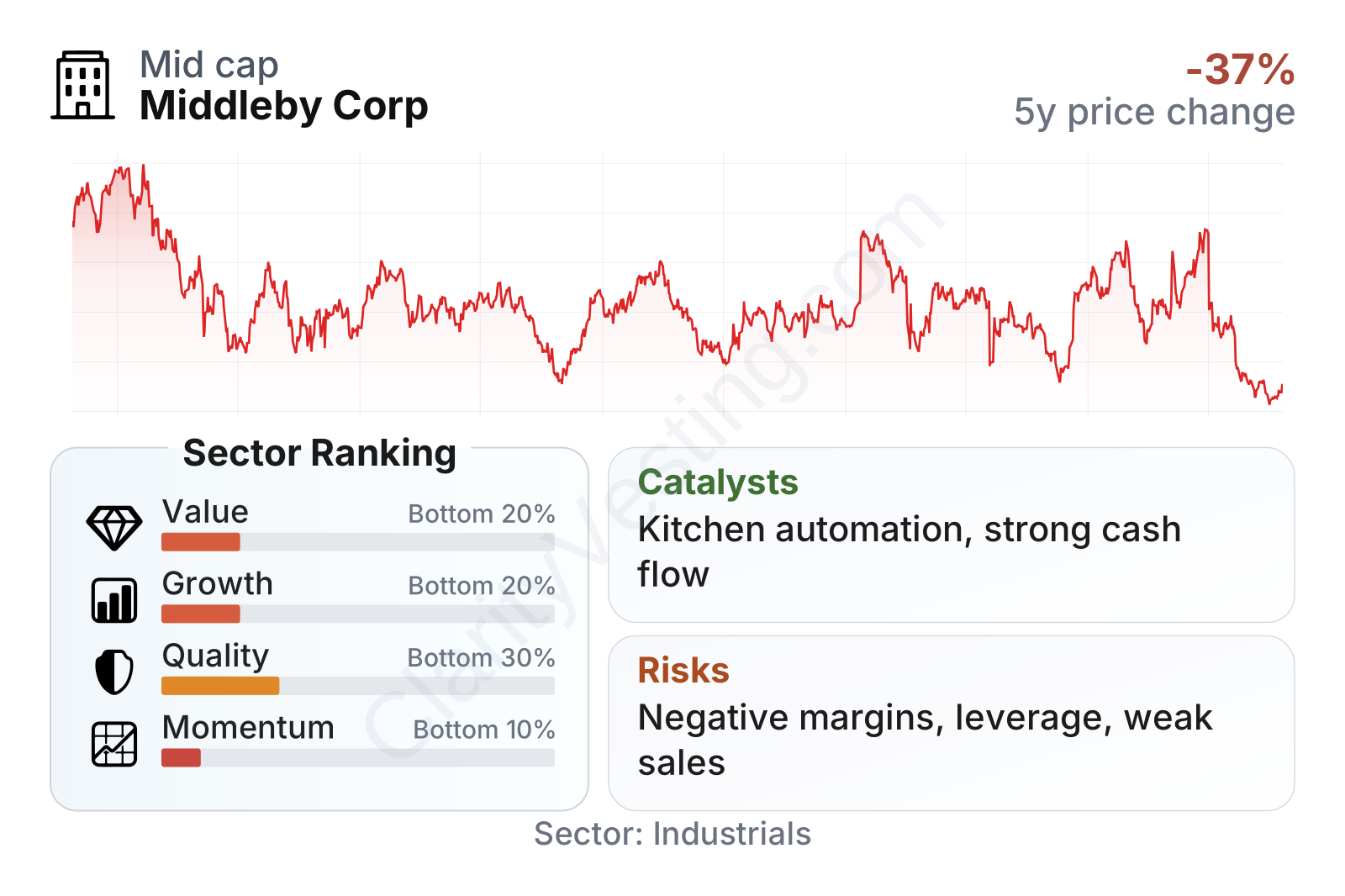
Middleby is a mid-sized industrial company with a stock that has recently traded with above-average volatility, as reflected by a beta above 1. On valuation, the earnings multiple sits below the sector median, while free cash flow yield is notably stronger than the industry midpoint. That combination usually suggests the market is discounting some clear concerns. At the same time, the factor breakdown is weak in growth, quality, and momentum, showing that the lower valuation is not coming from broad operating strength but from a mixed business picture.
The stock price history also shows this tension clearly: shares remain well below prior highs and recent momentum has been weak. In other words, the market is asking for proof that margin pressure, slower growth, and the recent hit to reported profitability are temporary rather than structural.
Growth
Middleby operates in end markets that still have attractive long-term drivers. Commercial kitchens continue to upgrade toward automation, labor-saving systems, faster throughput, better energy efficiency, and more consistent food quality. Food processors are also investing in efficiency and throughput, while premium residential kitchens benefit over time from remodeling cycles and consumer interest in high-end cooking equipment. These are not fast-changing software markets, but they are durable equipment categories with recurring replacement demand and room for innovation.
Its strategy also makes industrial sense. Middleby has long built scale through acquisitions, then used its portfolio breadth to cross-sell solutions, expand distribution, and improve manufacturing efficiency. In commercial foodservice especially, customers increasingly value integrated equipment platforms rather than isolated products. That supports a broader portfolio approach, particularly when large chain customers want kitchen systems that reduce labor and improve consistency.
Recent growth, however, has been uneven. The business posted strong year-over-year revenue growth in 2022, then slowed materially, with several negative periods afterward and another visible drop in 2026. That pattern suggests demand has become more cyclical and that some markets are digesting prior spending. So while the sector backdrop remains supportive over the long run, current growth is not yet showing steady acceleration.
Cash generation is a brighter point. Free cash flow rose strongly from 2022 through 2025 and, although it eased in the latest period, it remains substantial in absolute terms. For an equipment manufacturer, that matters because cash can support debt reduction, acquisitions, factory investment, and product development. A company with softer accounting earnings but still-solid cash generation often deserves closer attention, especially if the earnings weakness is tied to one-time items.
A notable catalyst is the continued push toward kitchen automation and operational efficiency in restaurants and food production. Middleby has been active in ventless cooking, faster cooking platforms, beverage systems, and other productivity-focused technologies. Another potential opportunity comes from normalization after a difficult comparison period: if restaurant and residential demand stabilize while the company keeps producing strong cash flow, operating performance could look better than recent headline figures suggest.
Risks
This article is for informational purposes only and does not constitute financial advice. Some content is AI-generated. See Disclaimer


