Stock Analysis · Magnolia Oil & Gas Corp (MGY)
Overview
Magnolia Oil & Gas Corp is an independent oil and gas producer focused on developing onshore U.S. shale assets. Its operations are concentrated mainly in South Texas, especially in the Karnes County area of the Eagle Ford Shale and in the Austin Chalk, with an additional position in the Giddings area. In simple terms, Magnolia drills wells, produces crude oil, condensate, natural gas, and natural gas liquids, and then sells those commodities into the market.
The business model is straightforward: revenue depends mostly on production volumes and commodity prices. The company does not operate a large refining or chemicals business, so results are more directly tied to upstream oil and gas economics than those of integrated energy majors.
Based on the company’s recent annual reporting, Magnolia’s revenue mix is led by oil, followed by natural gas liquids and then natural gas. Approximate shares can shift from quarter to quarter with commodity prices, but the broad mix is as follows:
- Oil sales: about 70% to 75% of total revenue. This is the largest contributor and includes crude oil and condensate production.
- Natural gas liquids sales: about 15% to 20% of total revenue. These are hydrocarbons such as propane and butane extracted during processing.
- Natural gas sales: about 8% to 12% of total revenue. This is the smallest of the three major product streams.
Operationally, Magnolia is built around disciplined capital spending, moderate production growth, and strong cash generation rather than aggressive expansion at any cost. That approach has helped it maintain a relatively lean cost base and a strong balance sheet compared with many peers.
The long-term pattern shows a company that keeps operating costs and overhead under control, but whose total revenue and earnings still move meaningfully with oil and gas prices. Even after the post-2022 normalization in commodity prices, Magnolia has remained profitable and cash generative, which is an important sign of resilience for a producer of its size.
Key Figures
| Metric | Value | Sector ⓘ |
|---|---|---|
| Date | Oct 17, 2026 | |
| Context | ||
| Sector | Energy | |
| Industry | Oil & Gas E&P | |
| Market Cap ⓘ | $6.90B | |
| Beta ⓘ | 0.79 | |
Value (Cheapness) | ||
| P/E Ratio ⓘ | 11.01 | 15.44 |
| P/B Ratio ⓘ | 2.14 | 1.73 |
| FCF Yield ⓘ | 7.62% | 8.20% |
| Dividend Yield ⓘ | 2.70% | 3.59% |
| EBIT / EV ⓘ | 8.40% | 7.46% |
| PEG ⓘ | N/A | |
Growth (Business expansion) | ||
| Revenue Growth ⓘ | 50.10% | 26.90% |
| RPS Growth (5Y CAGR) ⓘ | 3.54% | 6.90% |
| EPS Growth (5Y CAGR) ⓘ | -24.42% | -15.73% |
| BVPS Growth (5Y CAGR) ⓘ | 21.45% | 6.07% |
| Margin Growth (5Y Trend) ⓘ | -22.13% | 0.58% |
| FCF Growth (5Y CAGR) ⓘ | -7.21% | 1.86% |
| DPS Growth (5Y CAGR) ⓘ | 65.83% | 16.79% |
Quality (Business durability) | ||
| ROIC (Latest) ⓘ | 18.74% | 11.40% |
| ROA (Latest) ⓘ | 14.04% | 6.06% |
| ROIC (5Y Median) ⓘ | 21.85% | 10.30% |
| ROA (5Y Median) ⓘ | 14.57% | 5.42% |
| Net Debt / EBIT (Latest) ⓘ | 0.17 | 1.64 |
| Net Debt / EBIT (5Y Median) ⓘ | 0.04 | 1.83 |
| Net Debt / EBITDA (Latest) ⓘ | 0.10 | 1.08 |
| Net Debt / Assets ⓘ | 3.11% | 17.29% |
| EBITDA / Interest ⓘ | 43.37 | 9.64 |
| Operating Margin (Latest) ⓘ | 37.98% | 16.27% |
| Operating Margin (5Y Median) ⓘ | 44.81% | 20.39% |
| Debt to Equity (Latest) ⓘ | 18.34% | 54.76% |
| Profit Margin (Latest) ⓘ | 28.77% | 8.82% |
| Free Cash Flow (Latest) ⓘ | $525.70M | |
Momentum (Price trend) | ||
| 3Y Return ⓘ | +13.61% | +67.38% |
| 12M Return (excl. last month) ⓘ | +19.11% | +49.19% |
| 6M Return ⓘ | -12.00% | +7.07% |
| Price vs. 200-Day MA ⓘ | -6.68% | +9.56% |
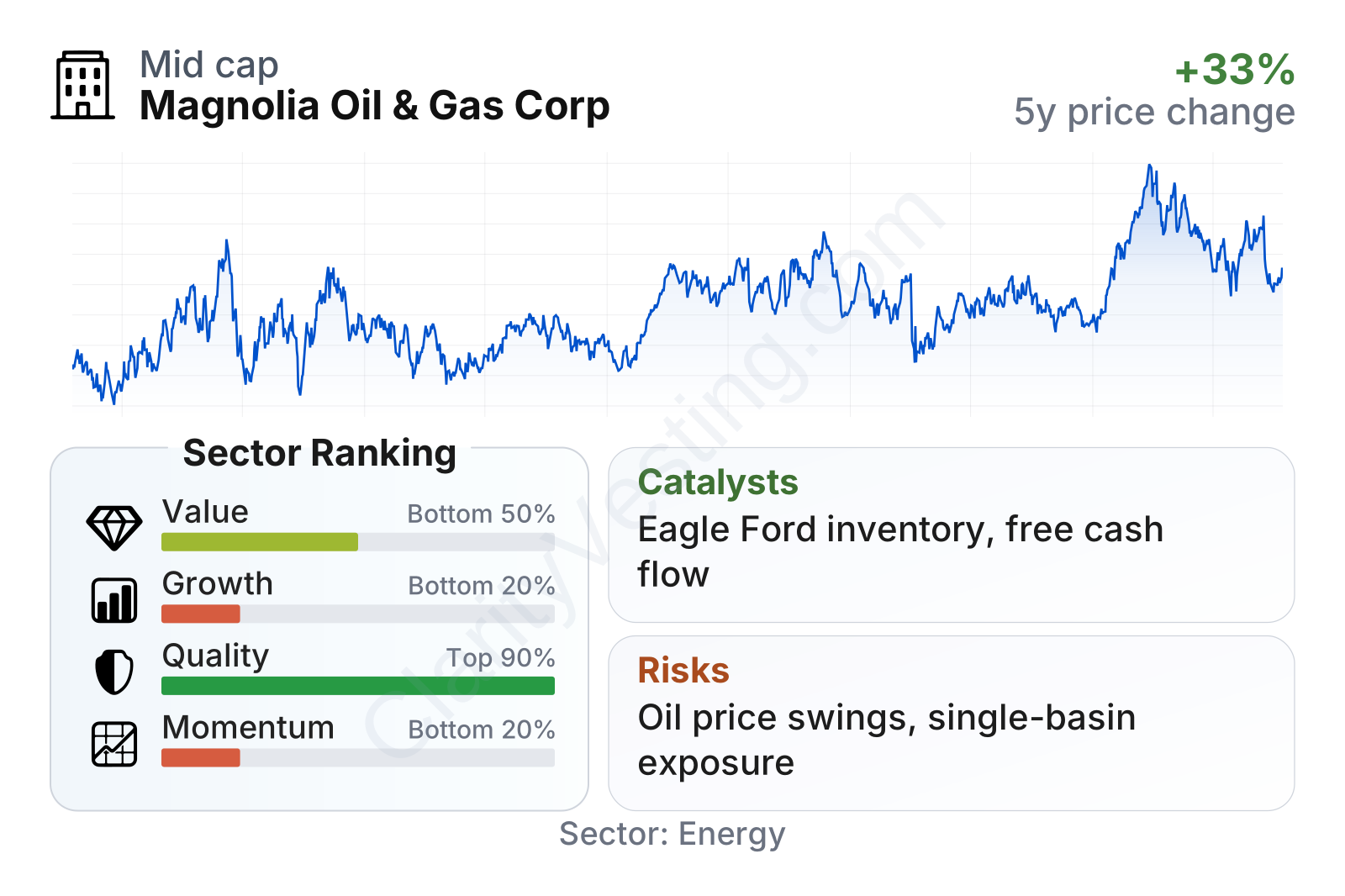
Magnolia sits in the mid-cap range within energy and shows a notably strong quality profile. Profitability measures, returns on capital, and balance-sheet strength are well above many sector peers, while leverage is far lower than the industry median. On value measures, the picture is mixed: the earnings multiple is below the sector median, but book value and cash flow measures do not point to an obvious deep discount. The weaker areas are growth and share-price momentum, which suggests the market has rewarded its financial discipline less aggressively than some faster-moving energy names.
Growth
Magnolia operates in a sector that is mature rather than structurally high-growth. Oil and gas demand still matters globally, and U.S. shale remains one of the most flexible supply sources, but long-term growth for producers usually depends more on asset quality, capital discipline, and commodity cycles than on broad industry expansion alone. That means Magnolia’s future is likely to be driven less by a booming end market and more by how efficiently it develops its acreage and converts production into free cash flow.
The company’s strategy is sensible for this kind of business. Management has emphasized low-cost development, selective acquisitions, and shareholder returns while avoiding heavy debt. That matters because shale wells decline naturally over time, so producers must keep investing to sustain output. A company with lower leverage and better well economics has more room to keep drilling through weaker commodity environments.
Revenue growth has been uneven, which is normal for an upstream producer. There was a sharp surge during the stronger pricing period, then a retreat as oil and gas markets cooled, and more recently a rebound. The latest year-over-year jump stands out, but it should be viewed carefully because energy revenue can swing quickly with both pricing and production mix. For long-term analysis, consistency of margins and cash generation matters more than one strong quarter.
Free cash flow has also been volatile, but it remains meaningful. That is one of Magnolia’s most attractive features. Even with fluctuations, the company has continued to generate cash after capital spending, which supports dividends, share repurchases, and financial flexibility. In a commodity business, the ability to stay cash-positive without stretching the balance sheet is a major advantage.
A relevant catalyst for future growth is Magnolia’s inventory in the Eagle Ford and Austin Chalk, where the company continues to develop drilling opportunities with relatively attractive economics. Another potential driver is bolt-on acquisitions that expand its position without changing the company’s conservative financial profile. Recent company communications have also pointed to continued operational execution and production growth, which can create upside if oil prices remain supportive and well performance stays strong.
Risks
This article is for informational purposes only and does not constitute financial advice. Some content is AI-generated. See Disclaimer


