Stock Analysis · MeiraGTx Holdings PLC (MGTX)
Overview
MeiraGTx Holdings PLC is a biotechnology company focused on genetic medicines. In simple terms, it develops treatments that aim to fix diseases at their biological source by delivering functional genes into cells. Its programs are concentrated in areas where treatment options are limited, especially inherited retinal diseases, neurodegenerative conditions, and severe forms of dry eye disease. The company also has a manufacturing platform for viral vectors, which are the delivery tools commonly used in gene therapy.
Unlike a mature pharmaceutical company, MeiraGTx does not generate broad product sales across many approved drugs. Its revenue mainly comes from collaboration agreements, license payments, research support, and manufacturing-related activities tied to partnerships. That makes revenue more uneven from year to year than in a typical commercial-stage healthcare business.
Based on recent annual reporting, MeiraGTx’s revenue sources appear to be concentrated in a small number of categories:
- Collaboration and license revenue: approximately 80% to 95% of recent annual revenue. This includes upfront payments, milestone recognition, and revenue recognized from strategic partnerships, especially in ophthalmology and other gene therapy programs.
- Manufacturing and other service-related revenue: approximately 5% to 20%. This includes work linked to production capabilities and support activities for partnered programs.
- Product revenue: 0% at this stage. The company remains largely pre-commercial, so recurring revenue from marketed therapies is not yet the core business model.
The business model therefore depends less on selling approved medicines today and more on creating valuable clinical assets, signing partnerships, advancing trials, and eventually converting pipeline programs into commercial opportunities.
Revenue has been volatile over the last several years, but one notable improvement is that total revenue rebounded strongly in 2025 after a weak 2023 and only moderate 2024. At the same time, research spending remained very high, showing that MeiraGTx is still in the heavy investment phase typical of development-stage biotech companies.
The company’s income profile remains shaped by large research and administrative costs, but the recent rise in revenue compared with earlier years suggests partnership-related inflows are starting to matter more than they did during the lowest-revenue period.
Key Figures
| Metric | Value | Sector ⓘ |
|---|---|---|
| Date | Oct 17, 2026 | |
| Context | ||
| Sector | Healthcare | |
| Industry | Biotechnology | |
| Market Cap ⓘ | $1.04B | |
| Beta ⓘ | 1.35 | |
Value (Cheapness) | ||
| P/E Ratio ⓘ | 12.44 | 24.79 |
| P/B Ratio ⓘ | 4.57 | 3.08 |
| FCF Yield ⓘ | 0.61% | 3.15% |
| Dividend Yield ⓘ | N/A | 1.94% |
| EBIT / EV ⓘ | 22.80% | 0.57% |
| PEG ⓘ | N/A | |
Growth (Business expansion) | ||
| Revenue Growth ⓘ | 8608.60% | 7.45% |
| RPS Growth (5Y CAGR) ⓘ | 4.33% | 8.61% |
| EPS Growth (5Y CAGR) ⓘ | N/A | -17.81% |
| BVPS Growth (5Y CAGR) ⓘ | N/A | 3.72% |
| Margin Growth (5Y Trend) ⓘ | N/A | -0.62% |
| FCF Growth (5Y CAGR) ⓘ | -6.53% | 1.04% |
| DPS Growth (5Y CAGR) ⓘ | N/A | 6.77% |
Quality (Business durability) | ||
| ROIC (Latest) ⓘ | 241.06% | 3.24% |
| ROA (Latest) ⓘ | 26.96% | 3.01% |
| ROIC (5Y Median) ⓘ | -51.98% | 4.60% |
| ROA (5Y Median) ⓘ | -40.61% | 1.89% |
| Net Debt / EBIT (Latest) ⓘ | -0.12 | 1.34 |
| Net Debt / EBIT (5Y Median) ⓘ | N/A | 1.84 |
| Net Debt / EBITDA (Latest) ⓘ | -0.12 | 1.00 |
| Net Debt / Assets ⓘ | -7.78% | 5.45% |
| EBITDA / Interest ⓘ | 21.03 | 9.64 |
| Operating Margin (Latest) ⓘ | 62.95% | 9.27% |
| Operating Margin (5Y Median) ⓘ | -404.22% | 7.38% |
| Debt to Equity (Latest) ⓘ | 52.10% | 28.58% |
| Profit Margin (Latest) ⓘ | 19.87% | 3.59% |
| Free Cash Flow (Latest) ⓘ | $6.31M | |
Momentum (Price trend) | ||
| 3Y Return ⓘ | +131.28% | +42.80% |
| 12M Return (excl. last month) ⓘ | +81.12% | +18.50% |
| 6M Return ⓘ | +11.82% | +7.57% |
| Price vs. 200-Day MA ⓘ | +3.46% | +5.12% |
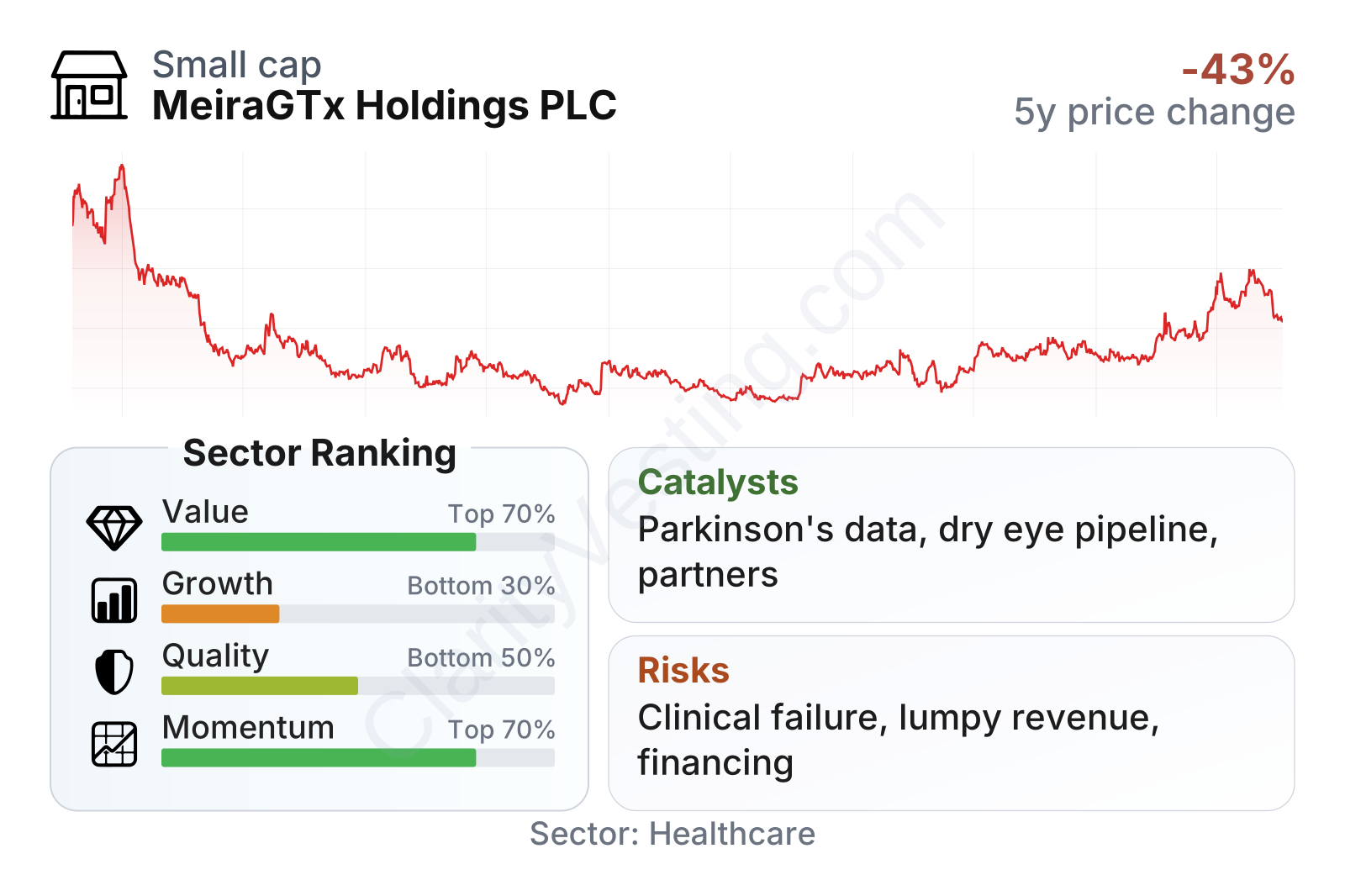
MeiraGTx is a mid-sized biotech company by market value, with share price behavior that has been more volatile than the broader market. The factor profile is mixed. Valuation measures look less demanding than much of the biotech sector on earnings-based metrics, but balance-sheet and profitability signals need careful interpretation because this is still a development-driven company with uneven reported results. Growth ranks weakly on a multi-year basis despite a sharp recent revenue surge, while price momentum has been stronger than the sector median.
The share price history reflects that pattern well: a long period of weakness was followed by a strong recovery into 2025 and 2026. That kind of move usually means the market is reassessing clinical or partnership potential rather than rewarding stable operating performance.
Growth
Gene therapy remains one of the more ambitious areas in healthcare. The sector is attractive because it targets diseases that often have limited or no good long-term treatment options, and successful programs can command high value if they demonstrate durable benefit. That said, it is also one of the hardest parts of biotech: development timelines are long, clinical risk is high, and manufacturing is complex.
MeiraGTx’s strategy is logical for that environment. Rather than trying to become a full-scale commercial drug company too early, it has built around three assets: a focused pipeline in severe diseases, in-house manufacturing capability, and partnerships that can help fund development. This is especially important in gene therapy, where production know-how can become a real barrier to entry.
A major growth angle is the company’s ophthalmology work, particularly inherited retinal disease and advanced dry eye disease. Eye disorders are attractive targets for gene therapy because the eye is a relatively contained organ, responses can often be measured more directly, and regulators have already seen successful gene therapy approaches in ophthalmology. MeiraGTx has also pursued central nervous system programs, which could become much larger opportunities if clinical results are strong, though those programs are also more technically demanding.
Recent operating trends show how uneven but potentially powerful this model can be.
Revenue growth has been highly irregular, which is common when collaboration payments drive the top line. The most recent jump is striking and points to a meaningful step-up in partnership-related income rather than a steady commercial ramp. For long-term analysis, that matters because it shows external validation of the platform, but it does not yet prove recurring demand.
Cash generation has improved sharply from deeply negative levels and recently moved close to break-even territory on a trailing basis. That is an important change for a clinical-stage biotech. It suggests the company’s financing burden may be easing, at least temporarily, if partnership cash inflows continue and spending stays controlled relative to milestones.
One of the strongest recent catalysts has been the company’s work with AAV-GAD for Parkinson’s disease, developed with a partner structure that adds credibility and potential financing support. Public company updates in 2026 also highlighted progress in xerostomia, or severe dry mouth, and ophthalmology-related programs. For MeiraGTx, the biggest opportunities over the next several years are likely to come from additional clinical data, regulatory alignment, and new or expanded partnerships rather than from near-term broad product sales.
Risks
This article is for informational purposes only and does not constitute financial advice. Some content is AI-generated. See Disclaimer


