Stock Analysis · Mega Fortune Company Limited (MGRT)
Overview
Mega Fortune Company Limited is a technology services company that has historically operated through Internet-of-Things solutions and mobile device services, with activities tied to software, hardware integration, and related support. Public filings show a relatively small operating base in prior years, followed by a sharp expansion in fiscal 2025, which suggests the business is still in a transition phase rather than a mature, steady-state model.
Based on the company’s recent annual filing, revenue appears to come primarily from technology-related service and product activities rather than recurring subscription income. The exact split is not always detailed with enough precision for a full segment breakdown, but the business can be understood through the following main streams:
- IoT and system-related solutions — solutions combining devices, connectivity, and software support for enterprise or commercial use.
- Mobile and hardware-related sales — device distribution or equipment-related revenue, which can materially affect year-to-year sales because hardware tends to be lower margin but larger in dollar volume.
- Technical and related services — installation, maintenance, and support work attached to delivered systems or products.
The clearest takeaway from the company’s financial structure is that revenue increased substantially in the latest fiscal year while gross profit also expanded, indicating that the recent scale-up was not purely volume at uneconomic pricing. At the same time, the mix still looks exposed to project-based or transaction-based activity, which can make results less predictable than a recurring software model.
The business profile changed meaningfully in fiscal 2025: revenue rose from roughly $3 million to about $11 million, while gross profit climbed from under $2 million to more than $5 million. That points to much better commercial traction, although investors following the long term still need to separate temporary surges from durable demand.
Key Figures
| Metric | Value | Sector ⓘ |
|---|---|---|
| Date | Oct 31, 2026 | |
| Context | ||
| Sector | Technology | |
| Industry | Information Technology Services | |
| Market Cap ⓘ | $1.64B | |
| Beta ⓘ | N/A | |
Value (Cheapness) | ||
| P/E Ratio ⓘ | N/A | 29.73 |
| FCF Yield ⓘ | -0.09% | 3.96% |
| Dividend Yield ⓘ | N/A | 1.30% |
| EBIT / EV ⓘ | -0.01% | 2.90% |
| PEG ⓘ | N/A | |
Growth (Business expansion) | ||
| Revenue Growth ⓘ | -90.30% | 15.80% |
| RPS Growth (5Y CAGR) ⓘ | 46.96% | 8.54% |
| EPS Growth (5Y CAGR) ⓘ | N/A | -10.19% |
| Margin Growth (5Y Trend) ⓘ | 11.37% | 0.45% |
| FCF Growth (5Y CAGR) ⓘ | N/A | 9.80% |
| DPS Growth (5Y CAGR) ⓘ | N/A | 7.67% |
Quality (Business durability) | ||
| ROIC (Latest) ⓘ | N/A | 9.74% |
| ROIC (5Y Median) ⓘ | N/A | 8.31% |
| Net Debt / EBIT (Latest) ⓘ | N/A | 0.53 |
| Net Debt / EBIT (5Y Median) ⓘ | -0.02 | 0.46 |
| Net Debt / EBITDA (Latest) ⓘ | N/A | 0.29 |
| Net Debt / Assets ⓘ | 4.77% | 3.45% |
| EBITDA / Interest ⓘ | N/A | 13.54 |
| Operating Margin (Latest) ⓘ | -6.49% | 10.12% |
| Operating Margin (5Y Median) ⓘ | 18.79% | 8.50% |
| Debt to Equity (Latest) ⓘ | 5.43% | 35.18% |
| Profit Margin (Latest) ⓘ | -40.66% | 7.13% |
| Free Cash Flow (Latest) ⓘ | -$1.55M | |
Momentum (Price trend) | ||
| 3Y Return ⓘ | N/A | +61.79% |
| 12M Return (excl. last month) ⓘ | +2797.86% | +12.78% |
| 6M Return ⓘ | -15.28% | +7.85% |
| Price vs. 200-Day MA ⓘ | +62.84% | +5.43% |
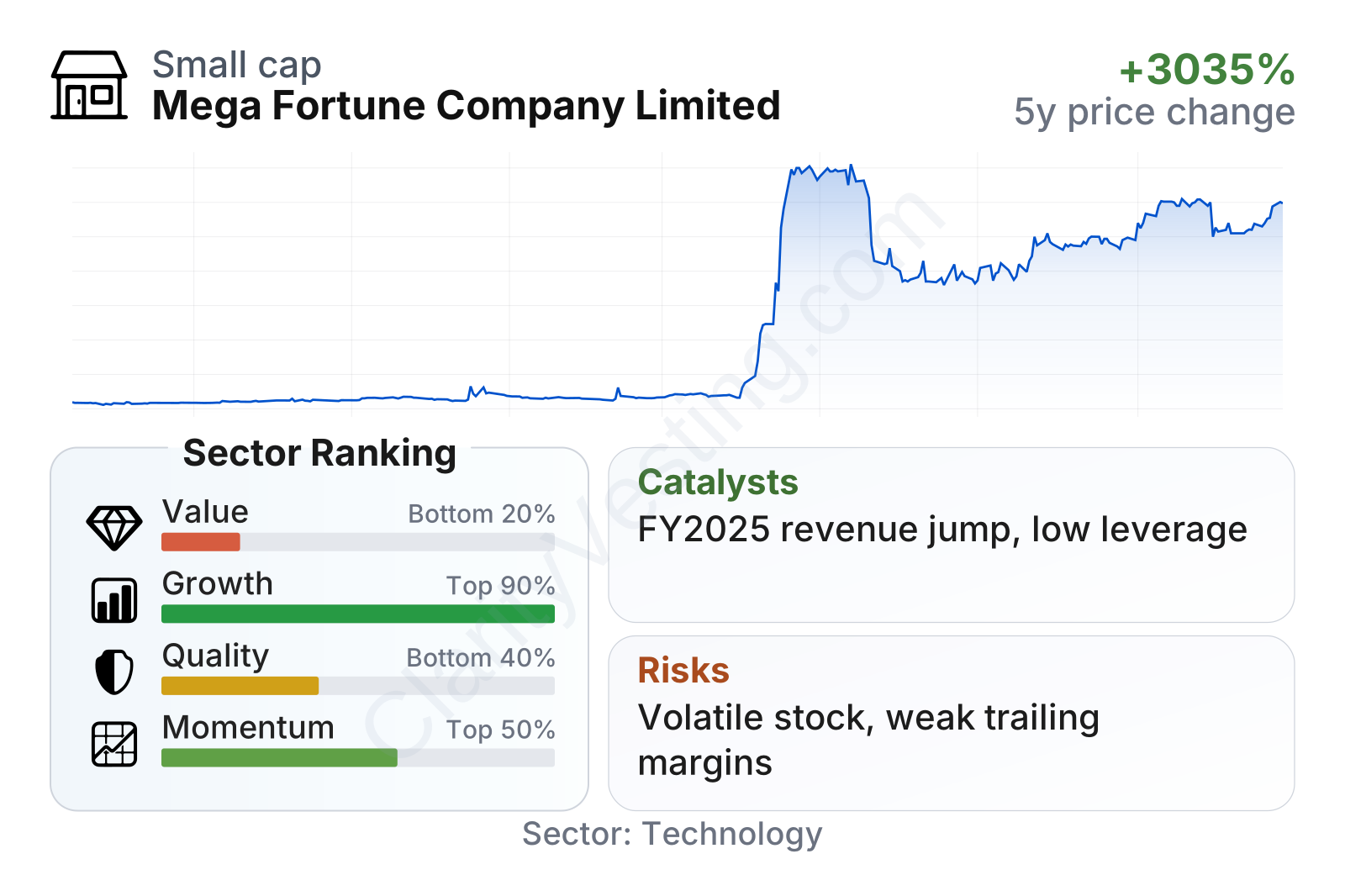
The market is currently treating Mega Fortune like a highly speculative small-cap technology name rather than a stable services company. Profitability and cash generation are weak on a trailing basis, with negative free cash flow, negative operating margin, and no meaningful P/E ratio because recent earnings do not support it. That helps explain why the value profile ranks poorly versus the broader technology sector.
At the same time, the longer-term growth record looks unusually strong on a five-year basis, especially for revenue per share and margin progression, even though the most recent year-over-year revenue comparison is extremely distorted and negative. This combination usually signals a company whose business model has been changing quickly through restructurings, acquisitions, or major shifts in operating scope.
Balance sheet pressure does not look severe. Debt to equity is low at roughly 5%, which is far below the sector median near 35%, and historical net debt relative to earnings has been modest. That gives the company more flexibility than many small firms, but it does not fully offset the fact that current profitability is weak.
The share price has also been extremely volatile. Over the past year it experienced a dramatic re-rating, including a sharp jump in early 2026, and it still sits far above its long-term moving average despite a pullback in the middle of the year. That pattern typically reflects speculative interest and changing expectations rather than a settled view of intrinsic business value.
Growth
Mega Fortune operates in a part of the technology market that can benefit from long-term digitalization, connected devices, and enterprise demand for integrated systems. Those themes remain structurally favorable. Businesses and public-sector users continue to invest in device connectivity, automation, and supporting IT services, which creates room for smaller providers if they can win specialized contracts or serve local niches effectively.
The company’s recent strategy appears sensible in one important way: it has shown an ability to scale revenue materially without taking on heavy financial leverage. The improvement in gross profit over the last several years suggests the company has not simply chased sales at any cost. In addition, the five-year operating margin trend is stronger than the sector median, which indicates that management has previously demonstrated operating discipline even if the latest trailing margins are negative.
A notable catalyst is the sharp increase in fiscal 2025 revenue and operating income shown in the annual results. For a company of this size, even a handful of larger contracts, product launches, or distribution wins can change the earnings profile quickly. Another positive signal is that the stock’s long-term price momentum remains elevated, which often means the market is paying attention to a possible shift in business scale.
The main issue is durability. Strong growth is more meaningful when it comes from repeat business, recurring service contracts, or a broadening customer base. Mega Fortune’s disclosures suggest growth has been real, but the company still needs to show that this higher level of activity can continue without sharp reversals.
Risks
This article is for informational purposes only and does not constitute financial advice. Some content is AI-generated. See Disclaimer


