Stock Analysis · McGrath RentCorp (MGRC)
Overview
McGrath RentCorp is an equipment rental company focused on business customers rather than consumers. Its model is straightforward: it buys specialized assets, rents them to customers for months or years, and earns recurring income while managing delivery, setup, maintenance, and eventual resale or redeployment. The company operates in practical niches where customers often prefer renting over owning because projects are temporary, budgets are tighter, or equipment needs change over time.
Following the 2024 sale of its former truck and trailer rental business, McGrath is now centered on modular space and portable storage. That makes the company simpler than it used to be, but also more concentrated. Its customers include construction firms, education systems, industrial operators, government agencies, and commercial users that need temporary or relocatable space solutions.
The main revenue sources are concentrated in two operating segments, with rental income remaining the economic core of the business.
- Mobile Modular – about 79% of 2025 revenue: rents and sells modular buildings used as classrooms, offices, restrooms, healthcare space, and other temporary or semi-permanent facilities. This is the company’s largest business by a wide margin.
- Portable Storage – about 21% of 2025 revenue: rents and sells portable steel storage containers and office containers used on construction sites, industrial locations, schools, and commercial properties.
Within both segments, revenue is generated from equipment rentals, delivery and installation services, sales of new or used units, and related service work. The attraction of this model is that a large part of demand is recurring and asset-backed rather than dependent on one-time product sales.
Over the last several years, revenue expanded materially, and operating income improved even faster. The business also shows the benefit of scale: once rental assets are in place and utilization is healthy, a larger share of each additional dollar of revenue can flow through to profit. The latest full-year results still show solid revenue growth, although earnings have become less smooth after the portfolio reshaping.
Key Figures
| Metric | Value | Sector ⓘ |
|---|---|---|
| Date | Oct 17, 2026 | |
| Context | ||
| Sector | Industrials | |
| Industry | Rental & Leasing Services | |
| Market Cap ⓘ | $2.80B | |
| Beta ⓘ | 0.47 | |
Value (Cheapness) | ||
| P/E Ratio ⓘ | 18.46 | 22.10 |
| P/B Ratio ⓘ | 2.20 | 1.97 |
| FCF Yield ⓘ | 7.48% | 6.38% |
| Dividend Yield ⓘ | 1.74% | 1.94% |
| EBIT / EV ⓘ | 6.94% | 4.79% |
| PEG ⓘ | 1.04 | |
Growth (Business expansion) | ||
| Revenue Growth ⓘ | -6.20% | 9.30% |
| RPS Growth (5Y CAGR) ⓘ | 11.10% | 7.81% |
| EPS Growth (5Y CAGR) ⓘ | -15.82% | -13.06% |
| BVPS Growth (5Y CAGR) ⓘ | 13.88% | 6.14% |
| Margin Growth (5Y Trend) ⓘ | 4.38% | 0.88% |
| FCF Growth (5Y CAGR) ⓘ | 27.92% | 11.01% |
| DPS Growth (5Y CAGR) ⓘ | 3.11% | 9.48% |
Quality (Business durability) | ||
| ROIC (Latest) ⓘ | 9.75% | 10.84% |
| ROA (Latest) ⓘ | 6.30% | 5.41% |
| ROIC (5Y Median) ⓘ | 9.76% | 9.38% |
| ROA (5Y Median) ⓘ | 6.97% | 4.95% |
| Net Debt / EBIT (Latest) ⓘ | 2.47 | 2.08 |
| Net Debt / EBIT (5Y Median) ⓘ | 2.81 | 2.27 |
| Net Debt / EBITDA (Latest) ⓘ | 1.68 | 1.39 |
| Net Debt / Assets ⓘ | 23.39% | 19.28% |
| EBITDA / Interest ⓘ | 12.31 | 9.58 |
| Operating Margin (Latest) ⓘ | 25.46% | 10.50% |
| Operating Margin (5Y Median) ⓘ | 23.11% | 10.29% |
| Debt to Equity (Latest) ⓘ | 47.36% | 65.48% |
| Profit Margin (Latest) ⓘ | 16.38% | 6.67% |
| Free Cash Flow (Latest) ⓘ | $209.53M | |
Momentum (Price trend) | ||
| 3Y Return ⓘ | +14.58% | +61.68% |
| 12M Return (excl. last month) ⓘ | -8.01% | +12.58% |
| 6M Return ⓘ | -1.16% | 0.00% |
| Price vs. 200-Day MA ⓘ | -0.87% | +0.02% |
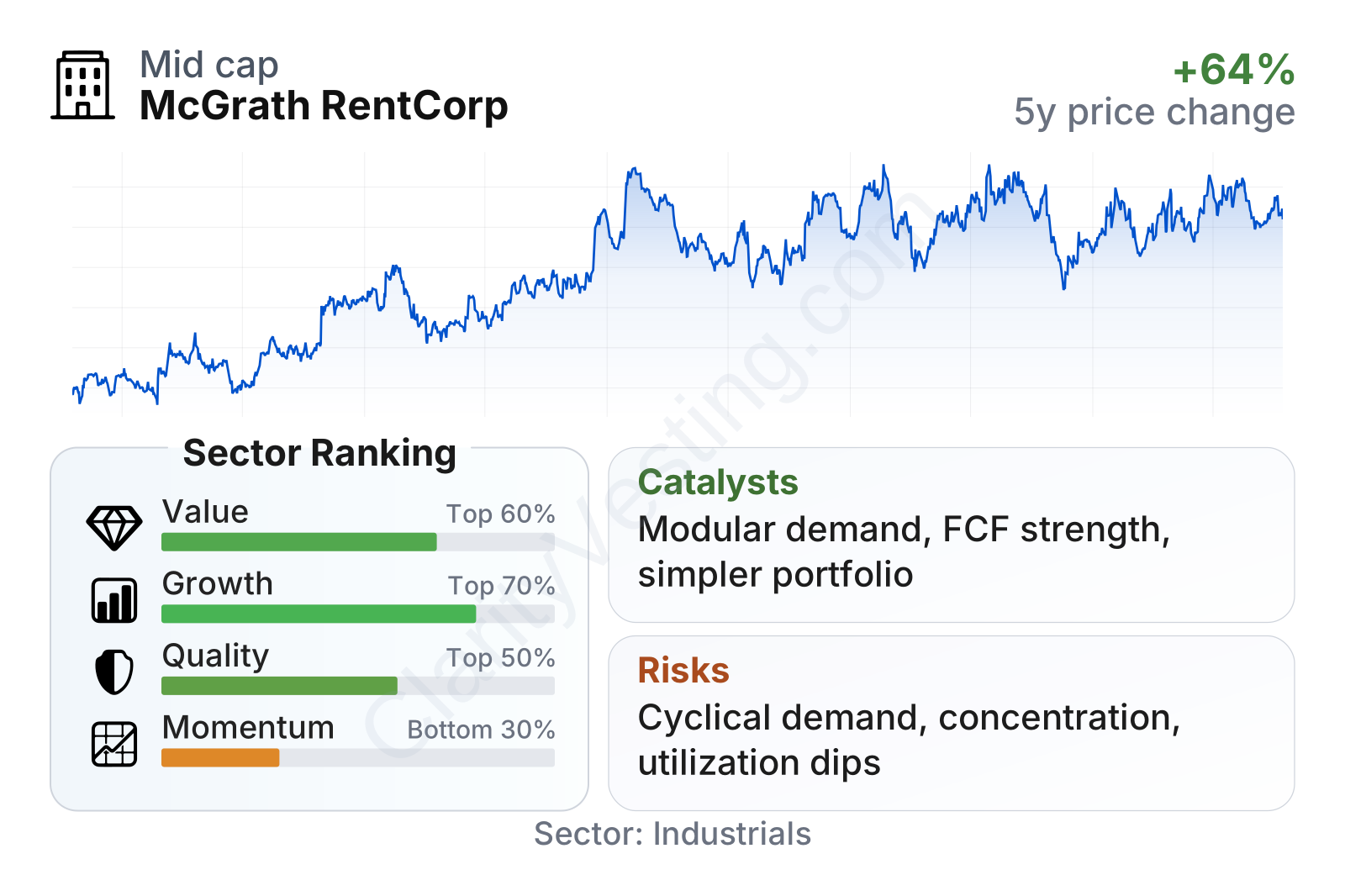
McGrath is a mid-sized industrial company with a relatively low share-price volatility profile, as reflected by its beta below 0.5. On valuation, the stock trades at an earnings multiple below the sector median, while free cash flow yield and EBIT relative to enterprise value look stronger than many peers. Quality is supported by unusually high operating and profit margins for this industry, although leverage measures are a bit heavier than the median on some debt-to-earnings comparisons. Growth indicators are mixed: the longer-term record in revenue, book value, and free cash flow is strong, but recent year-over-year sales momentum has cooled. Market performance has also lagged much of the sector over the last year and over three years.
Growth
McGrath operates in parts of the rental market that should remain relevant for a long time. Temporary classrooms, modular offices, jobsite storage, and relocatable facilities benefit from structural trends such as school capacity needs, infrastructure work, industrial projects, disaster response, and customer preference for flexible rather than permanent space. Renting also becomes more appealing when clients want to preserve capital or avoid ownership risk.
The company’s strategy appears coherent after the portfolio simplification. By focusing on modular space and portable storage, management is concentrating resources on categories where rental economics can be attractive and national scale matters. These businesses can benefit from larger fleet size, branch density, logistics know-how, refurbishment capabilities, and cross-selling between temporary space and storage needs.
The growth pattern has clearly shifted. Revenue growth was exceptionally strong in 2023 and remained positive through most of 2024 and 2025, but recent quarters show a much slower pace and one negative comparison in mid-2026. That does not automatically signal a broken business, but it does suggest McGrath is moving from a surge period into a more normal operating environment. For long-term analysis, that means future returns will likely depend more on utilization, pricing discipline, and capital allocation than on rapid top-line expansion alone.
Cash generation is an important part of the case. Free cash flow was negative during an earlier period of heavy fleet investment, then rebounded sharply and has remained clearly positive. That pattern is common in rental businesses: near-term cash flow can swing when the company is expanding its asset base, but healthy utilization later converts those investments into cash earnings. McGrath’s recent free cash flow level supports the idea that its current platform can produce meaningful cash after capital spending.
One notable catalyst is the company’s post-divestiture structure. With the truck and trailer business no longer part of the group, results should become easier to understand and management can direct capital toward its remaining core operations. Another potential opportunity is any increase in nonresidential construction, public sector facility spending, school modernization, or emergency-response demand, all of which can favor modular buildings and storage rentals.
Risks
This article is for informational purposes only and does not constitute financial advice. Some content is AI-generated. See Disclaimer


