Stock Analysis · Magellan Financial Group Limited (MGLLF)
Overview
Magellan Financial Group Limited is an Australian asset manager. In simple terms, it manages money on behalf of clients such as institutions, financial advisers, retirement savers, and individual investors, and it earns fees for doing so. Its business is built around investment strategies focused mainly on global equities and infrastructure assets, offered through separately managed accounts and funds.
The company’s revenue is driven primarily by management and performance fees linked to assets under management. Because this is an asset-management business, revenue tends to move with three things: market performance, client inflows or outflows, and the fee rate charged on those assets.
Based on recent annual disclosures, the main revenue sources can be summarized as follows:
- Funds management fees: approximately 90% to 95% of revenue. This is the recurring fee base generated from managing client assets across global equities, infrastructure, and related strategies.
- Performance fees: usually a small and variable share of revenue, depending on whether certain investment strategies outperform agreed benchmarks.
- Other income: typically a low-single portion of revenue, including interest and miscellaneous items.
What stands out is that Magellan is still primarily a pure-play listed asset manager rather than a diversified financial conglomerate. That can be attractive when markets are supportive and client assets are stable, but it also makes the business more exposed to swings in sentiment and net fund flows.
The earnings bridge over recent years shows a business that remains highly profitable at the operating level, but with a much smaller revenue base than a few years ago. Revenue has fallen sharply since 2022, while margins are still strong by industry standards, reflecting the low-capital nature of asset management and tight balance-sheet discipline.
Key Figures
| Metric | Value | Sector ⓘ |
|---|---|---|
| Date | Oct 24, 2026 | |
| Context | ||
| Sector | Financial Services | |
| Industry | Asset Management | |
| Market Cap ⓘ | $1.97B | |
| Beta ⓘ | 0.38 | |
Value (Cheapness) | ||
| P/E Ratio ⓘ | 19.82 | 12.46 |
| P/B Ratio ⓘ | 0.86 | 1.25 |
| FCF Yield ⓘ | 14.03% | 9.82% |
| Dividend Yield ⓘ | 9.64% | 2.94% |
| EBIT / EV ⓘ | N/A | 8.11% |
| PEG ⓘ | N/A | |
Growth (Business expansion) | ||
| Revenue Growth ⓘ | -46.50% | 9.10% |
| RPS Growth (5Y CAGR) ⓘ | -17.21% | 12.31% |
| EPS Growth (5Y CAGR) ⓘ | -3.80% | -6.97% |
| BVPS Growth (5Y CAGR) ⓘ | 11.86% | 5.02% |
| Margin Growth (5Y Trend) ⓘ | -11.52% | -4.00% |
| FCF Growth (5Y CAGR) ⓘ | -26.38% | 4.71% |
| DPS Growth (5Y CAGR) ⓘ | -12.62% | 8.92% |
Quality (Business durability) | ||
| ROIC (Latest) ⓘ | N/A | 9.18% |
| ROE (Latest) ⓘ | 24.18% | 13.93% |
| ROA (Latest) ⓘ | 22.54% | 1.57% |
| ROIC (5Y Median) ⓘ | 17.55% | 7.80% |
| ROE (5Y Median) ⓘ | 18.36% | 12.15% |
| ROA (5Y Median) ⓘ | 15.12% | 1.28% |
| Net Debt / EBIT (Latest) ⓘ | -1.10 | 1.02 |
| Net Debt / EBIT (5Y Median) ⓘ | -1.06 | 0.72 |
| Net Debt / EBITDA (Latest) ⓘ | -1.08 | 0.88 |
| Operating Margin (Latest) ⓘ | 55.09% | 22.30% |
| Operating Margin (5Y Median) ⓘ | 70.30% | 24.50% |
| Debt to Equity (Latest) ⓘ | 0.19% | 59.34% |
| Profit Margin (Latest) ⓘ | 44.65% | 26.42% |
| Free Cash Flow (Latest) ⓘ | $276.73M | |
Momentum (Price trend) | ||
| 3Y Return ⓘ | +61.49% | +95.73% |
| 12M Return (excl. last month) ⓘ | +12.53% | +17.30% |
| 6M Return ⓘ | +7.90% | +6.07% |
| Price vs. 200-Day MA ⓘ | +6.22% | +5.36% |
Magellan looks unusual when its metrics are viewed together. On one side, quality measures are strong: return on equity is about 24%, return on assets is about 23%, operating margin is around 55%, and debt is nearly nonexistent. The company also carries net cash rather than net debt, which is a meaningful advantage in a cyclical business. On the other side, growth measures remain weak, with revenue down sharply year over year and longer-term revenue per share still in decline. The value picture is mixed: the earnings multiple sits above the sector median, but the price-to-book ratio is below the sector median and the cash flow yield is comparatively strong. The dividend yield is also far above the sector median, though investors need to remember that very high yields in asset management can reflect a smaller earnings base and a depressed valuation rather than pure strength.
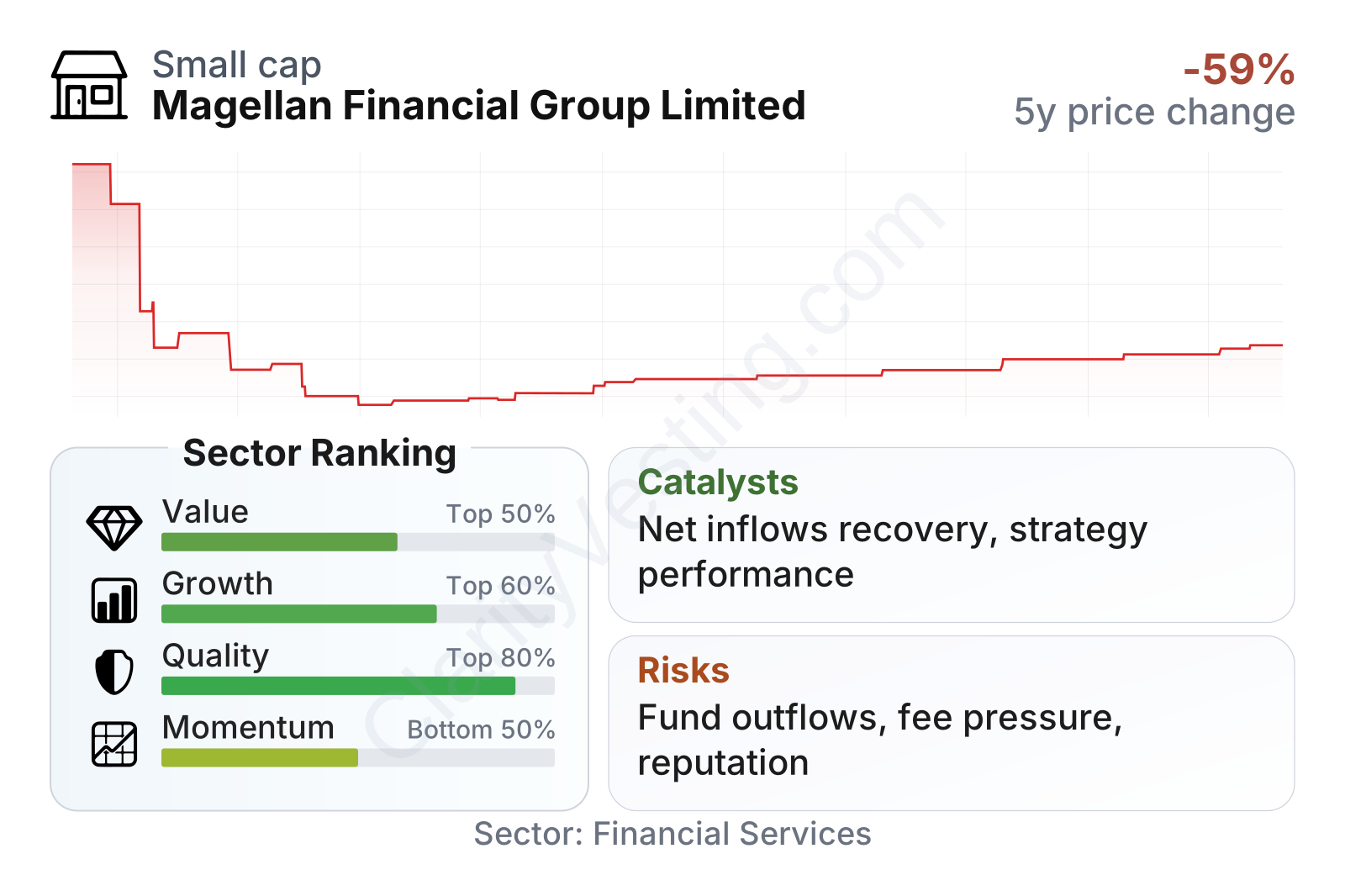
The share price history also helps frame expectations. After a severe decline from 2021 into 2023, the stock has recovered somewhat, but it remains far below earlier levels. That pattern suggests the market is recognizing stabilization, not a full return to the business conditions Magellan once enjoyed.
Growth
Magellan operates in a sector that should remain relevant over the long term. Global wealth creation, retirement savings, pension outsourcing, and demand for professional investment management continue to support the broader asset-management industry. Within that context, infrastructure investing also has durable appeal because many investors want exposure to long-life assets tied to utilities, transport, energy transition, and inflation-linked cash flows.
The challenge is that sector growth alone does not guarantee company growth. In Magellan’s case, the key issue is whether it can stabilize and then rebuild assets under management after several years of pressure. Its strategy appears sensible in that it remains focused on areas where active managers can still argue for differentiation: concentrated global investing, infrastructure, and institutional-quality portfolio management. The business model does not need heavy capital investment to grow, so even a modest improvement in client flows can have a meaningful effect on earnings.
Book value per share has improved notably over the last several years, especially in the latest period, which points to balance-sheet strengthening even while revenue has been under pressure. That matters because it shows the company has preserved financial capacity during a difficult stretch.
A practical catalyst would be sustained net inflow improvement. For an asset manager, fresh client money matters just as much as market performance, and often more. Another catalyst is investment performance: if flagship strategies perform well over multi-year periods, consultant ratings, adviser confidence, and institutional mandates can recover. Cost discipline is also relevant. Magellan has already shown it can maintain high margins despite lower revenue, so any rebound in assets could have disproportionate earnings impact.
Recent company communications have centered on business simplification, capital management, and maintaining a strong financial position while working to improve investment outcomes and client retention. That does not create an immediate growth surge, but it supports the view that the company is trying to rebuild from a more stable base rather than chase expansion at any cost.
Risks
This article is for informational purposes only and does not constitute financial advice. Some content is AI-generated. See Disclaimer


