Stock Analysis · Mercury NZ Limited (MGHTF)
Overview
Mercury NZ Limited is a New Zealand electricity company focused on renewable generation and retail energy services. Its core business is producing electricity from renewable sources, mainly hydro and geothermal, and selling that electricity to households, businesses, and wholesale market participants. The company also sells natural gas and telecommunications services to some retail customers, but electricity remains the center of the business.
Mercury operates a portfolio of hydro stations in the Waikato region and geothermal power stations in the central North Island. This matters for long-term analysis because it gives the company ownership of essential infrastructure with long operating lives, while also positioning it in a part of the utility sector tied to decarbonization and electrification.
Based on company reporting, Mercury’s revenue is mainly generated from energy sales and related customer services. The exact mix can move meaningfully from year to year because wholesale electricity prices, customer demand, hedge contracts, and gas activity can all affect the top line. In broad terms, the main sources are:
- Electricity sales to mass-market and business customers: the largest source, likely well above 60% of revenue in most years. This includes electricity supplied to residential, commercial, and industrial customers.
- Wholesale electricity and generation-related revenue: a significant secondary source, often around 20% to 35%, depending on market prices, generation output, and contract structure.
- Gas sales: a smaller contribution, generally in the single- to low-double-digit percentage range, linked to retail customer offerings.
- Other revenue: a small remainder from products and services such as broadband and other customer-related activities.
What stands out is that Mercury is not an early-stage renewable developer trying to prove a concept. It is an established utility with physical assets, recurring customer demand, and exposure to regulated and essential energy markets. That usually makes the business easier to understand than many fast-changing growth companies, although earnings can still be volatile because weather conditions and wholesale prices matter.
The business has shown a clear pattern of high revenue but uneven profit conversion. Revenue expanded strongly between fiscal 2022 and fiscal 2025, then eased in fiscal 2026, while operating income and net income moved much more sharply. That suggests the important issue is not just sales growth, but how well Mercury manages generation conditions, pricing, and financing costs from year to year.
Key Figures
| Metric | Value | Sector ⓘ |
|---|---|---|
| Date | Oct 17, 2026 | |
| Context | ||
| Sector | Utilities | |
| Industry | Utilities - Renewable | |
| Market Cap ⓘ | $6.28B | |
| Beta ⓘ | 0.32 | |
Value (Cheapness) | ||
| P/E Ratio ⓘ | 109.25 | 17.28 |
| P/B Ratio ⓘ | 1.05 | 1.51 |
| FCF Yield ⓘ | 2.42% | 0.65% |
| Dividend Yield ⓘ | 6.18% | 3.77% |
| EBIT / EV ⓘ | N/A | 5.01% |
| PEG ⓘ | 20.54 | |
Growth (Business expansion) | ||
| Revenue Growth ⓘ | -10.50% | 6.10% |
| RPS Growth (5Y CAGR) ⓘ | 9.88% | 3.87% |
| EPS Growth (5Y CAGR) ⓘ | -28.08% | -11.30% |
| BVPS Growth (5Y CAGR) ⓘ | 1.53% | 4.23% |
| Margin Growth (5Y Trend) ⓘ | -5.40% | 3.57% |
| FCF Growth (5Y CAGR) ⓘ | N/A | -8.84% |
| DPS Growth (5Y CAGR) ⓘ | -1.57% | 4.84% |
Quality (Business durability) | ||
| ROIC (Latest) ⓘ | N/A | 6.53% |
| ROA (Latest) ⓘ | 3.20% | 3.20% |
| ROIC (5Y Median) ⓘ | N/A | 5.95% |
| ROA (5Y Median) ⓘ | 3.02% | 2.75% |
| Net Debt / EBIT (Latest) ⓘ | 2.96 | 7.13 |
| Net Debt / EBIT (5Y Median) ⓘ | 5.45 | 7.23 |
| Net Debt / EBITDA (Latest) ⓘ | 1.55 | 4.31 |
| Net Debt / Assets ⓘ | 22.71% | 38.42% |
| EBITDA / Interest ⓘ | 7.11 | 4.58 |
| Operating Margin (Latest) ⓘ | 11.99% | 20.83% |
| Operating Margin (5Y Median) ⓘ | 16.15% | 20.08% |
| Debt to Equity (Latest) ⓘ | 46.97% | 137.69% |
| Profit Margin (Latest) ⓘ | 9.96% | 11.37% |
| Free Cash Flow (Latest) ⓘ | $151.88M | |
Momentum (Price trend) | ||
| 3Y Return ⓘ | +32.15% | +52.37% |
| 12M Return (excl. last month) ⓘ | +24.17% | +8.84% |
| 6M Return ⓘ | +1.91% | -3.95% |
| Price vs. 200-Day MA ⓘ | -2.61% | -0.79% |
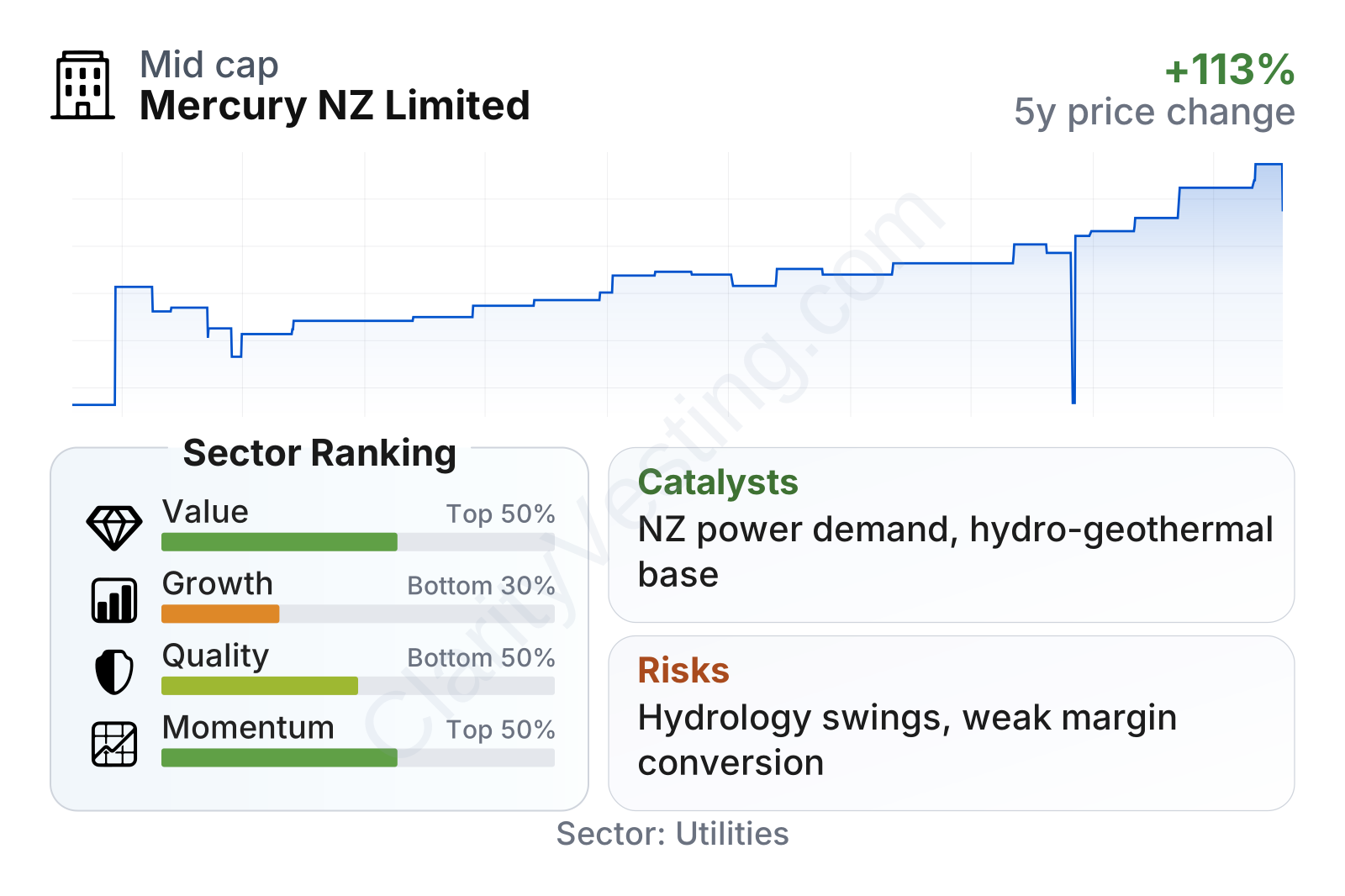
Mercury looks like a relatively defensive utility in market behavior, with low share-price volatility and stronger recent price momentum than much of its sector. On income and cash generation, the profile is appealing: free cash flow yield and dividend yield are both above sector medians. Balance-sheet leverage also appears more conservative than many peers, with lower debt relative to equity, assets, EBITDA, and EBIT, while interest coverage is comfortably above the sector midpoint.
The weaker area is growth quality. Recent revenue declined year over year, earnings growth over five years has been poor, and operating margins have trended below sector norms. The valuation picture is mixed. Price-to-book is not stretched versus utilities peers, but the earnings multiple is extremely high, largely reflecting depressed reported earnings rather than a cheap profit base. That makes the stock look much more expensive on earnings than on assets or cash flow.
Growth
Mercury operates in a sector with durable long-term relevance. Electricity demand in New Zealand is supported by population needs, industrial activity, and the broader shift toward electrification. Over time, more electric vehicles, greater use of electric heating, and possible industrial fuel switching can support demand for renewable electricity. That gives the company exposure to a growth theme, even though utilities usually expand at a steadier pace than technology or consumer sectors.
The company’s strategy is broadly logical for that environment. Owning renewable generation creates a natural fit with decarbonization trends, while a retail customer base provides a recurring outlet for electricity sales. In simple terms, Mercury is positioned on both sides of the value chain: it produces power and it sells power. That can be valuable when managed well because it reduces reliance on a single revenue stream.
Over a five-year period, revenue per share has grown at a solid pace and clearly ahead of the sector median, even though the latest year pulled back from the previous peak. That pattern points to a company that has expanded its commercial base over time but still faces year-to-year swings tied to market conditions rather than smooth linear growth.
A meaningful catalyst is New Zealand’s need for reliable renewable generation. Hydro and geothermal assets are difficult to replicate quickly, and new supply is often slowed by permitting, construction timelines, and capital intensity. If power demand rises while supply remains disciplined, established generators can benefit from favorable pricing and stronger asset utilization. Mercury’s geothermal and hydro mix is particularly relevant because it provides renewable generation with a more stable role in the system than intermittent sources alone.
Recent company reporting also points to continued investment in generation development and system resilience, which supports the long-duration nature of the business. For a long-term lens, the biggest opportunity is not explosive growth, but the possibility of steady value creation from essential infrastructure operating in a market where cleaner electricity should become more important over time.
Risks
This article is for informational purposes only and does not constitute financial advice. Some content is AI-generated. See Disclaimer


