Stock Analysis · Midera Food Processing Inc (MFP)
Overview
Midera Food Processing Inc operates in food processing equipment and related industrial systems. In simple terms, it designs, builds, and supports machinery used by food manufacturers to process, prepare, and package food at industrial scale. That places the company in a niche of the industrial machinery market where customer demand is tied to food production, automation, hygiene standards, and efficiency upgrades.
The business appears to generate revenue mainly from selling equipment and from related support activities such as parts and services. Public company materials indicate that this type of model typically combines one-time machinery sales with recurring aftermarket revenue, although the precise split is not clearly disclosed in the material available here. Based on the company’s industrial profile, its main revenue sources can be summarized as follows:
- Equipment and system sales — the largest source of revenue, covering food processing machinery, integrated production lines, and plant-level solutions.
- Parts, maintenance, and technical services — a smaller but strategically important source, usually tied to installed equipment and ongoing customer support.
- Other related industrial revenue — may include installation, upgrades, engineering support, or project-based work where disclosed.
Recent operating trends show that revenue moved higher over the last three reported years, but the quality of that growth weakened in 2025. Sales increased from about $759 million in 2023 to about $772 million in 2024 and then to about $853 million in 2025. However, that improvement at the top line came with a much sharper rise in operating expenses and production costs, which heavily reduced operating profit and net income. In other words, the company sold more, but kept far less of each dollar of revenue.
That is an important point for long-term readers: Midera is not a pure early-stage growth company. It already operates at meaningful scale, but its recent results suggest that execution and margin stability matter as much as revenue expansion.
The profit flow highlights a mixed picture. Revenue has grown steadily, but cost of revenue and especially operating expenses accelerated in 2025, causing a sharp drop in operating income and net income. This suggests that recent growth has come with weaker efficiency, making future margin recovery a central issue for the company.
Key Figures
| Metric | Value | Sector ⓘ |
|---|---|---|
| Date | Oct 17, 2026 | |
| Context | ||
| Sector | Industrials | |
| Industry | Specialty Industrial Machinery | |
| Market Cap ⓘ | $1.80B | |
| Beta ⓘ | N/A | |
Value (Cheapness) | ||
| P/E Ratio ⓘ | 110.36 | 22.10 |
| P/B Ratio ⓘ | 2.29 | 1.97 |
| FCF Yield ⓘ | 3.09% | 6.38% |
| Dividend Yield ⓘ | N/A | 1.94% |
| EBIT / EV ⓘ | 3.66% | 4.79% |
| PEG ⓘ | N/A | |
Growth (Business expansion) | ||
| Revenue Growth ⓘ | 13.20% | 9.30% |
| RPS Growth (5Y CAGR) ⓘ | 6.00% | 7.81% |
| EPS Growth (5Y CAGR) ⓘ | N/A | -13.06% |
| BVPS Growth (5Y CAGR) ⓘ | N/A | 6.14% |
| Margin Growth (5Y Trend) ⓘ | -12.25% | 0.88% |
| FCF Growth (5Y CAGR) ⓘ | -20.64% | 11.01% |
| DPS Growth (5Y CAGR) ⓘ | N/A | 9.48% |
Quality (Business durability) | ||
| ROIC (Latest) ⓘ | N/A | 10.84% |
| ROA (Latest) ⓘ | N/A | 5.41% |
| ROIC (5Y Median) ⓘ | N/A | 9.38% |
| ROA (5Y Median) ⓘ | N/A | 4.95% |
| Net Debt / EBIT (Latest) ⓘ | 2.60 | 2.08 |
| Net Debt / EBIT (5Y Median) ⓘ | N/A | 2.27 |
| Net Debt / EBITDA (Latest) ⓘ | 1.99 | 1.39 |
| Net Debt / Assets ⓘ | 15.15% | 19.28% |
| EBITDA / Interest ⓘ | N/A | 9.58 |
| Operating Margin (Latest) ⓘ | 9.58% | 10.50% |
| Operating Margin (5Y Median) ⓘ | 19.73% | 10.29% |
| Debt to Equity (Latest) ⓘ | 33.56% | 65.48% |
| Profit Margin (Latest) ⓘ | 7.09% | 6.67% |
| Free Cash Flow (Latest) ⓘ | $55.60M | |
Momentum (Price trend) | ||
| 3Y Return ⓘ | N/A | +61.68% |
| 12M Return (excl. last month) ⓘ | N/A | +12.58% |
| 6M Return ⓘ | N/A | 0.00% |
| Price vs. 200-Day MA ⓘ | N/A | +0.02% |
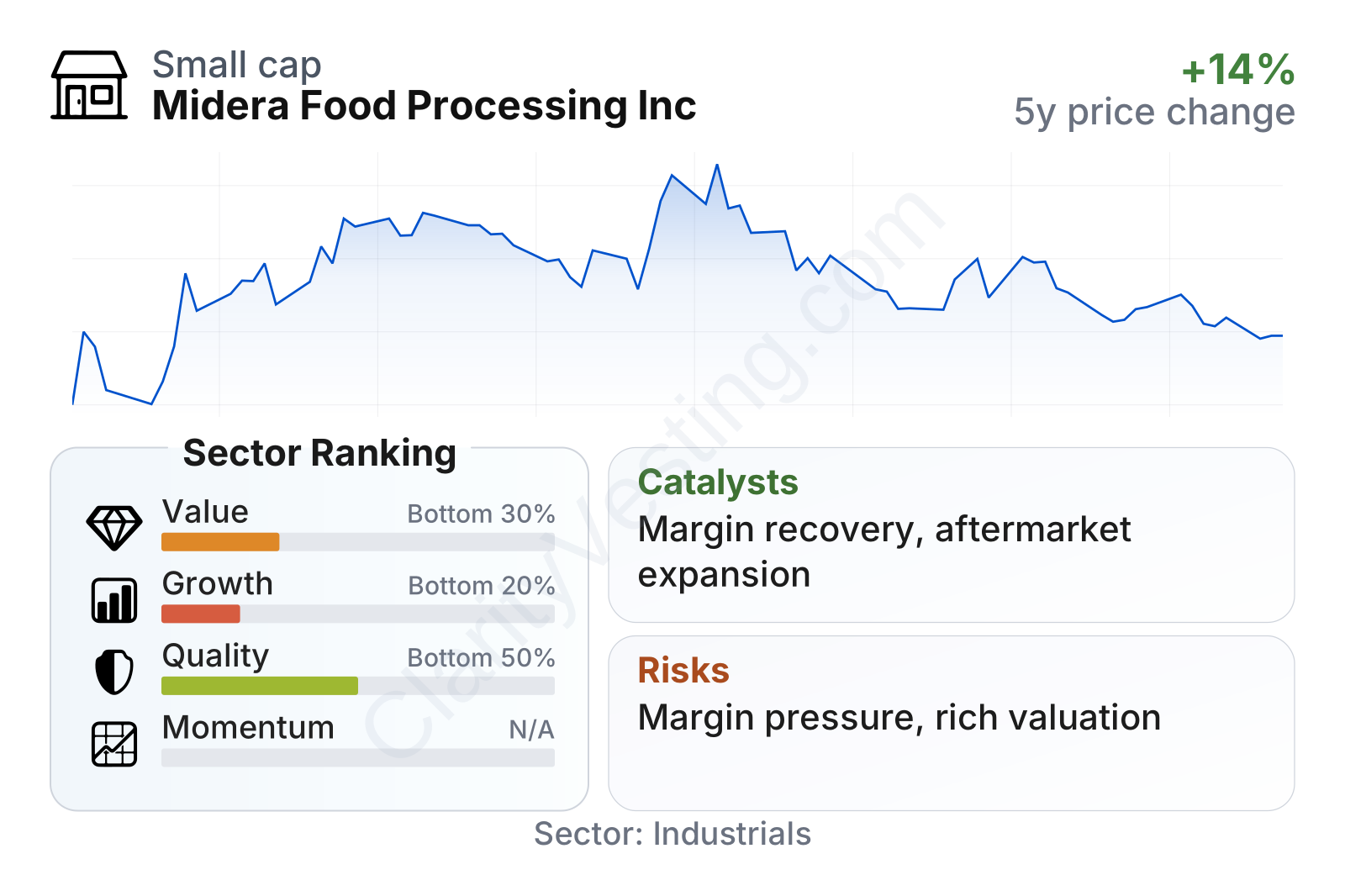
Midera is a small-to-mid-sized industrial company with a market value around the low single-digit billions of dollars. The recent share price trend has been positive over the last few months, but the underlying fundamentals in the table are more cautious than the price move alone suggests.
On valuation, the stock screens as expensive relative to much of its sector. The earnings multiple is far above the sector median, while free cash flow yield and EBIT relative to enterprise value are both weaker than typical peers. Price-to-book is closer to sector norms, but not low enough to offset the pressure coming from the earnings-based measures.
On growth, the picture is uneven. Recent year-over-year revenue growth is stronger than the sector median, which shows the company is still expanding. But longer-term indicators are less favorable: revenue per share growth over five years is below the sector median, free cash flow has contracted over that period, and operating margin trend has deteriorated sharply. That combination usually points to growth that has become less profitable.
On balance sheet quality, leverage is not extreme, but debt compared with operating earnings is above the sector median. Debt-to-equity remains moderate at roughly 34%, which is lower than many peers, and profit margin is still slightly above the sector median. Even so, weaker earnings coverage makes the current debt load less comfortable than the equity ratio alone might imply.
Growth
Midera operates in an area with credible long-term demand drivers. Food producers continue to invest in automation, labor efficiency, throughput improvement, food safety compliance, and modernization of processing facilities. Those trends support steady need for specialized equipment, especially when manufacturers want to reduce waste, improve consistency, or replace older systems.
That said, being in a favorable sector is not enough by itself. For Midera, the key question is whether it can convert industry demand into profitable expansion. Revenue growth of about 13% year over year is better than the sector median, which suggests the company is still winning business. The challenge is that this growth has not recently translated into stronger profitability. A long-term growth case therefore depends less on market demand alone and more on whether management can improve pricing, cost discipline, and project execution.
A meaningful catalyst would be a recovery in margins after the weak 2025 earnings profile. If the cost surge was linked to temporary factors such as project mix, integration costs, inflation in inputs, or elevated overhead, then normalized profitability could change the financial picture materially. Another positive factor is the installed base dynamic common in industrial equipment: once machinery is placed with customers, parts, servicing, upgrades, and retrofits can become a steadier revenue stream than original equipment sales.
The recent share price increase from late June to late September 2026 indicates the market may be reacting to signs of stabilization or improved expectations. Still, without clear evidence of sustained margin repair, the strongest opportunity for the company remains operational improvement rather than simple revenue growth.
Risks
This article is for informational purposes only and does not constitute financial advice. Some content is AI-generated. See Disclaimer


