Stock Analysis · Mainfreight Limited (MFGHF)
Overview
Mainfreight Limited is a global freight and logistics company founded in New Zealand. It helps businesses move goods between factories, ports, warehouses, stores, and final destinations. Its network covers domestic transport, international freight forwarding, warehousing, and supply chain services across New Zealand, Australia, Asia, Europe, and the Americas. In simple terms, Mainfreight is one of the companies businesses hire when they need products picked up, shipped across borders, stored, and delivered on time.
The company’s revenue is spread across several logistics activities rather than one single product line. Based on its latest annual reporting structure, the main sources of revenue are approximately:
- Transport: about 45% to 50% of revenue. This includes domestic road freight and local distribution networks.
- Air & Ocean: about 25% to 30% of revenue. This is freight forwarding for international shipments by air and sea.
- Warehousing: about 20% to 25% of revenue. This includes storage, inventory handling, and contract logistics.
- Other / intersegment activities: a small remainder, depending on reporting adjustments and geography.
Geographically, New Zealand and Australia remain important profit centers, while Europe, the United States, and Asia give the business a wider runway for expansion. That geographic mix matters because it reduces dependence on one economy, even though freight demand still tends to move with global trade and industrial activity.
The business model is straightforward but operationally demanding: win customer volumes, keep trucks and warehouses well utilized, manage freight capacity efficiently, and maintain service quality. When trade volumes are healthy, this model can scale well. When volumes weaken, margins can come under pressure because staffing, depots, and networks carry fixed costs.
The recent financial flow shows a business that has recovered revenue after the post-boom downturn, but not all of that recovery has reached the bottom line. Sales moved back above prior levels, while operating profit and net income remain below the earlier peak, suggesting tighter margins and higher cost pressure than during the strongest freight market years.
Key Figures
| Metric | Value | Sector ⓘ |
|---|---|---|
| Date | Oct 24, 2026 | |
| Context | ||
| Sector | Industrials | |
| Industry | Integrated Freight & Logistics | |
| Market Cap ⓘ | $3.95B | |
| Beta ⓘ | 0.73 | |
Value (Cheapness) | ||
| P/E Ratio ⓘ | 24.66 | 22.29 |
| P/B Ratio ⓘ | 1.68 | 1.98 |
| FCF Yield ⓘ | 15.80% | 6.26% |
| Dividend Yield ⓘ | 4.78% | 1.92% |
| EBIT / EV ⓘ | N/A | 4.83% |
| PEG ⓘ | 1.09 | |
Growth (Business expansion) | ||
| Revenue Growth ⓘ | 3.50% | 9.30% |
| RPS Growth (5Y CAGR) ⓘ | 1.03% | 7.76% |
| EPS Growth (5Y CAGR) ⓘ | -6.64% | -13.17% |
| BVPS Growth (5Y CAGR) ⓘ | 10.90% | 6.13% |
| Margin Growth (5Y Trend) ⓘ | -1.88% | 0.74% |
| FCF Growth (5Y CAGR) ⓘ | 7.59% | 10.79% |
| DPS Growth (5Y CAGR) ⓘ | 14.81% | 9.41% |
Quality (Business durability) | ||
| ROIC (Latest) ⓘ | N/A | 10.75% |
| ROA (Latest) ⓘ | 12.52% | 5.41% |
| ROIC (5Y Median) ⓘ | 13.35% | 9.37% |
| ROA (5Y Median) ⓘ | 6.99% | 4.95% |
| Net Debt / EBIT (Latest) ⓘ | 1.26 | 2.04 |
| Net Debt / EBIT (5Y Median) ⓘ | 2.47 | 2.27 |
| Net Debt / EBITDA (Latest) ⓘ | 0.75 | 1.39 |
| Net Debt / Assets ⓘ | 28.80% | 19.27% |
| EBITDA / Interest ⓘ | 15.87 | 9.58 |
| Operating Margin (Latest) ⓘ | 9.60% | 10.49% |
| Operating Margin (5Y Median) ⓘ | 8.61% | 10.30% |
| Debt to Equity (Latest) ⓘ | 66.80% | 64.82% |
| Profit Margin (Latest) ⓘ | 4.66% | 6.67% |
| Free Cash Flow (Latest) ⓘ | $624.96M | |
Momentum (Price trend) | ||
| 3Y Return ⓘ | +11.10% | +67.77% |
| 12M Return (excl. last month) ⓘ | +27.50% | +12.05% |
| 6M Return ⓘ | -9.58% | 0.00% |
| Price vs. 200-Day MA ⓘ | +3.82% | +0.67% |
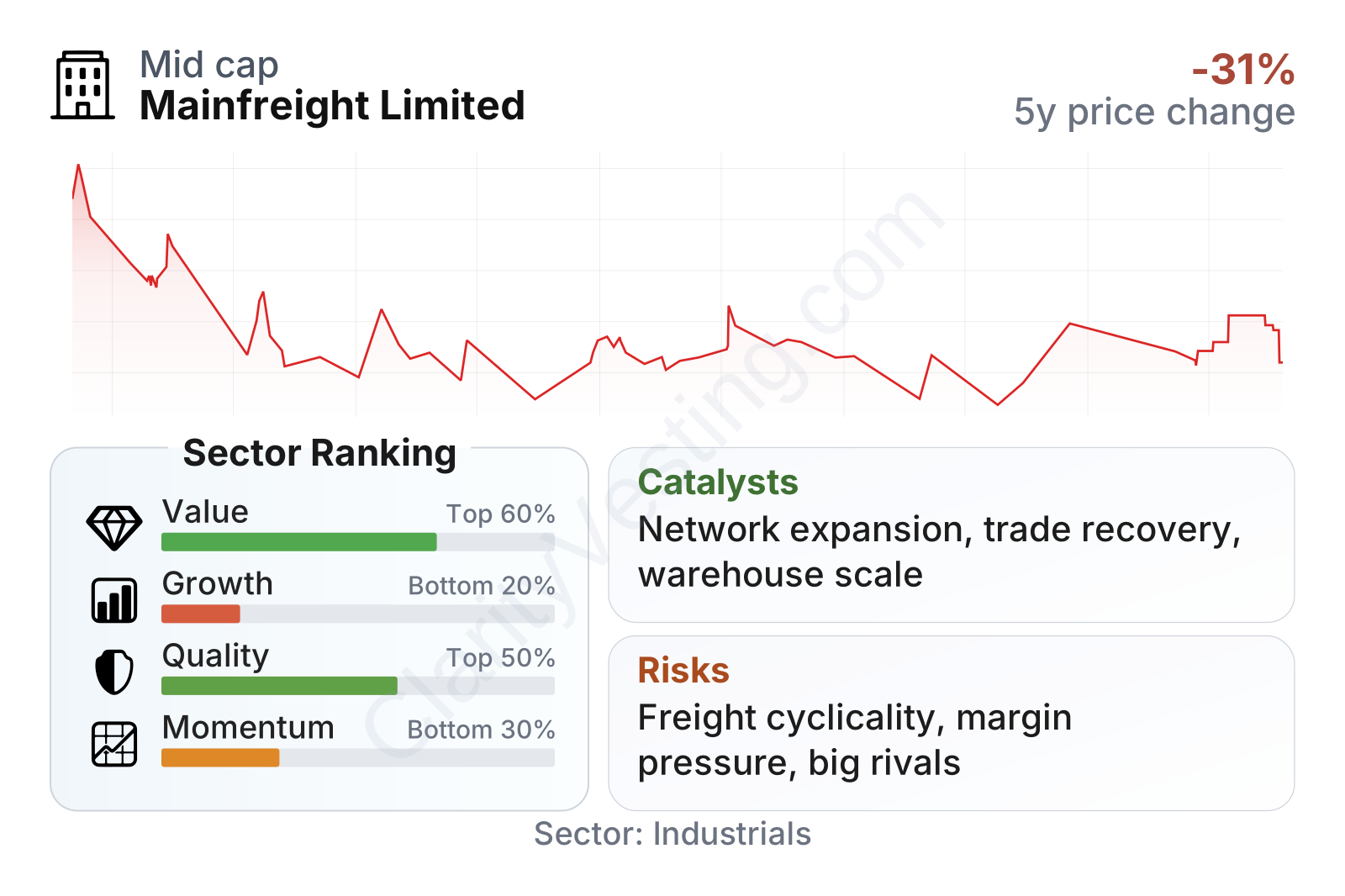
Mainfreight stands out more for balance-sheet quality and cash generation than for fast recent growth. Profitability on assets has been clearly above the sector median, leverage is moderate, and interest coverage is strong. Free cash flow and dividend yield also compare well with many industrial peers. The weaker area is growth: revenue expansion has been modest, margin trends have softened over five years, and longer-term share-price performance has lagged much of the sector even after a decent rebound over the last year.
In size terms, Mainfreight is a mid-sized logistics operator rather than a global giant. Its beta below 1 suggests the stock has historically moved somewhat less sharply than the broader market, which can be relevant for a cyclical transportation business.
Growth
Mainfreight operates in a sector with long-term structural support. Global trade, e-commerce, supply chain outsourcing, and the need for integrated logistics all create demand for companies that can coordinate transport and warehousing across multiple regions. Even so, this is not a straight-line growth market. Freight forwarding and domestic transport can swing sharply with inventory cycles, industrial demand, and shipping rates.
Mainfreight’s strategy is sensible for long-duration growth because it is based on building a unified international network rather than simply chasing short-term freight margins. The company has spent years adding warehouses, transport sites, and overseas branches, especially outside New Zealand. That matters because customers often prefer logistics partners that can handle several steps of the supply chain under one brand. A broader owned network can improve customer retention and cross-selling between transport, forwarding, and warehousing.
A key catalyst is the normalization of freight conditions after the unusual volatility of the pandemic period. During the industry downturn, freight rates and shipment volumes fell from elevated levels. If trade volumes continue recovering while Mainfreight keeps discipline on costs, earnings can improve even without spectacular revenue growth. Another possible tailwind is warehouse and transport density: once existing sites handle more volume, profitability can expand faster than sales.
Recent company updates have pointed to uneven but improving activity in some regions, with management continuing to invest despite softer conditions. That approach can weigh on near-term margins, but it also positions the company to capture demand when volumes strengthen. For a logistics operator, new facilities, network reach, and local market presence can become meaningful advantages over time because they are hard to replicate quickly.
Risks
This article is for informational purposes only and does not constitute financial advice. Some content is AI-generated. See Disclaimer


