Stock Analysis · MFA Financial Inc (MFA-PB)
Overview
MFA Financial Inc. is a mortgage real estate investment trust, or mortgage REIT. Unlike a traditional property REIT that owns office buildings, apartments, or shopping centers, MFA mainly invests in residential mortgage assets and earns money from the spread between the income generated by those assets and its financing costs. In simpler terms, it buys pools of home-related loans or securities linked to them, finances part of those purchases with borrowed money, and keeps the difference after expenses.
The company’s portfolio is centered on residential credit rather than government-guaranteed mortgage bonds. That means MFA is more exposed to the credit quality of borrowers and to housing-market conditions, but it also has the potential to earn higher yields than agency-focused mortgage REITs. Based on recent company filings, its business mix is primarily tied to whole loans and mortgage securities backed by residential properties, with a smaller contribution from other investment activities and servicing-related economics.
MFA’s revenue does not look like the revenue of an industrial or consumer company, so the easiest way to understand it is by economic source rather than product sales.
- Interest income from residential whole loans: the largest source, likely around 60% to 75% of recurring earning power in recent periods. This includes loans secured by single-family homes and other residential properties.
- Interest income from mortgage-backed securities and related investments: roughly 15% to 30%. These assets can include securitized residential mortgage exposure, often with more market-price volatility than directly held loans.
- Gains on sales, fair-value changes, and other investment income: usually more variable, often around 5% to 20% depending on market conditions. This can materially lift or reduce reported results from year to year.
- Other income: a small residual share linked to servicing, fees, or miscellaneous items.
That structure matters for long-term shareholders because MFA is not mainly driven by unit sales or store expansion. Its results depend on loan performance, financing costs, home prices, credit spreads, and how well management allocates capital across mortgage assets.
The recent financial flow trend shows how sensitive this model is to interest rates. Reported revenue and profit were hit hard in 2022 as the rate shock disrupted mortgage valuations, then improved in 2023 through 2025 as earnings power recovered. At the same time, interest expense rose sharply over that period, which remains one of the key variables to watch.
Key Figures
| Metric | Value | Sector ⓘ |
|---|---|---|
| Date | Oct 17, 2026 | |
| Context | ||
| Sector | Real Estate | |
| Industry | REIT - Mortgage | |
| Market Cap ⓘ | $2.69B | |
| Beta ⓘ | 1.52 | |
Value (Cheapness) | ||
| P/E Ratio ⓘ | 14.38 | 17.38 |
| P/B Ratio ⓘ | 1.02 | 0.85 |
| FCF Yield ⓘ | 9.38% | 7.38% |
| Dividend Yield ⓘ | 8.45% | 4.85% |
| EBIT / EV ⓘ | 3.17% | 3.78% |
| PEG ⓘ | N/A | |
Growth (Business expansion) | ||
| Revenue Growth ⓘ | 20.20% | 5.30% |
| RPS Growth (5Y CAGR) ⓘ | 19.16% | 6.02% |
| EPS Growth (5Y CAGR) ⓘ | N/A | -11.37% |
| BVPS Growth (5Y CAGR) ⓘ | -5.17% | 0.45% |
| Margin Growth (5Y Trend) ⓘ | -13.16% | -0.22% |
| FCF Growth (5Y CAGR) ⓘ | -8.39% | 5.40% |
| DPS Growth (5Y CAGR) ⓘ | -30.01% | 5.02% |
Quality (Business durability) | ||
| ROIC (Latest) ⓘ | 4.21% | 5.69% |
| ROE (Latest) ⓘ | 8.24% | 7.56% |
| ROA (Latest) ⓘ | 1.15% | 2.85% |
| ROIC (5Y Median) ⓘ | 8.01% | 4.22% |
| ROE (5Y Median) ⓘ | 6.37% | 6.03% |
| ROA (5Y Median) ⓘ | 1.08% | 2.44% |
| Net Debt / EBIT (Latest) ⓘ | 27.49 | 7.59 |
| Net Debt / EBIT (5Y Median) ⓘ | 15.62 | 8.40 |
| Net Debt / EBITDA (Latest) ⓘ | 27.41 | 5.27 |
| Net Debt / Assets ⓘ | 84.32% | 37.76% |
| EBITDA / Interest ⓘ | 0.79 | 4.10 |
| Operating Margin (Latest) ⓘ | 55.69% | 35.29% |
| Operating Margin (5Y Median) ⓘ | 78.84% | 37.31% |
| Debt to Equity (Latest) ⓘ | 656.15% | 88.87% |
| Profit Margin (Latest) ⓘ | 48.95% | 19.61% |
| Free Cash Flow (Latest) ⓘ | $252.21M | |
Momentum (Price trend) | ||
| 3Y Return ⓘ | +22.50% | +30.75% |
| 12M Return (excl. last month) ⓘ | +1.76% | +4.36% |
| 6M Return ⓘ | -11.81% | -2.52% |
| Price vs. 200-Day MA ⓘ | -11.28% | -2.34% |
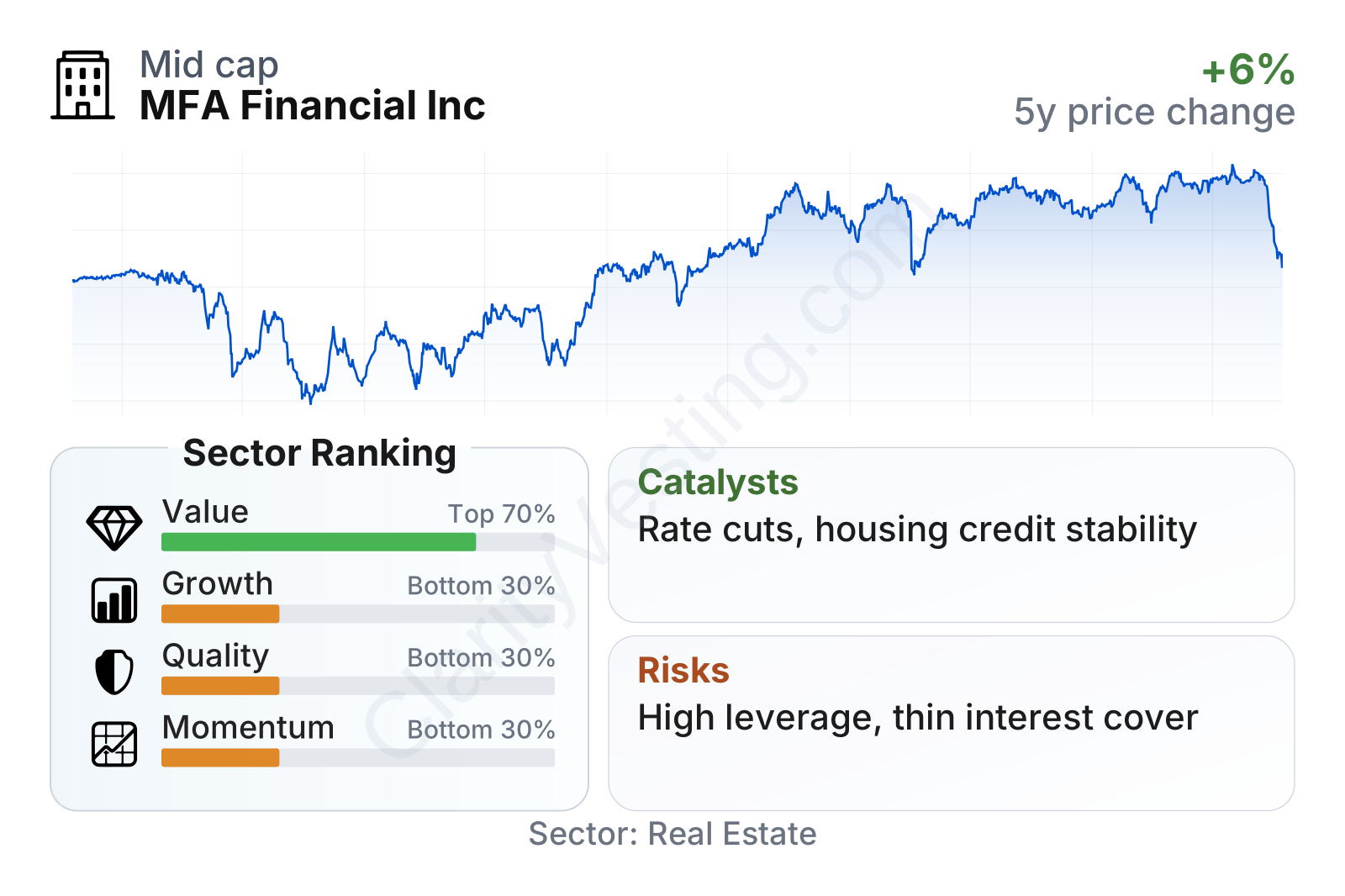
MFA is a mid-sized mortgage REIT with a stock that has been volatile over the last several years but has recovered meaningfully from the 2022 drawdown. On valuation, the shares screen near the middle of the pack on earnings but above the sector median on price-to-book, while the cash flow yield and dividend yield stand out as stronger than many peers. The more cautious reading comes from the balance sheet: leverage is very high, net debt relative to earnings is elevated, and interest coverage is thin. Profitability margins look strong on the surface, but in this industry those figures can move sharply with market pricing and asset marks, so balance-sheet resilience matters more than headline margins alone.
Growth
MFA operates in a sector that should remain relevant as long as the U.S. housing finance system depends on private capital alongside banks and government-backed entities. Mortgage REITs are not classic growth businesses, but there are periods when the environment becomes favorable for expanding earnings and book value. That tends to happen when asset yields are attractive, financing markets are available, and credit performance remains stable.
For MFA specifically, the strategy has a reasonable long-term logic. The company has focused on residential whole loans and credit-sensitive mortgage assets rather than relying mainly on agency securities. That gives it access to higher-yielding assets and creates room for earnings recovery when spreads are favorable. It also gives management more flexibility to rotate capital between loan purchases, securitizations, and portfolio sales.
The longer-term revenue-per-share trend shows why the company remains interesting despite its cyclical profile. Results were severely disrupted in 2022, but the rebound since then has been significant, with 2025 marking a much stronger level than the prior two years. That suggests the portfolio has benefited from improved asset income and a more constructive operating setup, even if the path has been uneven.
The dividend pattern is less reassuring than the revenue recovery. Distributions were much stronger earlier in the period and then dropped sharply, which reflects how mortgage REIT payouts can change when funding costs, portfolio repositioning, or preferred/common capital decisions alter available cash generation. For readers focused on stability, that history is an important distinction: MFA has shown recovery in earnings power, but not a smooth record of dividend consistency.
A useful catalyst is the possibility of lower or more stable short-term interest rates. If financing costs stop rising, or begin to ease, the spread between what MFA earns on assets and what it pays to fund them could improve. Another supportive factor is a healthy U.S. housing market with limited severe credit deterioration. As long as borrowers keep paying and home values remain broadly supportive, residential credit assets can perform better than feared.
Recent operating momentum also suggests the company has been rebuilding earnings after the 2022 disruption. Revenue growth over the last year and over the last five years has been stronger than the sector median, even though the broader growth score remains weak because book value, free cash flow, margins, and dividends have not followed the same positive trajectory.
Risks
This article is for informational purposes only and does not constitute financial advice. Some content is AI-generated. See Disclaimer


