Stock Analysis · Methanex Corporation (MEOH)
Overview
Methanex Corporation is a global producer and supplier of methanol, a basic chemical used in many everyday and industrial products. Methanol goes into formaldehyde, paints, plastics, insulation, silicones, resins, and solvents, and it is also used in fuel blending, marine fuel applications, biodiesel, and some emerging low-emission energy uses. The company owns production assets in North America, South America, Europe, the Middle East, and Asia Pacific, and sells into a broad international customer base.
For a simple way to think about the business, Methanex is not a diversified chemical conglomerate. It is largely a focused methanol company. That gives it scale and expertise in one market, but it also means results are heavily tied to methanol prices, plant operating rates, and feedstock costs such as natural gas.
The company’s revenue is therefore concentrated in a small number of economic drivers rather than many product lines. Based on company disclosures, the main sources of revenue can be summarized as follows:
- Methanol sales to chemical markets: approximately 70% to 80% — this includes demand linked to formaldehyde, acetic acid, silicones, solvents, and other downstream chemicals.
- Methanol sales to energy-related markets: approximately 20% to 30% — this includes fuel blending, marine fuel, MTBE/gasoline-related demand, biodiesel, and other energy applications.
- Other revenue: minimal — mostly freight, logistics, and other incidental items rather than a distinct operating segment.
Methanex’s business model combines global production, extensive logistics, and marketing reach. A notable strategic feature is its participation in Geismar in Louisiana, a major methanol hub that has become increasingly important to the company’s operating footprint. The business is large enough to matter globally in methanol, but still specialized enough that one major asset ramp-up or outage can materially change results.
The multi-year pattern shows a business with fairly steady revenue in the last several years but much more volatile profit conversion. Operating income has held up better than net income, while interest expense rose sharply in 2025, which helps explain why bottom-line earnings became much thinner even when gross profit improved.
Key Figures
| Metric | Value | Sector ⓘ |
|---|---|---|
| Date | Oct 24, 2026 | |
| Context | ||
| Sector | Basic Materials | |
| Industry | Chemicals | |
| Market Cap ⓘ | $4.90B | |
| Beta ⓘ | 0.98 | |
Value (Cheapness) | ||
| P/E Ratio ⓘ | 62.68 | 16.92 |
| P/B Ratio ⓘ | 2.17 | 1.66 |
| FCF Yield ⓘ | 15.10% | 5.83% |
| Dividend Yield ⓘ | 1.15% | 2.07% |
| EBIT / EV ⓘ | 7.32% | 6.38% |
| PEG ⓘ | 0.20 | |
Growth (Business expansion) | ||
| Revenue Growth ⓘ | 75.20% | 11.25% |
| RPS Growth (5Y CAGR) ⓘ | -3.88% | 4.49% |
| EPS Growth (5Y CAGR) ⓘ | -3.36% | -15.24% |
| BVPS Growth (5Y CAGR) ⓘ | 7.68% | 5.49% |
| Margin Growth (5Y Trend) ⓘ | -6.58% | -1.54% |
| FCF Growth (5Y CAGR) ⓘ | -0.57% | 0.37% |
| DPS Growth (5Y CAGR) ⓘ | 23.45% | 5.91% |
Quality (Business durability) | ||
| ROIC (Latest) ⓘ | 6.73% | 9.59% |
| ROA (Latest) ⓘ | 1.20% | 4.92% |
| ROIC (5Y Median) ⓘ | 9.62% | 7.91% |
| ROA (5Y Median) ⓘ | 2.67% | 3.92% |
| Net Debt / EBIT (Latest) ⓘ | 5.19 | 1.36 |
| Net Debt / EBIT (5Y Median) ⓘ | 5.67 | 1.69 |
| Net Debt / EBITDA (Latest) ⓘ | 2.73 | 0.93 |
| Net Debt / Assets ⓘ | 38.32% | 13.69% |
| EBITDA / Interest ⓘ | 4.45 | 12.38 |
| Operating Margin (Latest) ⓘ | 12.42% | 13.24% |
| Operating Margin (5Y Median) ⓘ | 11.78% | 11.82% |
| Debt to Equity (Latest) ⓘ | 122.11% | 40.30% |
| Profit Margin (Latest) ⓘ | 2.07% | 6.38% |
| Free Cash Flow (Latest) ⓘ | $739.49M | |
Momentum (Price trend) | ||
| 3Y Return ⓘ | +63.26% | +73.47% |
| 12M Return (excl. last month) ⓘ | +53.63% | +27.59% |
| 6M Return ⓘ | +8.84% | -4.02% |
| Price vs. 200-Day MA ⓘ | +13.67% | -0.65% |
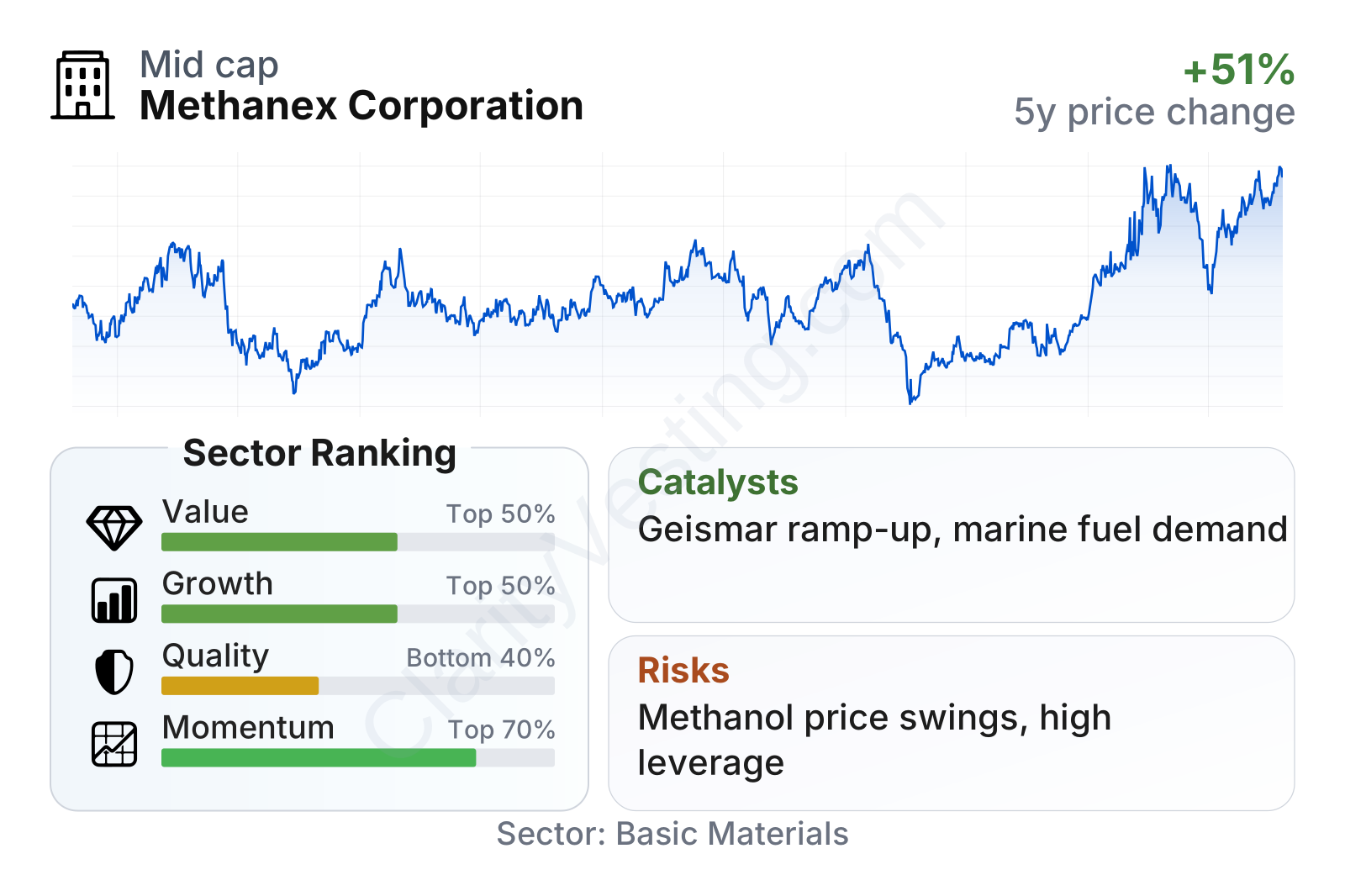
Methanex sits in the middle of the pack on growth and value measures, but the quality profile is weaker than much of the chemicals sector. The most striking mix is a very high earnings multiple alongside a strong free cash flow yield, which signals that reported earnings and cash generation are telling different stories at the moment. The company is mid-sized, its recent share-price trend has improved versus much of the sector, and volatility is meaningful but not extreme for a cyclical materials business.
The stock’s history also reflects the nature of the company: large swings tied to commodity conditions, project milestones, and changes in market sentiment. That makes headline valuation ratios less straightforward than they would be for a steadier industrial or consumer company.
Growth
Methanex operates in a sector that has both mature and developing elements. Traditional methanol demand is linked to industrial production and construction-related chemicals, which tends to make it cyclical rather than structurally fast-growing. At the same time, new uses such as marine fuel and cleaner-burning fuel applications create an additional growth angle that did not matter as much a decade ago.
The company’s strategy for future growth is logical for this industry: expand low-cost production capacity, improve operating reliability, and use its global distribution network to place product where margins are strongest. The Geismar 3 project is especially important because it adds scale in the United States, where logistics and customer access are attractive. A successful ramp-up can lift volumes and strengthen Methanex’s position in a market where reliable supply matters.
Recent revenue growth has rebounded sharply after a long stretch of uneven and often negative comparisons. That kind of acceleration is encouraging, but it also needs to be viewed in context: Methanex’s sales can snap back quickly when methanol prices, volumes, or plant availability improve, so one strong year-over-year figure does not by itself establish a durable long-term growth rate.
Cash generation has recovered much better than accounting earnings. Free cash flow moved from a weak period in 2023 and 2024 to a much stronger level more recently, which suggests improved operations, reduced capital intensity after a large build cycle, or both. For a cyclical producer, this matters because cash flow often gives a cleaner view of financial flexibility than net income alone.
A meaningful catalyst is the wider adoption of methanol as a marine fuel. Shipping is under pressure to lower emissions, and methanol has become one of the practical options being tested and adopted by vessel operators. Methanex is not simply waiting for that market to appear; through its operating footprint and commercial reach, it has direct exposure if marine fuel demand scales further. Another supportive factor is the company’s global supply network, which can benefit when regional markets tighten and customers prioritize dependable deliveries.
Recent company updates have also pointed to progress in ramping key capacity and improving production availability. For a concentrated producer, these operational milestones are significant because they affect not just volume growth but also unit costs and margin recovery.
Risks
This article is for informational purposes only and does not constitute financial advice. Some content is AI-generated. See Disclaimer


