Stock Analysis · Mercialys (MEIYF)
Overview
Mercialys is a French retail real estate company focused on shopping centers and retail sites. It owns, manages, and develops commercial properties, with a portfolio centered mainly on grocery-anchored assets, shopping galleries, and urban retail locations in France. Its business model is relatively simple: acquire or develop retail properties, lease space to retailers, collect rent and service charges, and enhance asset value through redevelopment, tenant mix optimization, and selective disposals or acquisitions.
The company’s revenue comes primarily from rental income generated by its property portfolio. Based on the structure described in recent company communications and annual reporting, the main sources of revenue can be summarized as follows:
- Rental income from shopping centers and retail assets: approximately 85% to 90% of revenue. This includes base rents paid by tenants occupying stores, restaurants, and service locations.
- Variable rents, specialty leasing, and ancillary property income: approximately 5% to 10% of revenue. This can include temporary kiosks, advertising, parking-related income, and lease-linked charges depending on site configuration.
- Property management and other real estate services / disposals impact: generally less than 5% of recurring revenue, with disposal gains or asset sales appearing separately and potentially creating year-to-year volatility.
Mercialys is not a broad diversified REIT. It is a specialized retail landlord with a clear geographic focus on France, which makes the business easier to understand but also ties results closely to French consumer activity, retailer health, and local property conditions.
The financial flow over recent years points to a business with strong gross profitability and solid operating margins, which is typical of established property owners. At the same time, interest expense remains a meaningful drain on earnings, and the latest period shows that revenue growth did not fully translate into stronger net income, highlighting the importance of financing costs and portfolio mix.
Key Figures
| Metric | Value | Sector ⓘ |
|---|---|---|
| Date | Oct 17, 2026 | |
| Context | ||
| Sector | Real Estate | |
| Industry | REIT - Retail | |
| Market Cap ⓘ | $1.32B | |
| Beta ⓘ | 0.86 | |
Value (Cheapness) | ||
| P/E Ratio ⓘ | 21.41 | 17.38 |
| P/B Ratio ⓘ | 1.01 | 0.85 |
| FCF Yield ⓘ | 16.46% | 7.38% |
| Dividend Yield ⓘ | 7.08% | 4.85% |
| EBIT / EV ⓘ | N/A | 3.78% |
| PEG ⓘ | N/A | |
Growth (Business expansion) | ||
| Revenue Growth ⓘ | 3.90% | 5.30% |
| RPS Growth (5Y CAGR) ⓘ | 3.69% | 6.02% |
| EPS Growth (5Y CAGR) ⓘ | N/A | -11.37% |
| BVPS Growth (5Y CAGR) ⓘ | -12.25% | 0.45% |
| Margin Growth (5Y Trend) ⓘ | -19.64% | -0.22% |
| FCF Growth (5Y CAGR) ⓘ | -37.27% | 5.40% |
| DPS Growth (5Y CAGR) ⓘ | 36.89% | 5.02% |
Quality (Business durability) | ||
| ROIC (Latest) ⓘ | 11.34% | 5.69% |
| ROE (Latest) ⓘ | 8.55% | 7.56% |
| ROA (Latest) ⓘ | 3.25% | 2.85% |
| ROIC (5Y Median) ⓘ | 6.48% | 4.22% |
| ROE (5Y Median) ⓘ | 8.66% | 6.03% |
| ROA (5Y Median) ⓘ | 2.40% | 2.44% |
| Net Debt / EBIT (Latest) ⓘ | 5.84 | 7.59 |
| Net Debt / EBIT (5Y Median) ⓘ | 11.09 | 8.40 |
| Net Debt / EBITDA (Latest) ⓘ | 4.95 | 5.27 |
| Net Debt / Assets ⓘ | 43.38% | 37.76% |
| EBITDA / Interest ⓘ | 2.33 | 4.10 |
| Operating Margin (Latest) ⓘ | 50.16% | 35.29% |
| Operating Margin (5Y Median) ⓘ | 46.51% | 37.31% |
| Debt to Equity (Latest) ⓘ | 88.87% | 88.87% |
| Profit Margin (Latest) ⓘ | 11.36% | 19.61% |
| Free Cash Flow (Latest) ⓘ | $216.50M | |
Momentum (Price trend) | ||
| 3Y Return ⓘ | +151.99% | +30.75% |
| 12M Return (excl. last month) ⓘ | +24.20% | +4.36% |
| 6M Return ⓘ | +11.92% | -2.52% |
| Price vs. 200-Day MA ⓘ | N/A | -2.34% |
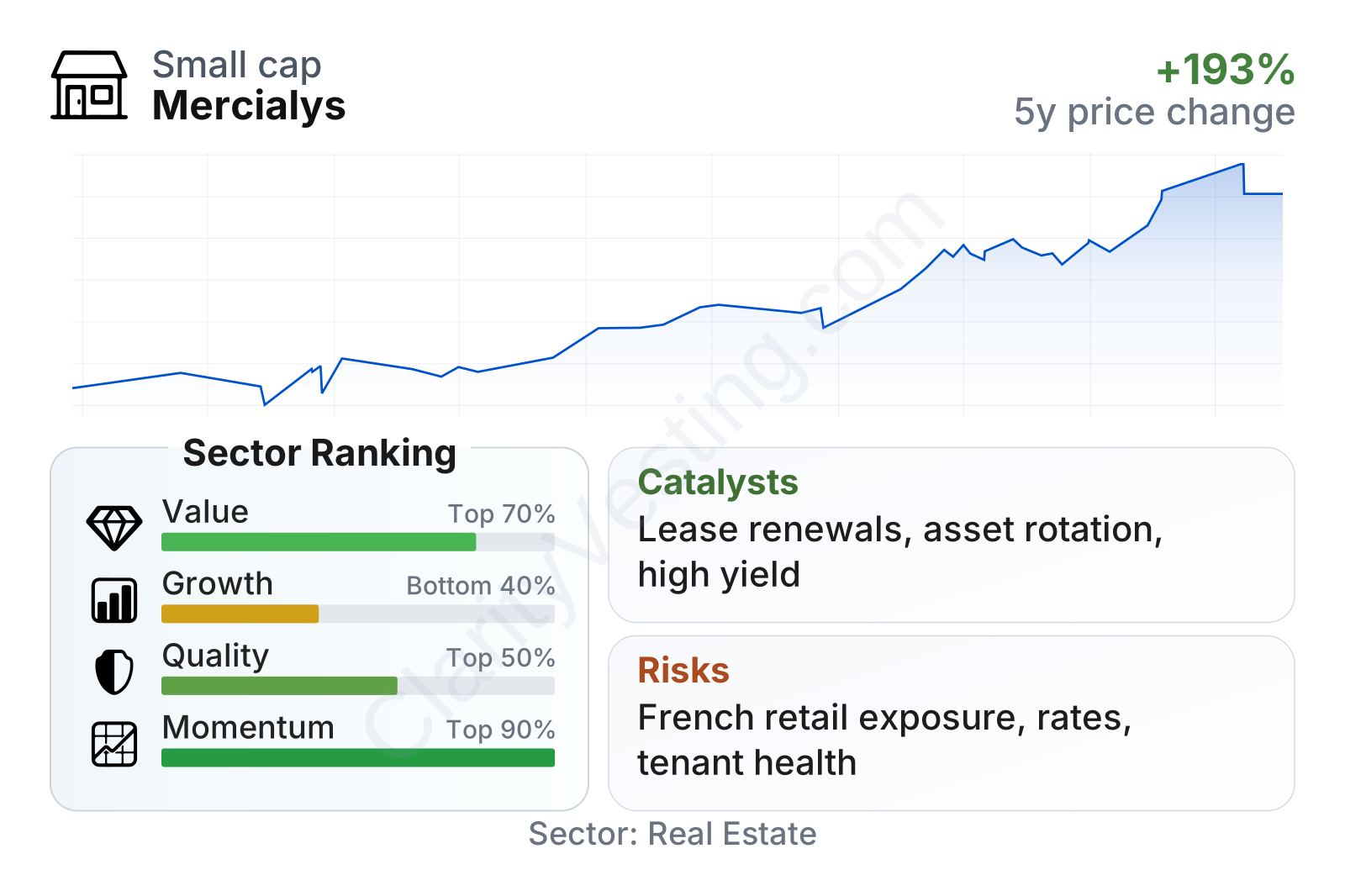
Mercialys stands out as a mid-sized retail REIT with a relatively low share-price volatility profile, reflected in a beta below 1. Profitability metrics are generally stronger than the sector median, especially operating margin and returns on capital, while balance-sheet leverage looks manageable by REIT standards. However, interest coverage is weaker than the sector median, which matters in a higher-rate environment. The valuation picture is mixed: the cash flow yield and dividend yield look attractive versus peers, but the earnings multiple is elevated, suggesting that accounting earnings may not be the best lens for judging the company.
Share performance has also been notably stronger than much of the sector over the last several years. That momentum indicates that the market has already recognized part of the operational recovery and income profile, which reduces the room for a simple re-rating argument.
Growth
Mercialys operates in a sector that is mature rather than fast-growing. Physical retail real estate in Europe is no longer a structural growth industry in the way logistics, data centers, or some residential niches can be. Still, that does not mean growth is absent. The segment where Mercialys is positioned—convenience-led, grocery-anchored, and service-oriented retail—has been more resilient than discretionary mall formats because these sites are tied to recurring consumer needs and daily traffic.
The company’s strategy appears coherent for that environment. Instead of relying on aggressive expansion, Mercialys has focused on asset rotation, redevelopment, occupancy optimization, and tenant mix improvement. That approach makes sense for a landlord operating in a slower-growth market: value creation comes more from improving the productivity of existing assets than from chasing large new developments. In retail property, this can be a durable model if locations remain relevant and if management keeps vacancy under control.
Revenue per share has moved upward over the last five years, although not in a straight line. That pattern suggests some progress in underlying rental generation, but also shows that growth has been uneven rather than consistently compounding. Compared with many long-term compounders, Mercialys looks more like a steady income-producing platform with periodic operational improvements than a business in rapid expansion.
The dividend profile is one of the company’s more visible attractions. The payout recovered sharply after the earlier low point and remained high in recent years, although the latest year shows some pullback. For a retail REIT, that pattern matters because it shows both cash-generating capacity and the sensitivity of distributions to property cash flow, financing conditions, and capital allocation choices.
Potential catalysts for future growth are relatively specific. One is the continued normalization and upgrading of French retail footfall in well-located centers, especially those linked to food, services, and everyday shopping. Another is leasing uplift from renewals and reletting if tenant demand stays firm in stronger catchment areas. A third is capital recycling: selling mature assets and reinvesting in higher-return projects can improve portfolio quality even if total size does not change much.
Recent company updates have emphasized portfolio management, leasing activity, and disciplined financial management rather than transformational expansion. That is important context: Mercialys’ growth case is based more on improving resilience and extracting better returns from existing assets than on a dramatic change in scale.
Risks
This article is for informational purposes only and does not constitute financial advice. Some content is AI-generated. See Disclaimer


