Stock Analysis · Medtronic PLC (MDT)
Overview
Medtronic is one of the largest medical device companies in the world. It develops and sells equipment used to treat chronic diseases and serious health conditions, especially in heart care, surgery, neuroscience, diabetes, and hospital-based procedures. Its products are generally used by hospitals, surgery centers, and physicians rather than sold directly to consumers. That gives the business a recurring healthcare profile tied to procedure volumes, hospital budgets, product innovation, and long product life cycles.
The company’s revenue is spread across several large therapy areas, which helps reduce dependence on any single product line. Based on its recent annual reporting structure, the main sources of revenue are approximately:
- Cardiovascular: about 37% of revenue. This includes cardiac rhythm devices, structural heart products, coronary and peripheral vascular tools, and related therapies.
- Medical Surgical: about 27% of revenue. This covers advanced surgical technologies, patient monitoring, respiratory support, and other hospital procedure-related products.
- Neuroscience: about 26% of revenue. This segment includes spinal products, brain therapies, specialty neuromodulation, and technologies used in cranial and neurological procedures.
- Diabetes: about 10% of revenue. This mainly includes insulin pumps, continuous glucose monitoring partnerships and ecosystem products for intensive insulin management.
Geographically, Medtronic is also diversified, with the United States as its largest market and a substantial international business across Europe, Asia-Pacific, and emerging markets. That broad footprint matters because medical needs such as cardiovascular disease, diabetes, and aging-related conditions are long-term global trends rather than narrow local opportunities.
The financial flow over the last few years shows a business with strong gross profit generation, but also sizable selling, administrative, and research spending. Revenue and operating income have improved from the post-pandemic period, while research and development has remained high, which is important in a device industry where product cycles, regulatory clearances, and clinical evidence drive competitiveness.
Key Figures
| Metric | Value | Sector ⓘ |
|---|---|---|
| Date | Oct 24, 2026 | |
| Context | ||
| Sector | Healthcare | |
| Industry | Medical Devices | |
| Market Cap ⓘ | $119.00B | |
| Beta ⓘ | 0.57 | |
Value (Cheapness) | ||
| P/E Ratio ⓘ | 22.86 | 25.42 |
| P/B Ratio ⓘ | 2.50 | 3.08 |
| FCF Yield ⓘ | 5.15% | 3.12% |
| Dividend Yield ⓘ | 3.01% | 1.85% |
| EBIT / EV ⓘ | 5.72% | 0.56% |
| PEG ⓘ | 1.60 | |
Growth (Business expansion) | ||
| Revenue Growth ⓘ | 13.70% | 7.50% |
| RPS Growth (5Y CAGR) ⓘ | 4.75% | 8.60% |
| EPS Growth (5Y CAGR) ⓘ | -32.87% | -17.73% |
| BVPS Growth (5Y CAGR) ⓘ | -0.54% | 3.72% |
| Margin Growth (5Y Trend) ⓘ | -0.32% | -0.57% |
| FCF Growth (5Y CAGR) ⓘ | -2.39% | 0.96% |
| DPS Growth (5Y CAGR) ⓘ | 3.07% | 6.69% |
Quality (Business durability) | ||
| ROIC (Latest) ⓘ | 7.54% | 3.17% |
| ROA (Latest) ⓘ | 5.66% | 2.98% |
| ROIC (5Y Median) ⓘ | 6.99% | 4.56% |
| ROA (5Y Median) ⓘ | 5.13% | 1.87% |
| Net Debt / EBIT (Latest) ⓘ | 3.61 | 1.34 |
| Net Debt / EBIT (5Y Median) ⓘ | 3.80 | 1.86 |
| Net Debt / EBITDA (Latest) ⓘ | 2.60 | 1.00 |
| Net Debt / Assets ⓘ | 28.36% | 5.06% |
| EBITDA / Interest ⓘ | 14.04 | 9.55 |
| Operating Margin (Latest) ⓘ | 19.52% | 9.25% |
| Operating Margin (5Y Median) ⓘ | 18.96% | 7.33% |
| Debt to Equity (Latest) ⓘ | 56.05% | 26.68% |
| Profit Margin (Latest) ⓘ | 13.93% | 3.34% |
| Free Cash Flow (Latest) ⓘ | $6.13B | |
Momentum (Price trend) | ||
| 3Y Return ⓘ | +47.21% | +51.61% |
| 12M Return (excl. last month) ⓘ | -0.95% | +19.90% |
| 6M Return ⓘ | +18.07% | +10.10% |
| Price vs. 200-Day MA ⓘ | +11.12% | +6.44% |
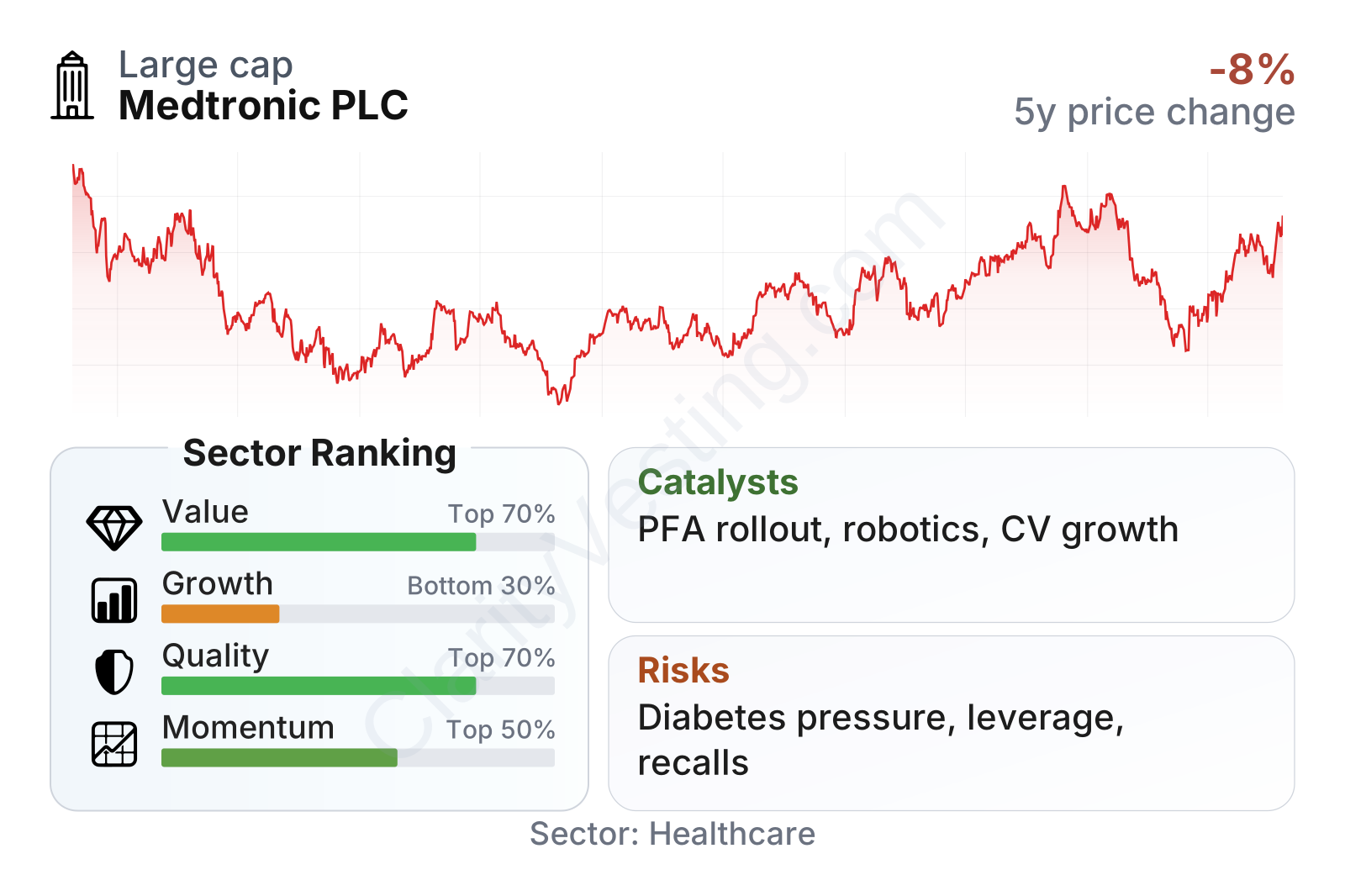
Medtronic is a very large healthcare company with relatively low share-price volatility, as reflected by a beta well below 1. On valuation, it screens somewhat cheaper than the sector median on earnings and book value, while its free cash flow yield and dividend yield are stronger than average. Quality metrics are solid, especially profitability and asset returns, but growth and stock momentum rank weaker relative to much of the healthcare equipment group. In short, the profile is that of a mature, cash-generating business rather than a fast-expanding medical technology name.
The share price history also reflects that pattern. The stock has recovered from earlier lows, but the path has been uneven over the past several years, which suggests the market has been waiting for stronger evidence of sustained acceleration rather than simply rewarding the company for size and stability alone.
Growth
Medtronic operates in a sector with favorable long-term demand drivers. Aging populations, higher rates of chronic disease, growing demand for less invasive procedures, and broader access to healthcare in emerging markets all support ongoing need for medical devices. These are structural trends that usually play out over many years, not short bursts.
Its strategy for growth is fairly logical. The company is focusing on innovation in higher-value device categories, new product launches, robotic and minimally invasive surgery platforms, pulsed field ablation in heart rhythm treatment, and ongoing expansion of its diabetes technology ecosystem. Medtronic also benefits from a large installed base, physician relationships, and global distribution, which can help newer products scale once approved and adopted.
Recent revenue trends look better than the company’s longer five-year record. Growth was pressured earlier by procedure disruption and product execution issues, but year-over-year revenue has clearly reaccelerated, moving from declines and low-single-digit growth in prior periods to high-single-digit and recently low-teens growth. That is a meaningful improvement, especially for a business of this size. Even so, the longer-term growth ranking remains weaker than the sector because Medtronic spent several years growing more slowly than many peers.
Cash generation remains a major support point. Free cash flow dipped from earlier levels but has recovered and remains in the multi-billion-dollar range. That matters because device companies need steady cash to fund research, acquisitions, manufacturing capacity, and shareholder returns while also navigating regulatory and reimbursement cycles.
A few recent developments appear important for future expansion. The company has been investing heavily in cardiac ablation technologies, including pulsed field ablation, an area attracting significant attention across the electrophysiology market. It has also continued to push surgical robotics and AI-enabled monitoring and workflow tools. In diabetes, the long-term opportunity remains large, although execution has been more mixed than in some other areas. Overall, the strongest growth catalysts appear concentrated in cardiovascular innovations and procedure-driven technology upgrades inside hospitals.
Risks
This article is for informational purposes only and does not constitute financial advice. Some content is AI-generated. See Disclaimer


