Stock Analysis · Medartis Holding AG (MDRSF)
Overview
Medartis Holding AG is a Swiss medical device company focused on surgical implants and instruments used to repair broken bones and support reconstruction procedures. Its specialty is highly engineered fixation systems, especially small plates and screws that surgeons use in areas where precision matters, such as the face, skull, hand, wrist, elbow, shoulder, foot, and ankle. The company also has a growing position in patient-specific solutions and digital planning tools that help surgeons prepare and execute complex procedures.
The business is mainly driven by orthopedic and cranio-maxillofacial trauma and reconstruction. Based on the company’s annual reporting and business descriptions, revenue is primarily generated from implant systems and related surgical instruments sold to hospitals and surgeons, with a large weighting toward upper and lower extremity products. Public disclosures do not always give a full percentage split across every product family, but the revenue mix can be summarized as follows:
- Upper extremities: the largest category, centered on hand, wrist, forearm, elbow, and shoulder fixation systems.
- Lower extremities: foot and ankle systems, a meaningful and growing part of the portfolio.
- CMF and head-related systems: implants for cranio-maxillofacial and related reconstruction procedures.
- Patient-specific and digital solutions: customized implants, guides, and planning services, still smaller than the core implant business but strategically important.
- Other revenue: supporting surgical tools and ancillary products tied to the implant platforms.
Geographically, Medartis is diversified across Europe, North America, and Asia-Pacific, with the United States representing a major growth market. That matters because the company is still much smaller than the global orthopedic leaders, so expansion in underpenetrated regions can have an outsized effect on future sales.
The financial profile shows a business with high gross margins, which is typical for specialized medical technology, but also meaningful spending on research, surgeon education, and commercial expansion. Over the last several years, revenue has climbed steadily while operating profitability has been less consistent, reflecting the cost of scaling the platform.
The flow of revenue and costs points to an encouraging pattern: sales have risen strongly from 2021 through 2025, gross profit has expanded with them, and operating income improved notably by 2025 after a weak 2022. At the same time, research and development and selling expenses remain substantial, showing that Medartis is still investing heavily to build a larger global footprint rather than harvesting mature margins.
Key Figures
| Metric | Value | Sector ⓘ |
|---|---|---|
| Date | Oct 17, 2026 | |
| Context | ||
| Sector | Healthcare | |
| Industry | Medical Devices | |
| Market Cap ⓘ | $1.43B | |
| Beta ⓘ | 1.14 | |
Value (Cheapness) | ||
| P/E Ratio ⓘ | 141.98 | 24.79 |
| P/B Ratio ⓘ | 5.12 | 3.08 |
| FCF Yield ⓘ | 1.45% | 3.15% |
| Dividend Yield ⓘ | N/A | 1.94% |
| EBIT / EV ⓘ | N/A | 0.57% |
| PEG ⓘ | N/A | |
Growth (Business expansion) | ||
| Revenue Growth ⓘ | 30.70% | 7.45% |
| RPS Growth (5Y CAGR) ⓘ | 12.41% | 8.61% |
| EPS Growth (5Y CAGR) ⓘ | -22.08% | -17.81% |
| BVPS Growth (5Y CAGR) ⓘ | 3.95% | 3.72% |
| Margin Growth (5Y Trend) ⓘ | 1.87% | -0.62% |
| FCF Growth (5Y CAGR) ⓘ | -3.03% | 1.04% |
| DPS Growth (5Y CAGR) ⓘ | N/A | 6.77% |
Quality (Business durability) | ||
| ROIC (Latest) ⓘ | 25.92% | 3.24% |
| ROA (Latest) ⓘ | 2.70% | 3.01% |
| ROIC (5Y Median) ⓘ | 3.50% | 4.60% |
| ROA (5Y Median) ⓘ | 0.87% | 1.89% |
| Net Debt / EBIT (Latest) ⓘ | 11.07 | 1.34 |
| Net Debt / EBIT (5Y Median) ⓘ | -2.33 | 1.84 |
| Net Debt / EBITDA (Latest) ⓘ | 2.64 | 1.00 |
| Net Debt / Assets ⓘ | 29.74% | 5.45% |
| EBITDA / Interest ⓘ | 3.60 | 9.64 |
| Operating Margin (Latest) ⓘ | 3.01% | 9.27% |
| Operating Margin (5Y Median) ⓘ | 5.40% | 7.38% |
| Debt to Equity (Latest) ⓘ | 73.53% | 28.58% |
| Profit Margin (Latest) ⓘ | 4.86% | 3.59% |
| Free Cash Flow (Latest) ⓘ | $20.72M | |
Momentum (Price trend) | ||
| 3Y Return ⓘ | +47.51% | +42.80% |
| 12M Return (excl. last month) ⓘ | +72.47% | +18.50% |
| 6M Return ⓘ | 0.00% | +7.57% |
| Price vs. 200-Day MA ⓘ | +2.75% | +5.12% |
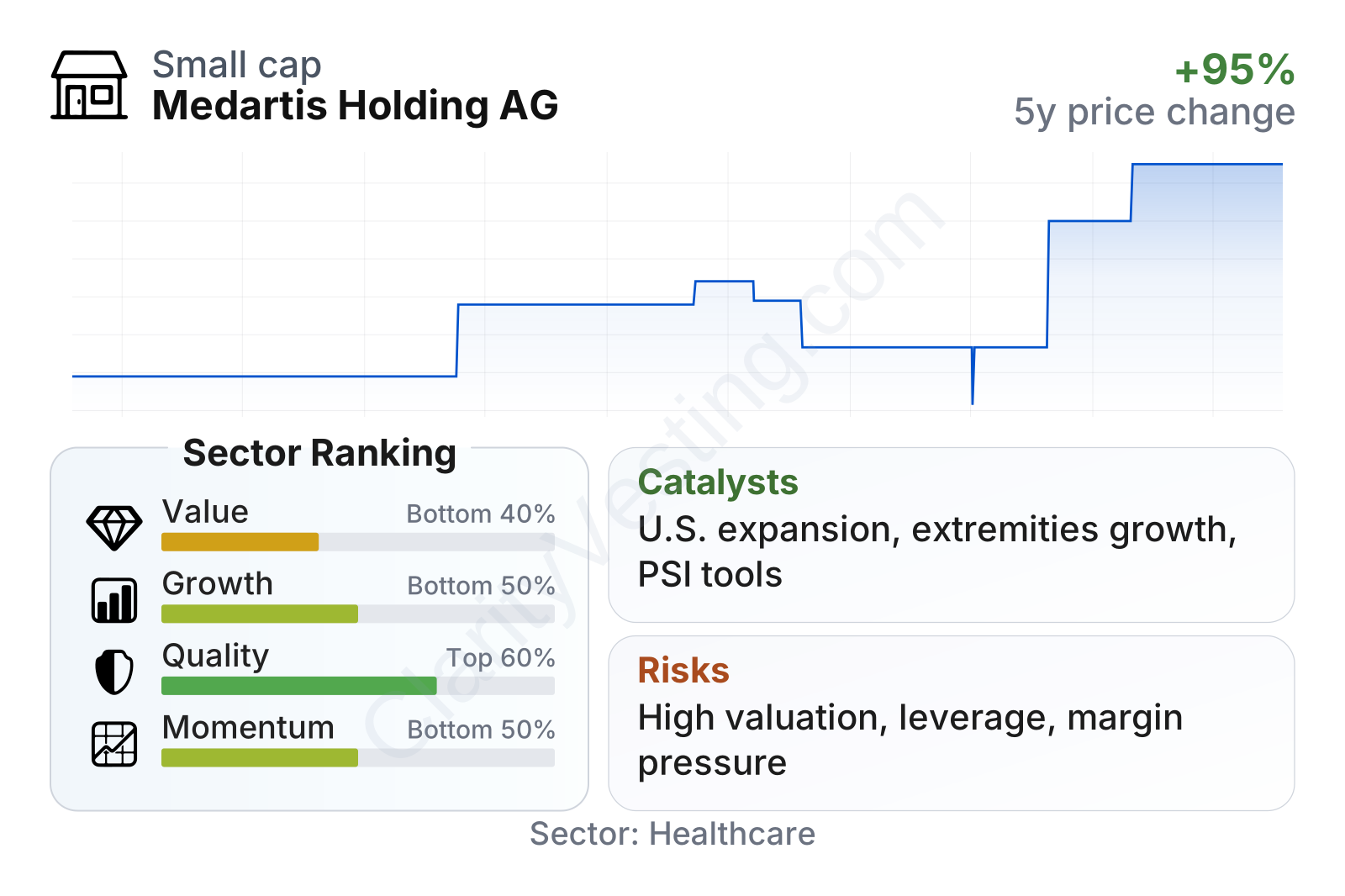
Medartis is a mid-sized medical device company with a share price that has been volatile but generally stronger over the past three years, including a sharp rebound into 2026. On growth, the recent revenue trend stands out positively: yearly sales growth is far above the healthcare sector median, and five-year revenue per share growth is also ahead of the sector. Profit conversion is less impressive. Operating margin remains below the sector median, free cash flow yield is modest, and earnings-based valuation multiples are elevated, which means the market is already assigning a rich price to future progress.
Quality indicators are mixed. Return on invested capital is very strong on a trailing basis, and net profit margin is slightly above the sector median, but leverage is clearly heavier than typical healthcare peers. Debt to equity is well above the sector median, net debt relative to EBITDA is elevated, and interest coverage is thinner than many competitors. In other words, Medartis has attractive underlying economics in parts of the business, but the balance sheet leaves less room for execution mistakes.
Growth
Medartis operates in a favorable long-term market. Bone fixation, extremities, and cranio-maxillofacial implants benefit from several durable forces: aging populations, rising fracture treatment volumes, increasing demand for mobility-preserving surgery, broader access to orthopedic care in emerging markets, and continued procedure innovation. Within orthopedics, extremities is often viewed as an attractive niche because it is more specialized and less commoditized than large-joint reconstruction.
The company’s strategy is coherent for this environment. Medartis has concentrated on narrower, technically demanding segments rather than trying to compete head-on across all orthopedic categories. That focus can support surgeon loyalty, premium pricing, and a reputation for precision. The company has also been expanding its product range, strengthening its direct sales capabilities in important markets, and building out patient-specific and digital offerings that can deepen relationships with hospitals and surgeons.
A major strategic catalyst has been the company’s combination with Nextremity Solutions, which expanded Medartis in the United States and added complementary extremities technologies. For a company of this size, stronger U.S. access matters because it can accelerate scale in the world’s largest medical device market. Integration execution still matters, but the industrial logic is clear: broader portfolio, deeper surgeon access, and a larger commercial base.
Recent operating performance also supports the idea that growth is not only conceptual. Revenue rose materially in 2025, and the cost structure showed improved operating leverage compared with earlier years. If Medartis can keep growing faster than the broader sector while gradually lifting margins, the earnings profile could improve more quickly than revenue alone would suggest.
Another useful catalyst is product complexity. In trauma and extremities, surgeons often prefer systems they know well, especially when procedures are technically demanding. That creates switching friction. It does not make Medartis untouchable, but it can help the company protect its installed base and expand through training, product upgrades, and adjacent procedure categories.
Risks
This article is for informational purposes only and does not constitute financial advice. Some content is AI-generated. See Disclaimer


