Stock Analysis · Mondelez International Inc (MDLZ)
Overview
Mondelez International is one of the world’s largest snack companies. It sells chocolate, biscuits, baked snacks, and gum and candy in more than 150 countries. Its portfolio includes globally known brands such as Oreo, Cadbury, Milka, Ritz, LU, Chips Ahoy!, Trident, Halls, and Toblerone. The business is built around everyday, relatively low-cost products that are purchased frequently, which gives it a more defensive profile than many other consumer companies.
The company’s revenue is mainly generated by product categories rather than by one single brand. Based on recent company reporting, the mix is approximately as follows:
- Biscuits and baked snacks: about 49% — Oreo, Ritz, LU, Chips Ahoy!, belVita, and other sweet and savory biscuits.
- Chocolate: about 31% — Cadbury, Milka, Toblerone, Côte d’Or, and regional chocolate brands.
- Gum and candy: about 11% — Trident, Dentyne, Halls, and other refreshment and candy products.
- Cheese, grocery, and meals / other: about 9% — mainly smaller and local categories, plus adjacent snack businesses and partnerships.
Geographically, Mondelez is broadly diversified. Europe is typically the largest contributor, followed by North America, Asia Pacific, Latin America, and AMEA. That broad reach matters because it reduces dependence on one single economy and gives the company exposure to faster-growing emerging snack markets alongside mature developed markets.
Operationally, the business model is simple: manufacture branded snacks at global scale, distribute them widely through supermarkets, convenience stores, club channels, e-commerce, and local retailers, then support demand with marketing and pricing power. The attraction of this model is that it can produce recurring sales and solid cash generation when brand strength remains intact.
The long-term pattern has been a rising revenue base with healthy gross profit, but the most recent annual picture also shows how exposed the company is to swings in input costs and margin pressure. Sales have expanded over the last several years, while earnings have been less smooth than revenue.
Key Figures
| Metric | Value | Sector ⓘ |
|---|---|---|
| Date | Oct 17, 2026 | |
| Context | ||
| Sector | Consumer Defensive | |
| Industry | Confectioners | |
| Market Cap ⓘ | $78.86B | |
| Beta ⓘ | 0.39 | |
Value (Cheapness) | ||
| P/E Ratio ⓘ | 23.23 | 17.88 |
| P/B Ratio ⓘ | 2.98 | 1.29 |
| FCF Yield ⓘ | 3.91% | 12.39% |
| Dividend Yield ⓘ | 3.31% | 2.85% |
| EBIT / EV ⓘ | 4.87% | 6.43% |
| PEG ⓘ | 0.90 | |
Growth (Business expansion) | ||
| Revenue Growth ⓘ | 4.10% | 4.10% |
| RPS Growth (5Y CAGR) ⓘ | 9.94% | 6.18% |
| EPS Growth (5Y CAGR) ⓘ | -18.25% | -13.59% |
| BVPS Growth (5Y CAGR) ⓘ | -0.18% | 3.20% |
| Margin Growth (5Y Trend) ⓘ | -7.93% | -0.15% |
| FCF Growth (5Y CAGR) ⓘ | 0.46% | 4.10% |
| DPS Growth (5Y CAGR) ⓘ | 10.35% | 6.79% |
Quality (Business durability) | ||
| ROIC (Latest) ⓘ | N/A | 12.34% |
| ROA (Latest) ⓘ | 4.93% | 6.30% |
| ROIC (5Y Median) ⓘ | 7.80% | 10.49% |
| ROA (5Y Median) ⓘ | 6.37% | 5.44% |
| Net Debt / EBIT (Latest) ⓘ | 4.25 | 1.96 |
| Net Debt / EBIT (5Y Median) ⓘ | 3.47 | 2.35 |
| Net Debt / EBITDA (Latest) ⓘ | 3.29 | 1.38 |
| Net Debt / Assets ⓘ | 28.55% | 21.51% |
| EBITDA / Interest ⓘ | 10.25 | 9.46 |
| Operating Margin (Latest) ⓘ | 12.08% | 8.87% |
| Operating Margin (5Y Median) ⓘ | 15.28% | 9.53% |
| Debt to Equity (Latest) ⓘ | 82.81% | 72.35% |
| Profit Margin (Latest) ⓘ | 8.86% | 5.40% |
| Free Cash Flow (Latest) ⓘ | $3.08B | |
Momentum (Price trend) | ||
| 3Y Return ⓘ | +9.31% | +20.92% |
| 12M Return (excl. last month) ⓘ | +4.24% | +2.13% |
| 6M Return ⓘ | +8.47% | +1.26% |
| Price vs. 200-Day MA ⓘ | +4.52% | +1.39% |
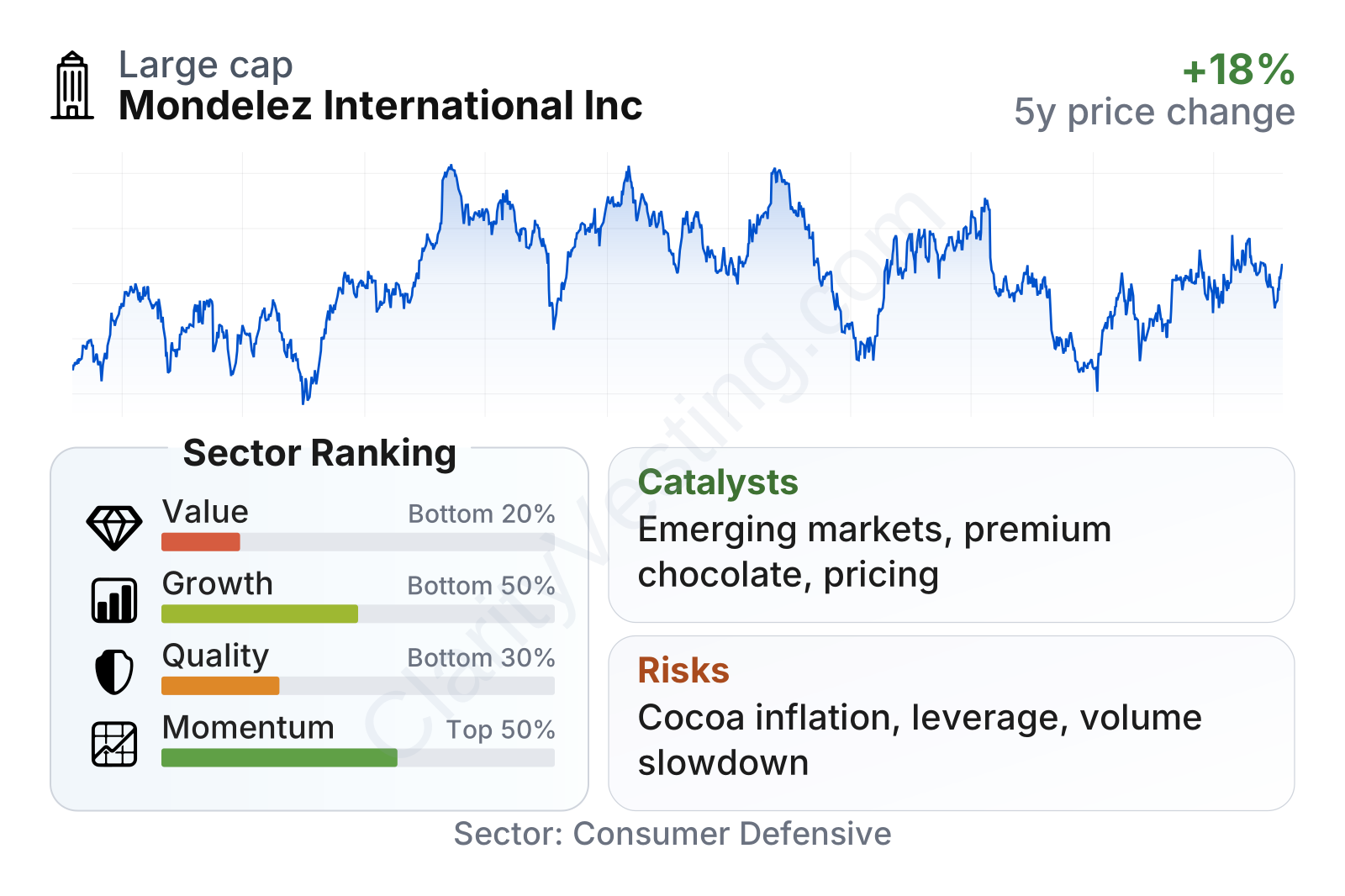
Mondelez is a very large consumer staples company with low share-price volatility, as shown by its beta well below 1. The latest factor profile is mixed. Growth is not weak for a staples business, especially on a multi-year revenue-per-share basis, and recent price momentum has improved. However, value metrics look less attractive than the sector median, and balance-sheet leverage is heavier than average. Profitability remains solid, with margins above many sector peers, but that strength is partly offset by slower free-cash-flow progression and pressure on earnings growth over a five-year view.
Growth
Mondelez operates in a sector with durable long-term demand rather than explosive expansion. Snacking continues to benefit from convenience, urbanization, on-the-go consumption, premiumization, and growing demand in emerging markets. That makes the category attractive for steady compounding, especially for companies with strong global brands and distribution systems.
The company’s strategy is broadly logical for that environment. Management has focused on core snack categories where brand recognition matters, while also pushing product mix toward higher-value offerings. Chocolate and biscuits are particularly important because they combine scale, pricing potential, and strong consumer loyalty. Mondelez has also expanded in faster-growing areas such as premium chocolate, baked snacks, and selected acquisitions that deepen its position in attractive niches.
Recent revenue growth has cooled from the unusually strong post-inflation pricing period, but the business is still growing. The latest year-over-year sales increase is around 4%, slightly ahead of the sector median. Over the past several years, growth was much stronger at times, showing that pricing and mix can meaningfully lift the top line. The key question is how much of that growth can remain once price increases normalize and volume trends become the main driver again.
Cash generation is still meaningful in absolute terms, with free cash flow in the multi-billion-dollar range, but the recent trend has been less impressive than the revenue trend. That suggests growth has come with some strain from working capital, commodity costs, or profit conversion. For a mature staples company, that is an important point because dependable cash flow is a major part of the investment case.
Several catalysts could support future expansion. First, emerging markets remain an important runway because snack consumption per person is still lower than in developed economies. Second, Mondelez continues to benefit from brand strength in chocolate and biscuits, where premium and seasonal products can lift mix. Third, e-commerce and direct digital engagement can gradually improve shelf visibility and product launches. In recent company communications, management has also emphasized portfolio shaping and productivity programs, which can help support growth even if category demand stays moderate.
A notable recent opportunity is the company’s ongoing push in chocolate and premium snacking, categories where consumers often accept higher prices more easily than in basic food staples. If cocoa inflation eventually stabilizes, that could become a stronger earnings tailwind than it appears today.
Risks
This article is for informational purposes only and does not constitute financial advice. Some content is AI-generated. See Disclaimer


